

20 Tolarjev – Slovenia
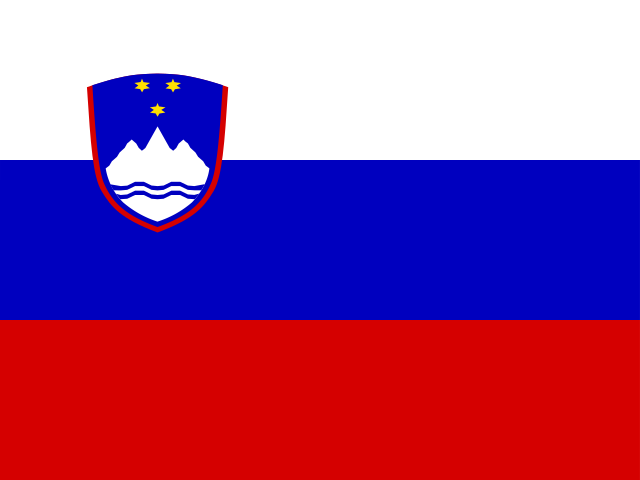
Slovenia
Obverse
Description:
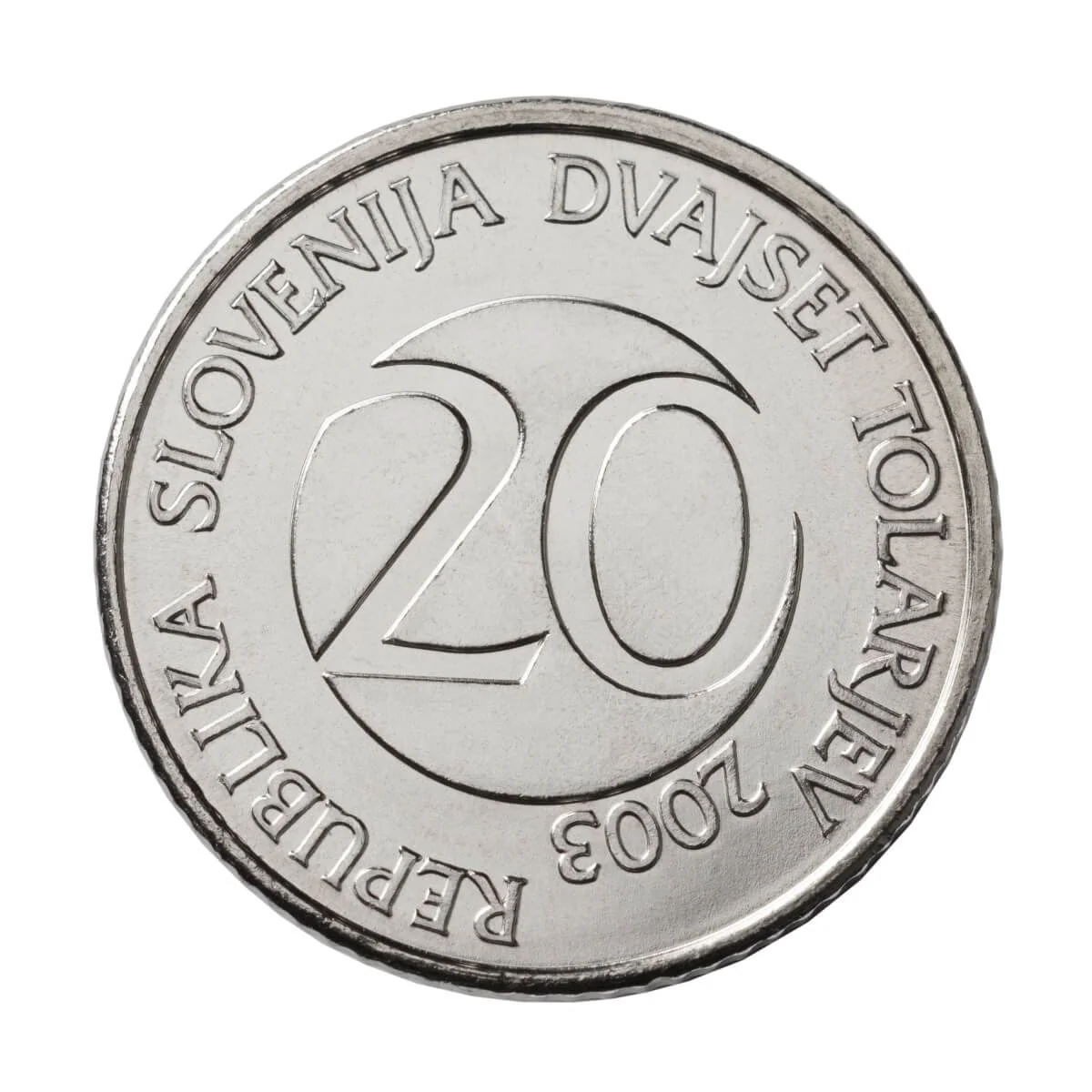
A circular coin with an embossed "20." On the left, "REPUBLIKA SLOVENIJA" curves upward, while "DVAJSET TOLARJEV" curves down on the right. The mint year is at the bottom.
Inscription:
REPUBLIKA SLOVENIJA
DVAJSET TOLARJEV
20
2004
DVAJSET TOLARJEV
20
2004
Translation:
REPUBLIC OF SLOVENIA
TWENTY TOLARS
20
2004
TWENTY TOLARS
20
2004
Script: Latin
Language: Slovenian
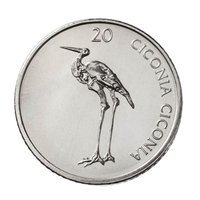
Reverse
Description:
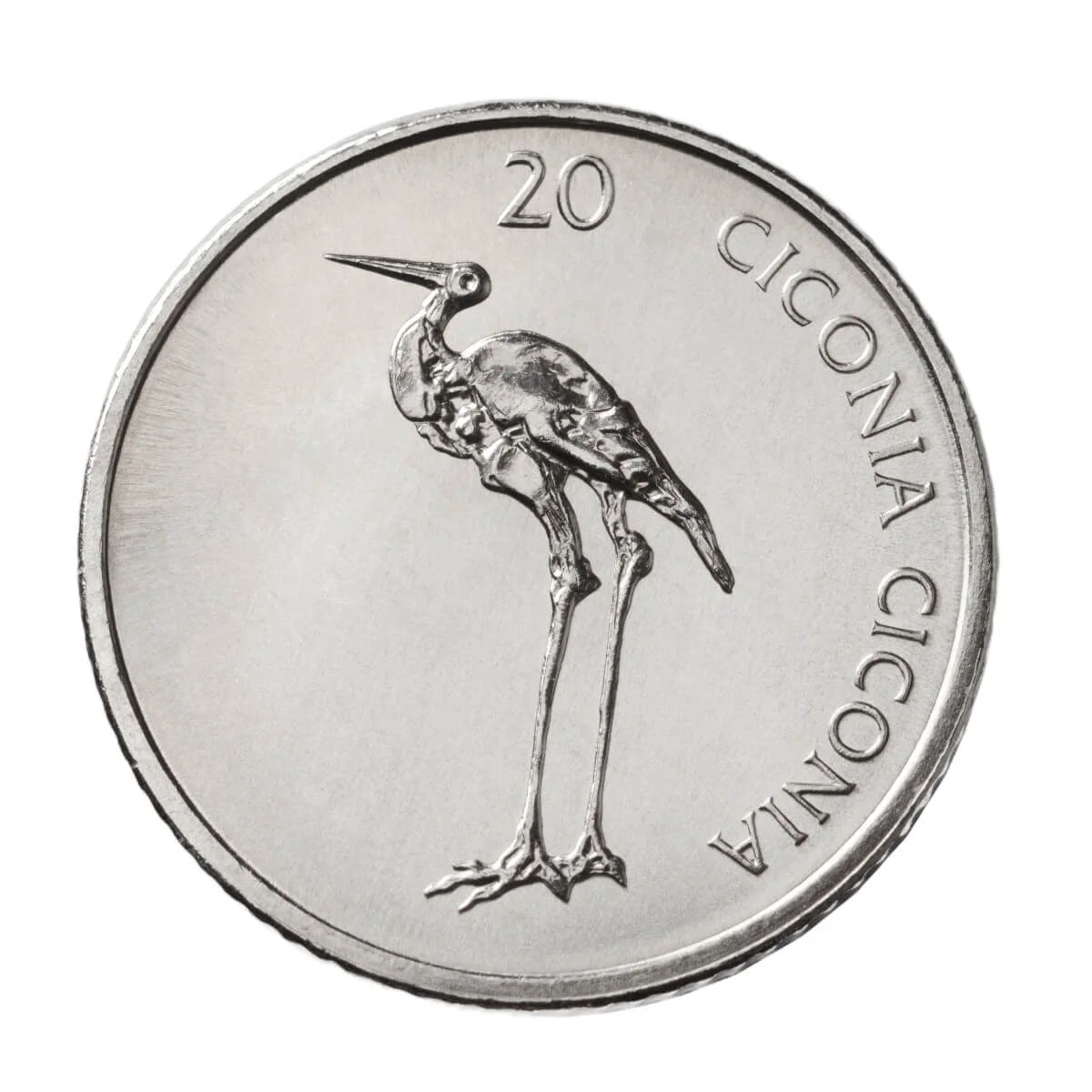
A central stork. Above it, "20" along the upper edge. "CICONIA CICONIA" is along the right edge.
Inscription:
20
CICONIA CICONIA
CICONIA CICONIA
Script: Latin
Edge
80 reeds (wave like reeds).
Mintings
| Year | Mint Mark | Mintage | Quality | Collection |
|---|---|---|---|---|
| 2003 | — | 10,000,000 | ||
| 2003 | — | 1,800 | Proof | |
| 2004 | — | 14,000,000 | ||
| 2004 | — | 1,500 | Proof | |
| 2005 | — | 8,002,000 | ||
| 2005 | — | 2,000 | Proof | |
| 2006 | — | 4,003,000 | ||
| 2006 | — | 2,000 | Proof |
Historical background
In 2003, Slovenia was in the final phase of its strategic journey toward European integration, with its currency situation being a central element of this transition. The country was operating under a managed float exchange rate regime, with the national currency, the Slovenian tolar (SIT), anchored to the euro. This policy, managed by the Bank of Slovenia, provided crucial stability by pegging the tolar to the European Exchange Rate Mechanism (ERM II) in principle, though formal entry would come later. This stability was vital for fostering investor confidence and controlling inflation as the economy continued to liberalize and grow.
The primary focus of monetary authorities throughout the year was meticulous preparation for Slovenia's scheduled adoption of the euro, which was targeted for January 1, 2007. This involved rigorous efforts to meet the Maastricht convergence criteria, including maintaining low inflation, sustainable public finances, and exchange rate stability. The tolar's proven stability against the euro over several years was a key argument in demonstrating Slovenia's readiness to join the Eurozone, proving it could function without devaluing its currency for competitive advantage.
Therefore, the 2003 currency landscape was one of deliberate and successful calibration. The tolar was not an object of crisis but a stable instrument being carefully steered toward obsolescence. The year solidified Slovenia's position as the frontrunner among the ten states that would join the EU in May 2004, confidently on track to become the first of them to replace its national currency with the euro.
The primary focus of monetary authorities throughout the year was meticulous preparation for Slovenia's scheduled adoption of the euro, which was targeted for January 1, 2007. This involved rigorous efforts to meet the Maastricht convergence criteria, including maintaining low inflation, sustainable public finances, and exchange rate stability. The tolar's proven stability against the euro over several years was a key argument in demonstrating Slovenia's readiness to join the Eurozone, proving it could function without devaluing its currency for competitive advantage.
Therefore, the 2003 currency landscape was one of deliberate and successful calibration. The tolar was not an object of crisis but a stable instrument being carefully steered toward obsolescence. The year solidified Slovenia's position as the frontrunner among the ten states that would join the EU in May 2004, confidently on track to become the first of them to replace its national currency with the euro.
🌱 Very Common