

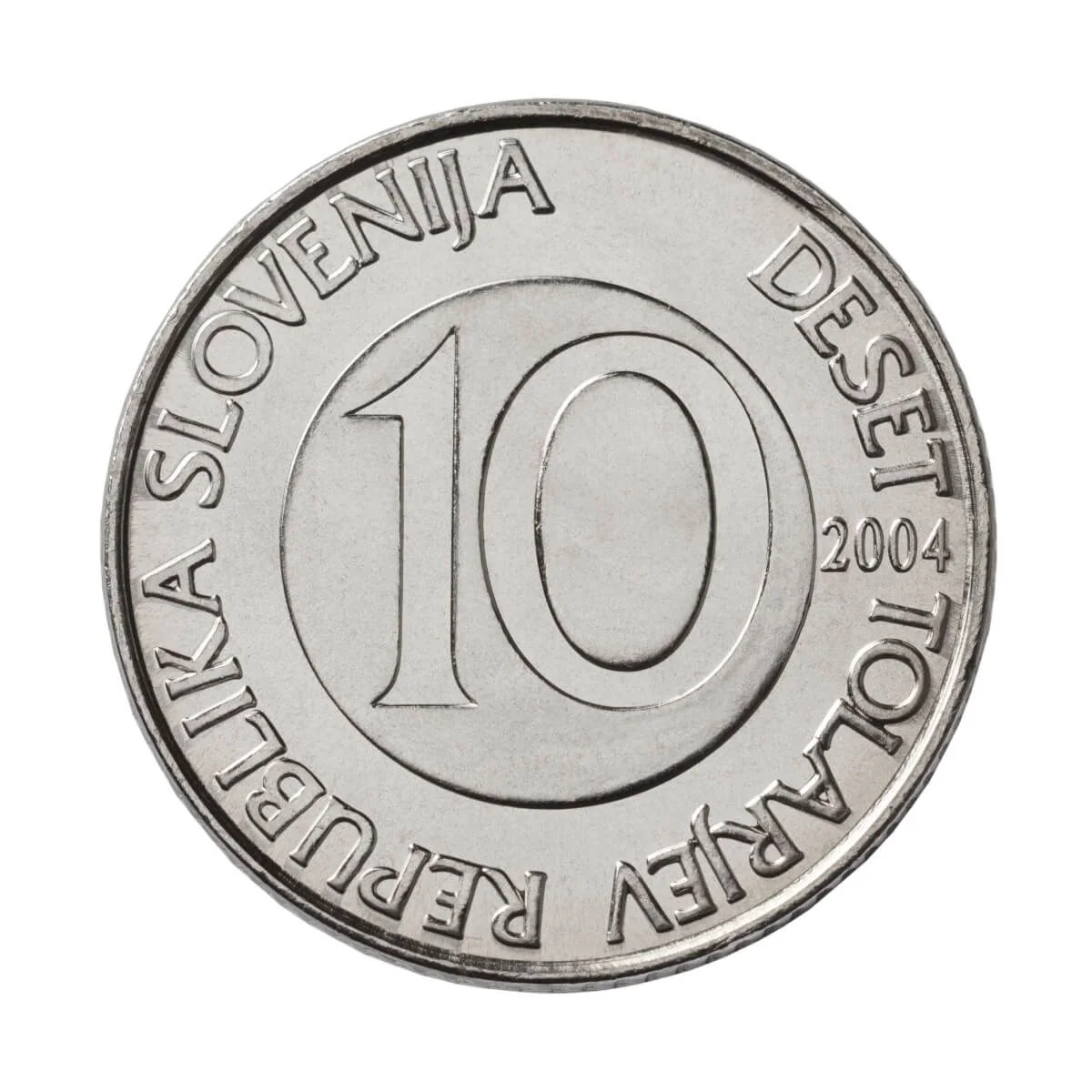
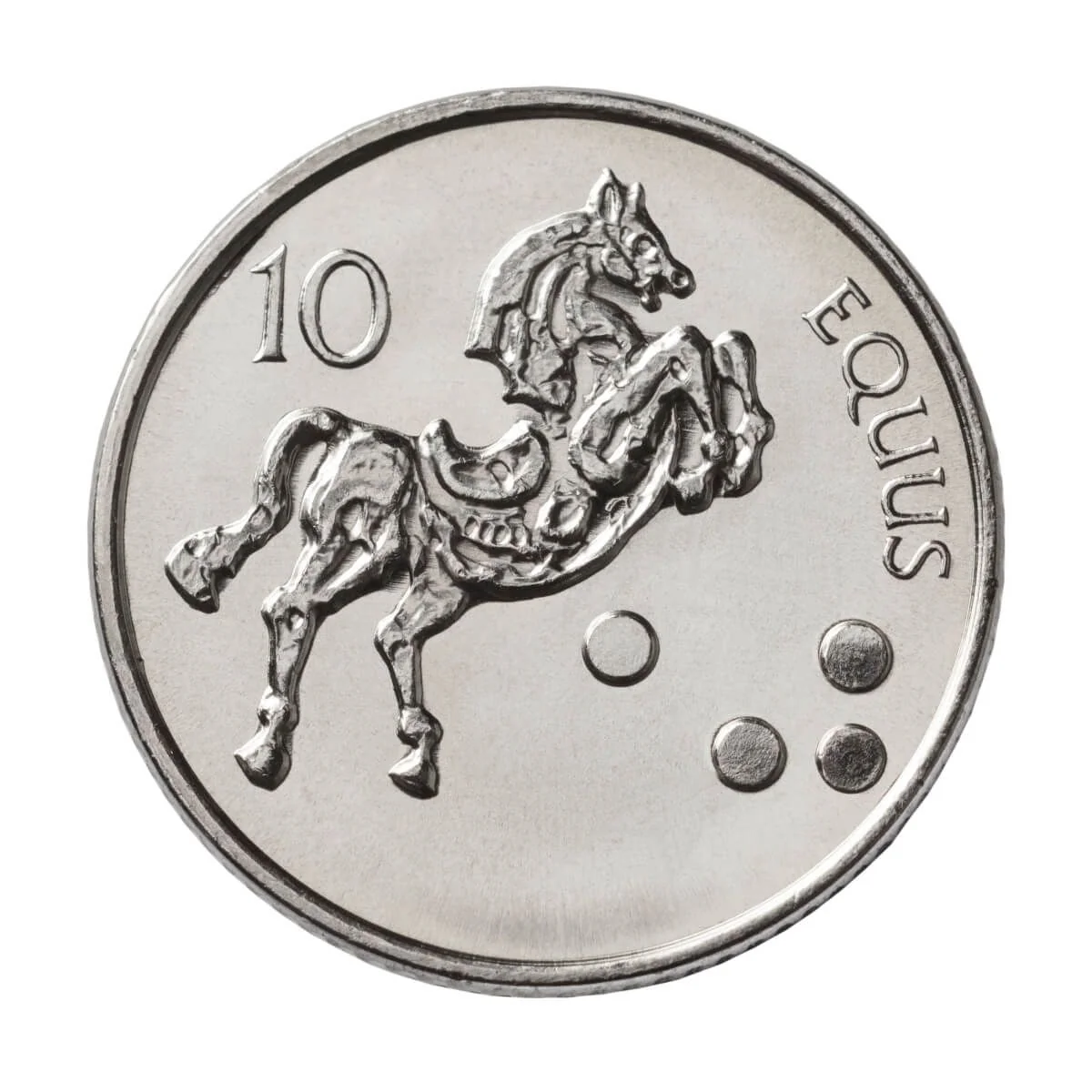
10 tolarjev – Slovenia
Add to wishlist
Slovenia
Obverse
Description:
Embossed circular surface with impressed number 10. The edge inscription reads "REPUBLIKA SLOVENIJA" and "DESET TOLARJEV", with the mintage year between DESET and TOLARJEV.
Inscription:
REPUBLIKA SLOVENIJA
DESET TOLARJEV
10
2005
DESET TOLARJEV
10
2005
Translation:
Republic of Slovenia
Ten Tolars
10
2005
Ten Tolars
10
2005
Script: Latin
Language: Slovenian
Reverse
Description:
A rearing horse left, with "EQUUS" and Braille 10 along the edge. The coin's value is above the horse.
Inscription:
10
EQUUS
EQUUS
Edge
90 reeds.
Mintings
| Year | Mint Mark | Mintage | Quality | Collection |
|---|---|---|---|---|
| 2000 | — | 20,001,000 | ||
| 2000 | — | 800 | Proof | |
| 2001 | — | 19,477,500 | ||
| 2001 | — | 800 | Proof | |
| 2002 | — | 10,001,000 | ||
| 2002 | — | 800 | Proof | |
| 2003 | — | 800 | Proof | |
| 2003 | — | 1,000 | In sets | |
| 2004 | — | 1,800 | Proof | |
| 2004 | — | 10,000,000 | ||
| 2005 | — | 6,002,000 | ||
| 2005 | — | 2,000 | Proof | |
| 2006 | — | 6,003,000 | ||
| 2006 | — | 2,000 | Proof |
Historical background
In the year 2000, Slovenia's currency situation was defined by a period of strategic stability and deliberate preparation for European integration. The national currency was the Slovenian tolar (SIT), which had been successfully introduced in 1991 following independence, replacing the Yugoslav dinar. By 2000, the Bank of Slovenia had established a managed float exchange rate regime, focusing on controlling inflation and maintaining monetary stability. This policy was largely successful, with inflation subdued and the tolar demonstrating resilience, providing a predictable economic environment for growth and foreign investment.
This stability was not an end in itself but a crucial step toward a larger strategic goal: accession to the European Union and eventual adoption of the euro. Throughout the late 1990s and into 2000, Slovenia was actively aligning its economic and legal frameworks with the EU's acquis communautaire. A key component of this was participation in the Exchange Rate Mechanism II (ERM II), the "waiting room" for euro adoption. While Slovenia would not formally enter ERM II until June 2004, the policies of 2000 were consciously building the necessary conditions—low inflation, sustainable public finances, and exchange rate stability—to meet the Maastricht convergence criteria in the near future.
Therefore, the currency situation in 2000 was one of confident transition. The tolar served as a symbol of national sovereignty and a tool for disciplined macroeconomic management. However, its trajectory was clearly set. The underlying focus for policymakers was less on the tolar's standalone legacy and more on meticulously preparing the Slovenian economy to irrevocably fix its exchange rate and, in time, replace the national currency with the euro, which it successfully did on 1 January 2007.
This stability was not an end in itself but a crucial step toward a larger strategic goal: accession to the European Union and eventual adoption of the euro. Throughout the late 1990s and into 2000, Slovenia was actively aligning its economic and legal frameworks with the EU's acquis communautaire. A key component of this was participation in the Exchange Rate Mechanism II (ERM II), the "waiting room" for euro adoption. While Slovenia would not formally enter ERM II until June 2004, the policies of 2000 were consciously building the necessary conditions—low inflation, sustainable public finances, and exchange rate stability—to meet the Maastricht convergence criteria in the near future.
Therefore, the currency situation in 2000 was one of confident transition. The tolar served as a symbol of national sovereignty and a tool for disciplined macroeconomic management. However, its trajectory was clearly set. The underlying focus for policymakers was less on the tolar's standalone legacy and more on meticulously preparing the Slovenian economy to irrevocably fix its exchange rate and, in time, replace the national currency with the euro, which it successfully did on 1 January 2007.

🌱 Very Common