

2000 forint – Hungary
Add to wishlist
Non-circulating coins
Commemoration: 3rd. series - Rákoskeresztúr New Public Cemetery
Hungary
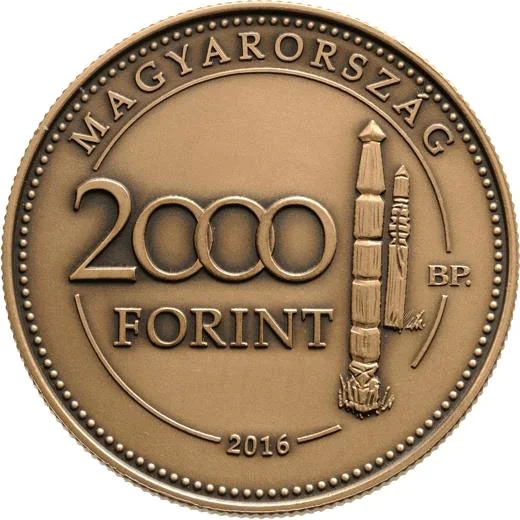
Obverse
Description:
Two stylized tombstones.
Inscription:
MAGYARORSZÁG
BP 2016
2000
FORINT
BP 2016
2000
FORINT
Translation:
HUNGARY
BP 2016
2000
FORINT
BP 2016
2000
FORINT
Script: Latin
Language: Hungarian
Designer: Kligl Sándor
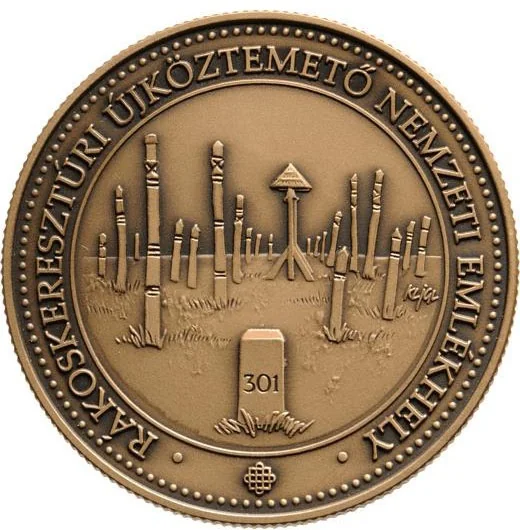
Reverse
Description:
Stone marker at plot 301, behind headstones and a belfry in plots 298, 300, and 301.
Inscription:
RÁKOSKERESZTÚRI ÚJKÖZTEMETŐ
NEMZETI EMLÉKHELY
301
NEMZETI EMLÉKHELY
301
Translation:
Rákoskeresztúr New Cemetery
National Memorial Site
301
National Memorial Site
301
Script: Latin
Language: Hungarian
Designer: Kligl Sándor
Edge
Reeded
Mints
| Name | Mark |
|---|---|
| Hungarian mint | — |
Mintings
| Year | Mint Mark | Mintage | Quality | Collection |
|---|---|---|---|---|
| 2016 | BP | 5,000 | BU |
Historical background
In 2016, Hungary's currency situation was defined by the National Bank of Hungary's (MNB) unconventional monetary policy aimed at suppressing yields and maintaining a weak forint (HUF). The central bank's primary tool was its "self-financing" strategy, which involved using mandatory reserves and a series of low-interest funding programs to encourage commercial banks to purchase Hungarian government bonds. This effectively kept domestic borrowing costs low for the government, supporting its fiscal policy, while also creating persistent selling pressure on the forint to bolster export competitiveness.
This policy of deliberate forint weakness existed in tension with rising inflation and the specter of U.S. Federal Reserve rate hikes, which typically drive capital away from emerging markets. Throughout the year, the forint was notably volatile, often acting as one of the most sensitive currencies in Central and Eastern Europe to global risk sentiment. It repeatedly tested and breached the psychologically important 310-per-euro level, reaching record lows during periods of market stress, which raised concerns about imported inflation and household mortgage costs for foreign-currency borrowers.
Ultimately, the MNB's priority in 2016 was clear: to ensure cheap financing for the state and stimulate the economy through exports, even at the cost of currency stability and despite inflationary pressures. The year underscored a deliberate policy divergence from traditional inflation-targeting, placing political and economic objectives ahead of a strong or stable national currency. This approach kept Hungary's monetary conditions exceptionally loose throughout 2016, setting the stage for a gradual and cautious policy shift only in the following years as inflation accelerated more sharply.
This policy of deliberate forint weakness existed in tension with rising inflation and the specter of U.S. Federal Reserve rate hikes, which typically drive capital away from emerging markets. Throughout the year, the forint was notably volatile, often acting as one of the most sensitive currencies in Central and Eastern Europe to global risk sentiment. It repeatedly tested and breached the psychologically important 310-per-euro level, reaching record lows during periods of market stress, which raised concerns about imported inflation and household mortgage costs for foreign-currency borrowers.
Ultimately, the MNB's priority in 2016 was clear: to ensure cheap financing for the state and stimulate the economy through exports, even at the cost of currency stability and despite inflationary pressures. The year underscored a deliberate policy divergence from traditional inflation-targeting, placing political and economic objectives ahead of a strong or stable national currency. This approach kept Hungary's monetary conditions exceptionally loose throughout 2016, setting the stage for a gradual and cautious policy shift only in the following years as inflation accelerated more sharply.

💎 Extremely Rare