

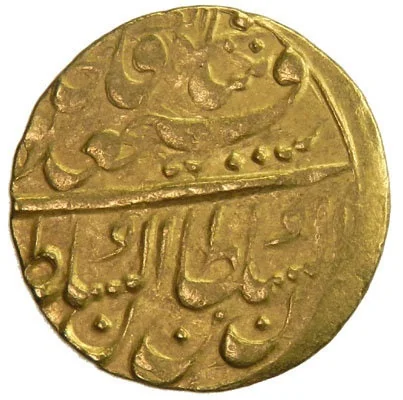
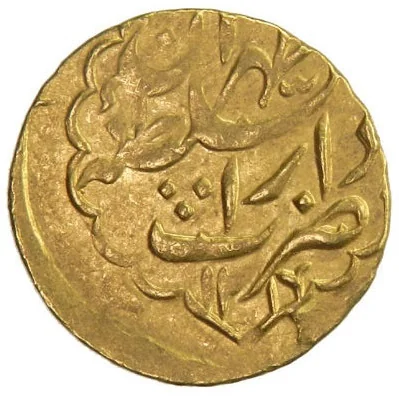
1 toman – Iran
Add to wishlist
Iran
Context
Year: 1802
Islamic (Hijri) Year:: 1217
Issuer: Iran
Ruler: Fath-Ali Shah
Currency:
(1825—1932)
Demonetization: 1834
Material
Weight: 6.07 g
Gold Weight:: 6.07 g
Shape: Irregular round
Composition: Gold
Magnetic: No
Technique: Hammered
Alignment: Coin alignment
flip
References
Numista: #213663
Value
Bullion value: $934.40
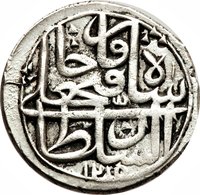
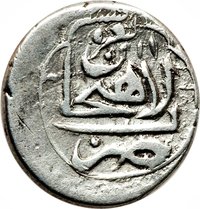
Obverse
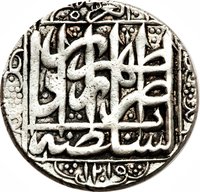
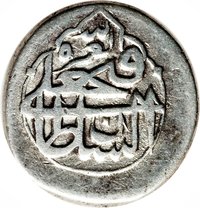
Reverse
Edge
Plain
Mints
| Name | Mark |
|---|---|
| Tehran | طهران |
Mintings
| Year | Mint Mark | Mintage | Quality | Collection |
|---|---|---|---|---|
| 1802 | — | — |
Historical background
In 1802, Iran’s currency system was a complex and fragmented reflection of the political instability of the late Zand and early Qajar periods. The country lacked a unified, centralized monetary authority, leading to a proliferation of coins minted not only by the central government in Tehran but also by provincial governors and major cities like Tabriz, Isfahan, and Mashhad. The primary unit was the silver qiran (or kran), but its weight and purity could vary significantly between regions, causing confusion in trade and taxation. Copper puls and gold tomans (a unit of account equal to 10 qirans) completed the system, but the absence of standardized minting made the economy vulnerable to debasement and fraud.
The economic backdrop was one of severe strain. Decades of civil war following the collapse of the Safavid dynasty had devastated agriculture and trade routes, reducing the state's tax base. To finance military campaigns, especially those of the new Qajar ruler, Fath-Ali Shah (r. 1797–1834), against internal rivals and external threats, the treasury often resorted to debasing the coinage—reducing the silver content in the qiran. This practice, combined with the inflow of lower-value European coins via trade, led to chronic inflation and a loss of public confidence in the currency. The situation was exacerbated by a scarcity of precious metals, as Iran's mining output was limited and its foreign trade balance was often negative.
Consequently, both domestic commerce and international trade faced significant hurdles. Merchants had to navigate a bewildering array of coins, relying on money changers (sarraf) who assessed each coin's actual metallic value, a process that hindered efficient trade. While there was no paper currency at this time, the monetary chaos of 1802 underscored the urgent need for the centralization and reform that the Qajar dynasty would later attempt in the mid-19th century. The currency's instability was a direct symptom of a state still struggling to consolidate its power and administer its economy effectively after a prolonged period of fragmentation.
The economic backdrop was one of severe strain. Decades of civil war following the collapse of the Safavid dynasty had devastated agriculture and trade routes, reducing the state's tax base. To finance military campaigns, especially those of the new Qajar ruler, Fath-Ali Shah (r. 1797–1834), against internal rivals and external threats, the treasury often resorted to debasing the coinage—reducing the silver content in the qiran. This practice, combined with the inflow of lower-value European coins via trade, led to chronic inflation and a loss of public confidence in the currency. The situation was exacerbated by a scarcity of precious metals, as Iran's mining output was limited and its foreign trade balance was often negative.
Consequently, both domestic commerce and international trade faced significant hurdles. Merchants had to navigate a bewildering array of coins, relying on money changers (sarraf) who assessed each coin's actual metallic value, a process that hindered efficient trade. While there was no paper currency at this time, the monetary chaos of 1802 underscored the urgent need for the centralization and reform that the Qajar dynasty would later attempt in the mid-19th century. The currency's instability was a direct symptom of a state still struggling to consolidate its power and administer its economy effectively after a prolonged period of fragmentation.
✨ Legendary