

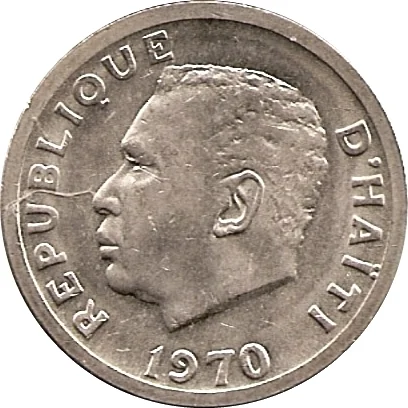
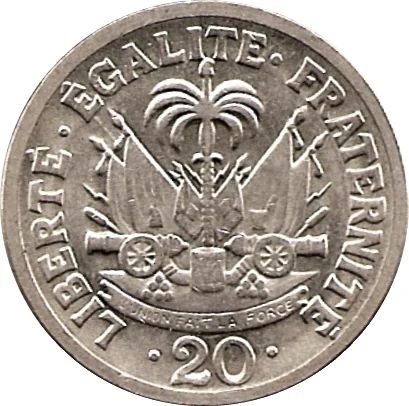
20 centimes – Haiti
Add to wishlist
Haiti
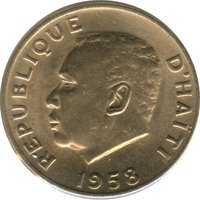
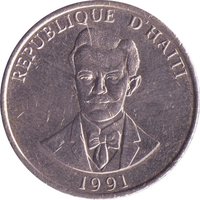
Obverse
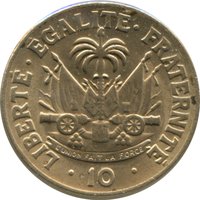
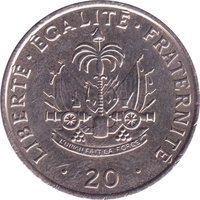
Reverse
Edge
Plain
Categories
| Symbols> Coat of Arms |
| Person> Politician |
Mints
| Name | Mark |
|---|---|
| United States Mint of Denver | — |
Mintings
| Year | Mint Mark | Mintage | Quality | Collection |
|---|---|---|---|---|
| 1970 | — | 1,000,000 |
Historical background
In 1970, Haiti's currency, the gourde, operated under a fixed exchange rate system pegged to the United States dollar at a rate of 5 gourdes to 1 USD. This peg, established in 1919, provided a long-standing facade of monetary stability but masked deeper economic vulnerabilities. The Haitian economy was overwhelmingly agrarian and export-dependent, relying heavily on coffee, sugar, and sisal, while the authoritarian regime of François "Papa Doc" Duvalier prioritized political control and elite patronage over sustainable economic development. Consequently, the fixed parity was largely artificial, maintained more by administrative fiat and restrictive capital controls than by robust foreign exchange reserves or a productive economic base.
Beneath this official stability, a significant parallel black market for foreign currency thrived, a direct reflection of the country's economic distress. The widening gap between the official rate and the black-market rate, where the gourde traded at a considerable discount, highlighted the scarcity of hard currency and a lack of confidence in the national economy. This duality created major distortions, disadvantaging official exporters and benefiting those with access to illicit exchange channels. The situation was exacerbated by chronic trade deficits, low foreign investment outside of assembly plants (the nascent "Taiwan of the Caribbean" model), and the systematic siphoning of public funds by the Duvalierist state.
Thus, the currency situation in 1970 was one of superficial order masking profound dysfunction. The fixed gourde served as a symbol of state authority, but the thriving black market revealed the true pressures of a struggling, controlled economy. This precarious balance was entirely dependent on the political status quo, leaving Haiti's monetary system vulnerable to future shocks, which would materialize in the coming years with the death of Papa Doc, rising oil prices, and the eventual collapse of the fixed peg in the 1980s.
Beneath this official stability, a significant parallel black market for foreign currency thrived, a direct reflection of the country's economic distress. The widening gap between the official rate and the black-market rate, where the gourde traded at a considerable discount, highlighted the scarcity of hard currency and a lack of confidence in the national economy. This duality created major distortions, disadvantaging official exporters and benefiting those with access to illicit exchange channels. The situation was exacerbated by chronic trade deficits, low foreign investment outside of assembly plants (the nascent "Taiwan of the Caribbean" model), and the systematic siphoning of public funds by the Duvalierist state.
Thus, the currency situation in 1970 was one of superficial order masking profound dysfunction. The fixed gourde served as a symbol of state authority, but the thriving black market revealed the true pressures of a struggling, controlled economy. This precarious balance was entirely dependent on the political status quo, leaving Haiti's monetary system vulnerable to future shocks, which would materialize in the coming years with the death of Papa Doc, rising oil prices, and the eventual collapse of the fixed peg in the 1980s.
🌟 Uncommon