

2 Pe – Myanmar
Myanmar
Context
Years: 1949–1951
Issuer: Myanmar 
Period:
(1948—1974)
Currency:
(1945—1952)
Demonetized: Yes
Total mintage: 23,080,100
Material
Weight: 5.83 g
Thickness: 1.6 mm
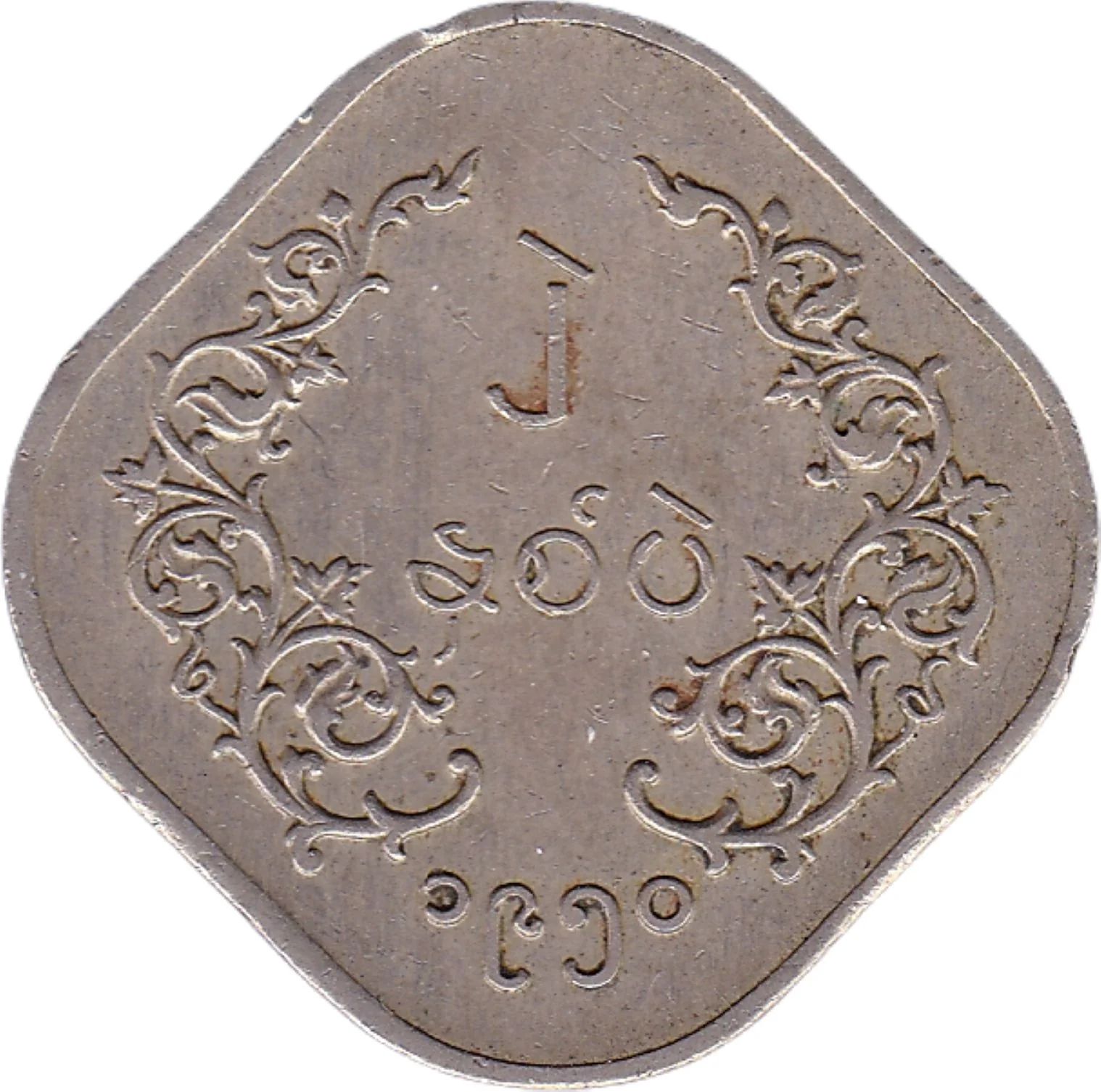
Shape: Square with rounded corners
Technique: Milled
Alignment: Medal alignment
flip
References
KM: #Click to copy to clipboard29
Numista: #21327
Value
Exchange value: ⅛ BUR
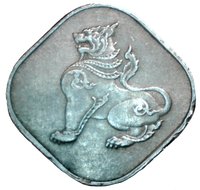
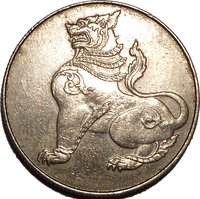
Obverse
Description:
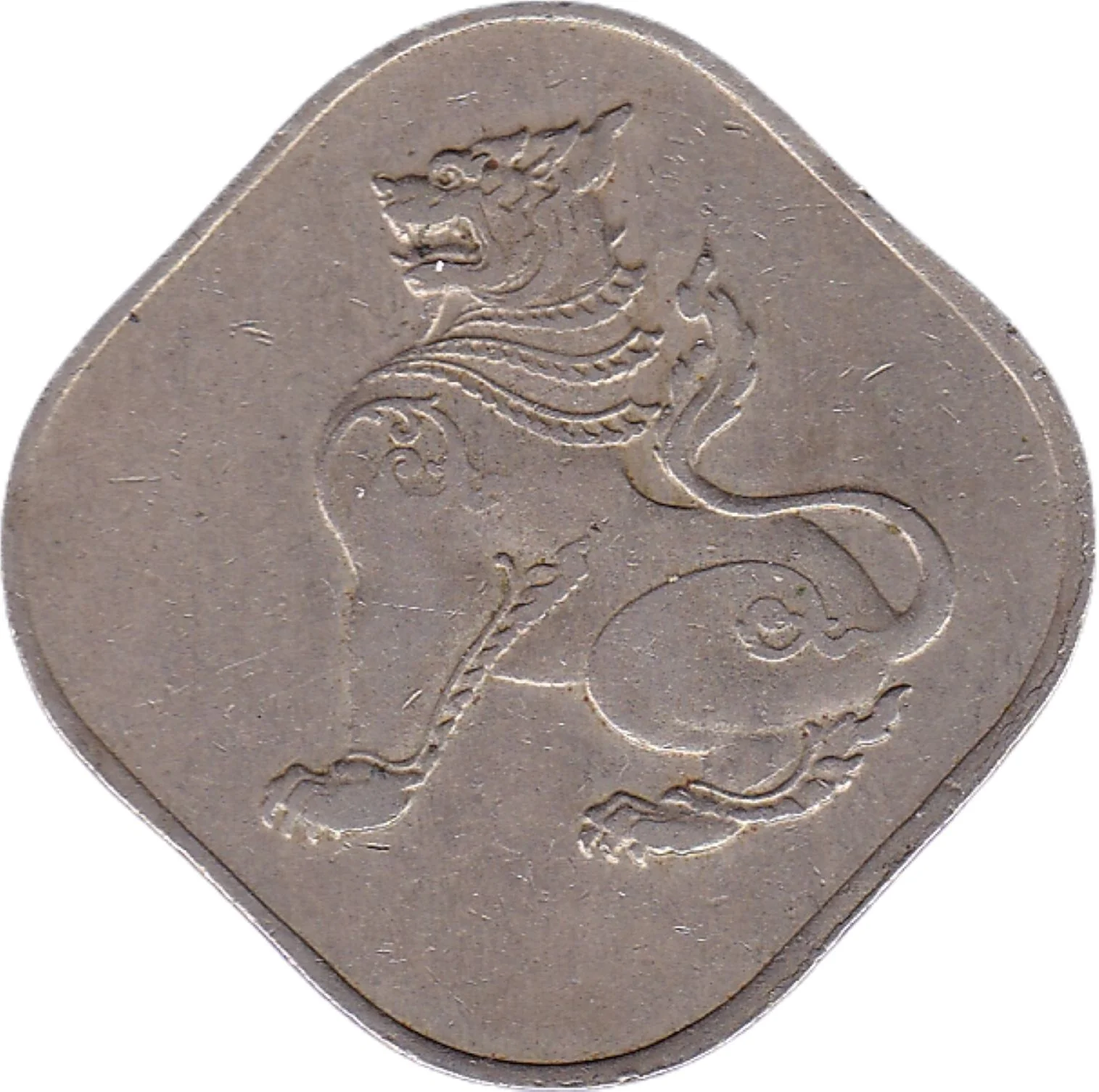
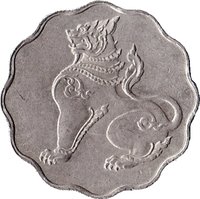
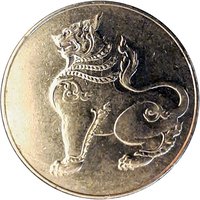
Chinthe: a Burmese lion-dragon guardian.
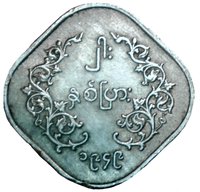
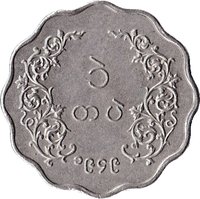
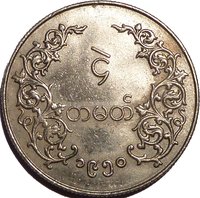
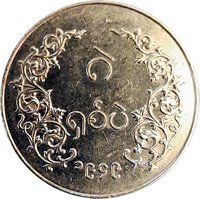
Reverse
Edge
Plain
Mints
| Name | Mark |
|---|---|
| Royal Mint (Tower Hill) | — |
Mintings
| Year | Mint Mark | Mintage | Quality | Collection |
|---|---|---|---|---|
| 1949 | — | 7,100,000 | ||
| 1949 | — | 100 | Proof | |
| 1950 | — | 8,500,000 | ||
| 1950 | — | — | Proof | |
| 1951 | — | 7,480,000 | ||
| 1951 | — | — | Proof |
Historical background
In 1949, Myanmar (then Burma) was in a state of profound monetary instability, a direct consequence of the political and military turmoil following its independence from Britain in 1948. The fledgling Union of Burma was fighting for its survival against multiple communist and ethnic insurgencies, which fractured the country's territory and economic unity. This civil conflict severely disrupted agriculture, trade, and government revenue collection, crippling the state's ability to manage the economy and leading to massive budget deficits financed by printing money.
The currency situation was characterized by a chaotic duality. The official currency, the Burmese kyat (issued by the Union Bank of Burma), was rapidly losing value due to hyperinflation driven by the government's deficit financing. Simultaneously, large areas of the country under insurgent control operated outside the government's monetary system. In these regions, barter trade became common, and various forms of informal or local scrip sometimes circulated, undermining the authority and reach of the central currency. The kyat's value plummeted, and public confidence in it eroded.
Furthermore, the legacy of British colonial currency and the wartime Japanese occupation currency had left a complex monetary landscape. The government struggled to establish the kyat as the sole legal tender and to control the smuggling of foreign currencies and goods across its porous borders. Thus, in 1949, Myanmar's currency situation was not one of a unified system but of a fragmented and failing one, where the state's inability to project authority was mirrored by its inability to maintain monetary stability, laying the groundwork for decades of economic isolation and control.
The currency situation was characterized by a chaotic duality. The official currency, the Burmese kyat (issued by the Union Bank of Burma), was rapidly losing value due to hyperinflation driven by the government's deficit financing. Simultaneously, large areas of the country under insurgent control operated outside the government's monetary system. In these regions, barter trade became common, and various forms of informal or local scrip sometimes circulated, undermining the authority and reach of the central currency. The kyat's value plummeted, and public confidence in it eroded.
Furthermore, the legacy of British colonial currency and the wartime Japanese occupation currency had left a complex monetary landscape. The government struggled to establish the kyat as the sole legal tender and to control the smuggling of foreign currencies and goods across its porous borders. Thus, in 1949, Myanmar's currency situation was not one of a unified system but of a fragmented and failing one, where the state's inability to project authority was mirrored by its inability to maintain monetary stability, laying the groundwork for decades of economic isolation and control.
Series: 1949 Myanmar circulation coins
🌱 Fairly Common