

2½ Shillings – South African Republic
South Africa
Context
Years: 1892–1897
Country: South Africa 
Issuer: South African Republic
Period:
(1874—1902)
Currency:
(1874—1902)
Demonetized: Yes
Total mintage: 902,418
Material
References
KM: #Click to copy to clipboard7
Numista: #21288
Value
Bullion value: $37.00
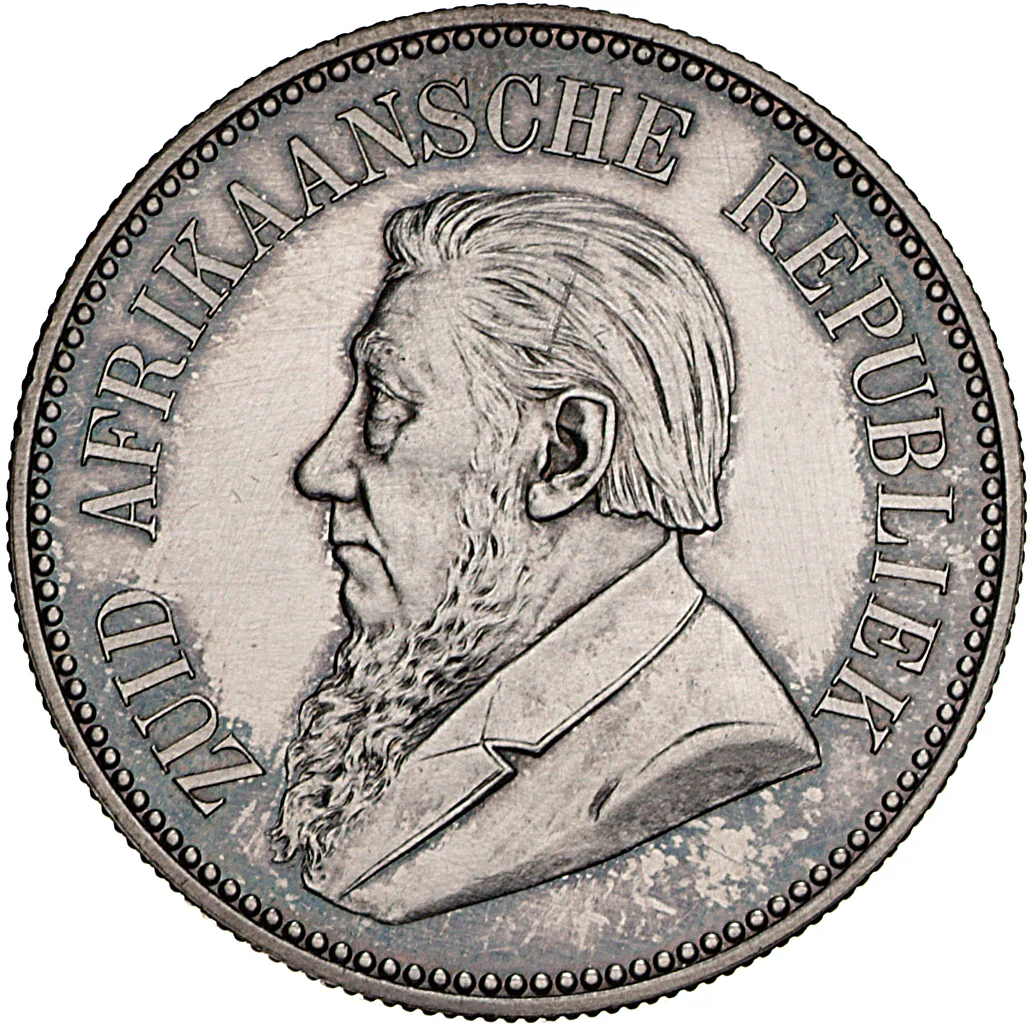
Obverse
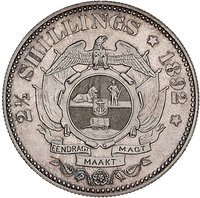
Description:
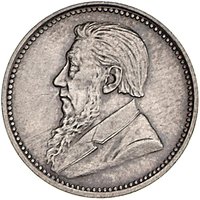
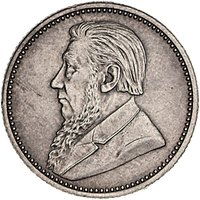
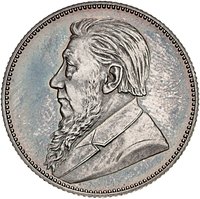
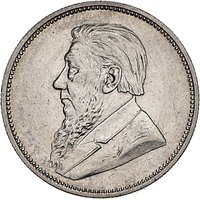
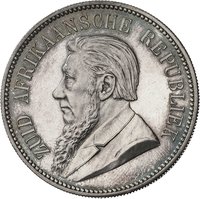
Bearded bust of Paul Kruger left, legend around.
Inscription:
ZUID AFRIKAANSCHE REPUBLIEK
Translation:
SOUTH AFRICAN REPUBLIC
Script: Latin
Language: Dutch
Engraver: Otto Schultz
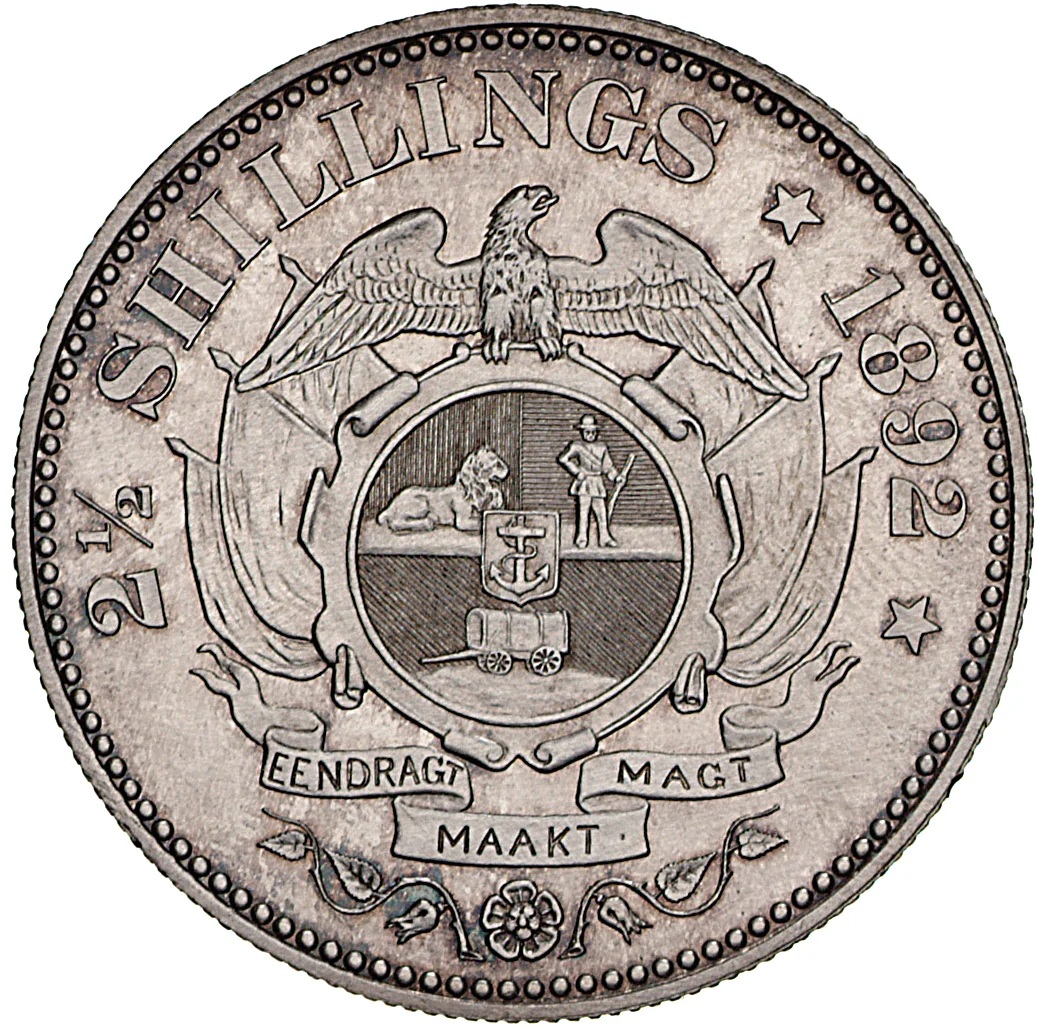
Reverse
Description:
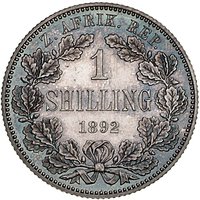
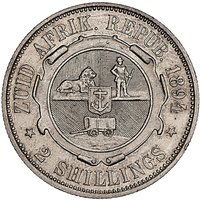
SAR arms below date and value.
Inscription:
2½ SHILLINGS * 1892 *
EENDRAGT MAAKT MAGT
EENDRAGT MAAKT MAGT
Translation:
Concord makes might
Script: Latin
Language: Dutch
Engraver: Otto Schultz
Edge
Reeded
Categories
| Animal> Bird |
| Person> Politician |
| Symbol> Flag |
| Plants> Flower |
| Symbols> Coat of Arms |
Mintings
| Year | Mint Mark | Mintage | Quality | Collection |
|---|---|---|---|---|
| 1892 | — | 16,300 | ||
| 1892 | — | 50 | Proof | |
| 1893 | — | 134,800 | ||
| 1894 | — | 135,012 | ||
| 1895 | — | 182,336 | ||
| 1896 | — | 284,760 | ||
| 1897 | — | 149,160 |
Historical background
By 1892, the currency situation in the South African Republic (ZAR) was a complex and politically charged issue, deeply intertwined with its economic ambitions and the growing influence of foreign capital. The state’s official currency was the pound sterling, but the reality was a chaotic mix of British gold sovereigns, silver coins from various European nations, and a substantial volume of paper notes issued by privately-owned banks, particularly the Netherlands Bank of South Africa. This fragmentation created significant uncertainty for trade and governance, as the value and acceptability of these mediums could vary widely.
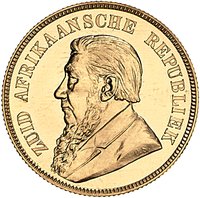
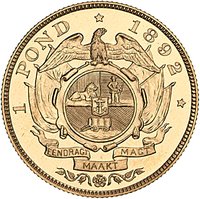
The core of the crisis lay in the state's desire for financial autonomy and its struggle with a chronic shortage of hard currency. The discovery of vast gold deposits on the Witwatersrand had transformed the ZAR's economy, but the wealth was largely controlled by Uitlander (foreign) mining magnates and European banks. To assert sovereignty and generate revenue, President Paul Kruger’s government had introduced its own coinage, the famous "Krugerrand" gold pounds and half-pounds, minted at the newly established Pretoria Mint. However, these coins often left the country to pay for imports, failing to solve the domestic circulation problem. The state’s own attempts to introduce paper currency, the "Staatskasbons" (Treasury Notes), in 1890 had met with public distrust and were largely unsuccessful.
Consequently, the government turned to a more radical solution, which came to fruition in 1892 with the chartering of the National Bank of the South African Republic (the Nationale Bank der Zuid-Afrikaansche Republiek). This state-backed institution was granted the sole right to issue banknotes, intended to replace the private bank issues and create a unified, state-controlled paper currency. This move was a direct assertion of Boer republican sovereignty against British economic dominance and private capital. However, the success of this new currency remained precarious, dependent on public confidence and the ZAR’s ability to maintain sufficient gold reserves—a tension that would persist until the republic's dissolution following the Anglo-Boer War.
The core of the crisis lay in the state's desire for financial autonomy and its struggle with a chronic shortage of hard currency. The discovery of vast gold deposits on the Witwatersrand had transformed the ZAR's economy, but the wealth was largely controlled by Uitlander (foreign) mining magnates and European banks. To assert sovereignty and generate revenue, President Paul Kruger’s government had introduced its own coinage, the famous "Krugerrand" gold pounds and half-pounds, minted at the newly established Pretoria Mint. However, these coins often left the country to pay for imports, failing to solve the domestic circulation problem. The state’s own attempts to introduce paper currency, the "Staatskasbons" (Treasury Notes), in 1890 had met with public distrust and were largely unsuccessful.
Consequently, the government turned to a more radical solution, which came to fruition in 1892 with the chartering of the National Bank of the South African Republic (the Nationale Bank der Zuid-Afrikaansche Republiek). This state-backed institution was granted the sole right to issue banknotes, intended to replace the private bank issues and create a unified, state-controlled paper currency. This move was a direct assertion of Boer republican sovereignty against British economic dominance and private capital. However, the success of this new currency remained precarious, dependent on public confidence and the ZAR’s ability to maintain sufficient gold reserves—a tension that would persist until the republic's dissolution following the Anglo-Boer War.

🌱 Common