

1 boliviano – Bolivia
Add to wishlist
Bolivia
Obverse
Description:
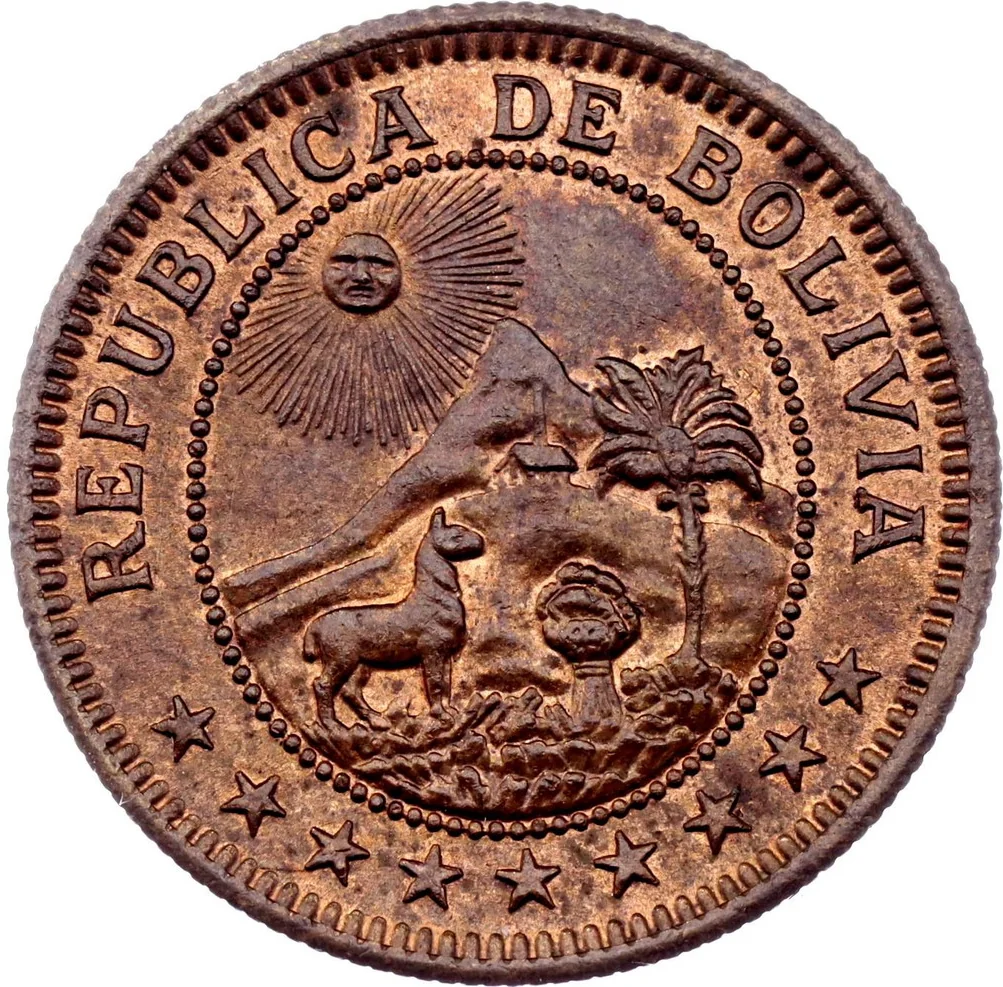
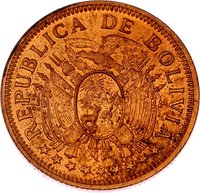
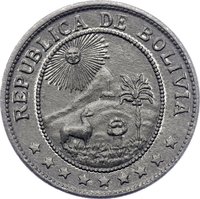
Bolivia's coat of arms features a beaded oval containing Cerro Rico and Cerro Menor mountains, a chapel, a palm tree, a wheat sheaf, an alpaca, and a sun. Nine stars below represent the departments.
Inscription:
REPUBLICA DE BOLIVIA
Translation:
Republic of Bolivia
Script: Latin
Language: Spanish
Reverse
Edge
Reeded
Categories
| Symbol> Sun |
| Symbol> Wreath |
| Animal> Camel |
| Geography> Mountain |
| Plant> Tree |
| Symbols> Coat of Arms |
Mints
| Name | Mark |
|---|---|
| Heaton and Sons / The Mint Birmingham | — |
| Heaton and Sons / The Mint Birmingham | H |
| Kings Norton Metal Company | KN |
Mintings
Historical background
In 1951, Bolivia's currency situation was characterized by severe inflation and economic instability, deeply rooted in the political and social upheaval of the post-Chaco War era. The national currency, the Boliviano, had been in a state of progressive devaluation for over a decade, a trend accelerated by the government's heavy reliance on printing money to finance deficits. This period followed the transformative National Revolution of 1952, but in 1951 the country was still under the conservative rule of the Movimiento Nacionalista Revolucionario (MNR)-backed military junta of General Hugo Ballivián, which was struggling to manage an economy burdened by a collapsing tin market and widespread social discontent.
The core economic problem was a fiscal crisis. Government revenue was overwhelmingly dependent on taxes from the "Big Three" tin-mining companies (Patino, Hochschild, and Aramayo), yet global tin prices were volatile and often depressed. Facing budget shortfalls and lacking access to substantial foreign credit, successive governments resorted to deficit financing through the Central Bank. This unchecked expansion of the money supply, disconnected from real economic growth, fueled rampant inflation. By the early 1950s, the cost of living was soaring, eroding the value of the Boliviano and devastating the purchasing power of workers and the middle class.
Consequently, Bolivia operated with a severely weakened and unstable currency, which crippled both domestic commerce and international trade. The inflationary spiral contributed directly to the social unrest that would culminate in the 1952 revolution. The incoming MNR government, after its victory, would soon be forced to confront this legacy head-on, leading to the dramatic 1956 monetary stabilization plan and the eventual introduction of a new currency, the Bolivian Peso, in 1963. Thus, the currency situation of 1951 was not merely a financial issue but a critical symptom of the structural crises that defined the pre-revolutionary period.
The core economic problem was a fiscal crisis. Government revenue was overwhelmingly dependent on taxes from the "Big Three" tin-mining companies (Patino, Hochschild, and Aramayo), yet global tin prices were volatile and often depressed. Facing budget shortfalls and lacking access to substantial foreign credit, successive governments resorted to deficit financing through the Central Bank. This unchecked expansion of the money supply, disconnected from real economic growth, fueled rampant inflation. By the early 1950s, the cost of living was soaring, eroding the value of the Boliviano and devastating the purchasing power of workers and the middle class.
Consequently, Bolivia operated with a severely weakened and unstable currency, which crippled both domestic commerce and international trade. The inflationary spiral contributed directly to the social unrest that would culminate in the 1952 revolution. The incoming MNR government, after its victory, would soon be forced to confront this legacy head-on, leading to the dramatic 1956 monetary stabilization plan and the eventual introduction of a new currency, the Bolivian Peso, in 1963. Thus, the currency situation of 1951 was not merely a financial issue but a critical symptom of the structural crises that defined the pre-revolutionary period.
🌱 Very Common