

1 Cent – Penang
Obverse
Description:
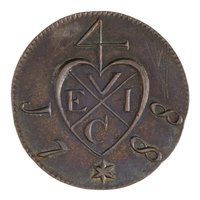
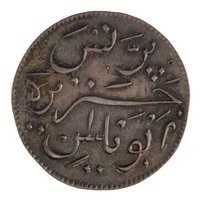
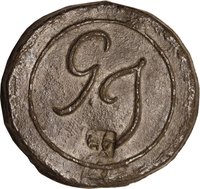
Cursive Latin initial in circle, countermarked with Chinese character.
Inscription:
GL
(元)
(元)
Translation:
Yuan
Language: Classical Chinese
Reverse
Description:
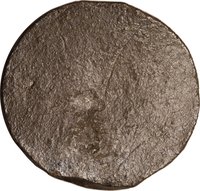
Simple.
Edge
Plain
Mintings
| Year | Mint Mark | Mintage | Quality | Collection |
|---|---|---|---|---|
| 1800 | — | — |
Historical background
In 1800, Penang's currency situation was a complex and chaotic reflection of its position as a newly established British trading post within a diverse Asian economic sphere. The island, officially ceded to the British East India Company in 1786, lacked a standardized official currency. Instead, the port's commerce operated on a bewildering array of circulating coins, including Spanish silver dollars (the dominant regional trade coin), Dutch guilders, Indian rupees, and various Chinese copper cash. This multiplicity created significant challenges for merchants and administrators, as exchange rates fluctuated constantly and coins were often judged by weight and perceived purity rather than face value.
The British administration, under the Government of Bengal, attempted to impose order by declaring the Indian rupee the sole legal tender for official government transactions and payments. However, this decree largely failed in the bustling marketplace of George Town, where the Spanish dollar remained the preferred medium for private trade due to its wide acceptance across the Straits and Southeast Asia. This created a dual-system: government accounts were kept in rupees, while most commercial contracts and daily business were conducted in dollars, leading to constant calculation and conversion problems.
Consequently, the period was marked by chronic currency scarcity and instability. Counterfeiting and the clipping of coins were rampant, further eroding trust. The lack of small change was a particular hindrance to everyday market life, often filled by ad-hoc solutions like cutting silver coins into fractions. This monetary confusion acted as a brake on Penang's economic development, highlighting the tension between colonial administrative ambition and the entrenched realities of regional Asian trade networks, a situation that would persist for decades before any coherent system emerged.
The British administration, under the Government of Bengal, attempted to impose order by declaring the Indian rupee the sole legal tender for official government transactions and payments. However, this decree largely failed in the bustling marketplace of George Town, where the Spanish dollar remained the preferred medium for private trade due to its wide acceptance across the Straits and Southeast Asia. This created a dual-system: government accounts were kept in rupees, while most commercial contracts and daily business were conducted in dollars, leading to constant calculation and conversion problems.
Consequently, the period was marked by chronic currency scarcity and instability. Counterfeiting and the clipping of coins were rampant, further eroding trust. The lack of small change was a particular hindrance to everyday market life, often filled by ad-hoc solutions like cutting silver coins into fractions. This monetary confusion acted as a brake on Penang's economic development, highlighting the tension between colonial administrative ambition and the entrenched realities of regional Asian trade networks, a situation that would persist for decades before any coherent system emerged.
✨ Legendary