

5 Francs – France
France
Context
Years: 1814–1815
Issuer: France 
Ruler: Louis XVIII
Currency:
(1795—1959)
Demonetization: 25 June 1928
Total mintage: 8,773,065
Material
References
KM: #Click to copy to clipboard702
Numista: #2110
Value
Bullion value: $64.87
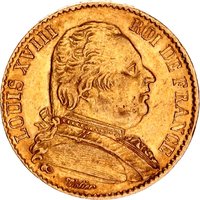
Obverse
Description:
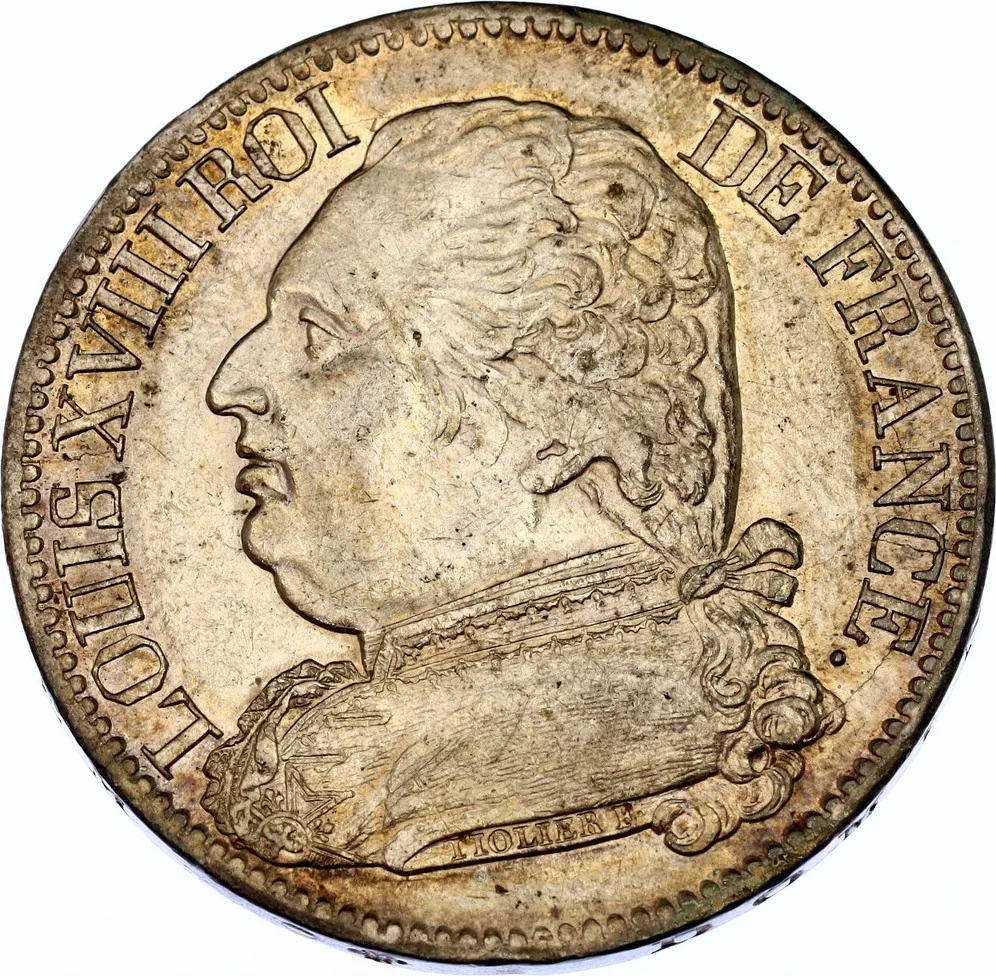
Bareheaded bust of Louis XVIII left, wearing the Order of the Holy Spirit plaque; signed "Tiolier F." in incuse on the drapery edge.
Inscription:
LOUIS XVIII ROI DE FRANCE.
TIOLIER F.
TIOLIER F.
Translation:
LOUIS XVIII KING OF FRANCE.
TIOLIER F.
TIOLIER F.
Script: Latin
Language: French
Engraver: Pierre-Joseph Tiolier
Reverse
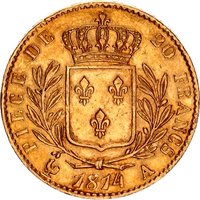
Description:
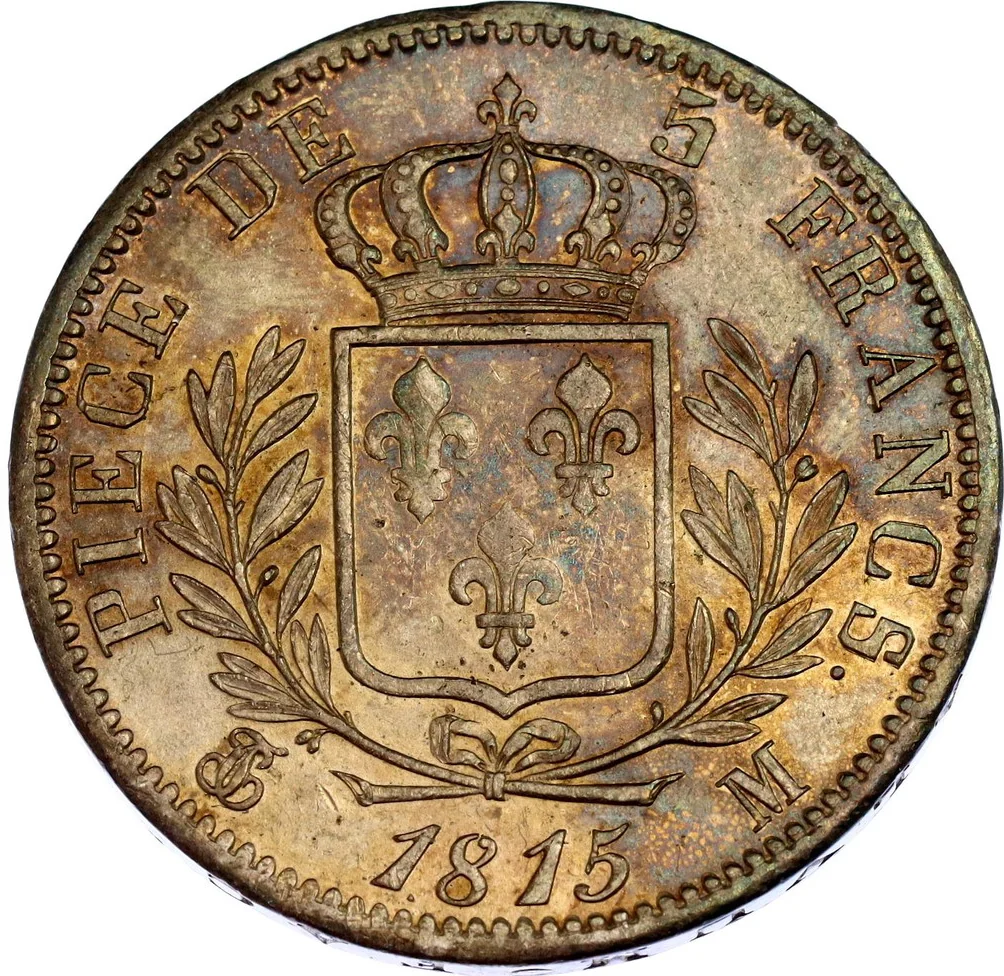
Shield of France crowned, flanked by olive branches.
Inscription:
PIECE DE 5 FRANCS.
1815/4 I (Limoges)
1815/4 I (Limoges)
Script: Latin
Engraver: Pierre-Joseph Tiolier
Edge
Inscribed in hollow
Legend:
DOMINE SALVUM FAC REGEM
Translation:
Lord, save the King.
Language: Latin
Mints
| Name | Mark |
|---|---|
| Monnaie de Paris | A |
| Rouen | B |
| Strasbourg | BB |
| Lyon | D |
| La Rochelle | H |
| Limoges | I |
| Bordeaux | K |
| Bayonne | L |
| Toulouse | M |
| Marseille | MA |
| Perpignan | Q |
| Nantes | T |
| Lille | W |
Mintings
| Year | Mint Mark | Mintage | Quality | Collection |
|---|---|---|---|---|
| 1814 | A | 4 | ||
| 1814 | B | 634,669 | ||
| 1814 | BB | 4,901 | ||
| 1814 | I | 1,553,458 | ||
| 1814 | K | 355,087 | ||
| 1814 | MA | 98,617 | ||
| 1814 | T | 5,217 | ||
| 1814 | W | — | ||
| 1814 | M | 2,376,486 | ||
| 1814 | Q | 1,181,316 | ||
| 1814 | D | 81,763 | ||
| 1814 | H | 46,107 | ||
| 1814 | L | 1,901,563 | ||
| 1815 | W | 114,053 | ||
| 1815 | A | — | ||
| 1815 | B | 253,983 | ||
| 1815 | BB | 1,545 | ||
| 1815 | D | 7,470 | ||
| 1815 | H | 33,704 | ||
| 1815 | L | — | ||
| 1815 | M | — | ||
| 1815 | MA | 7,401 | ||
| 1815 | Q | — | ||
| 1815 | T | 7,976 | ||
| 1815 | I | — | ||
| 1815 | K | 107,745 |
Historical background
Following Napoleon's abdication in April 1814, France faced a severe and complex monetary crisis. The economy was burdened by the colossal debts of two decades of nearly continuous warfare, which had been financed through heavy taxation, forced loans, and the systematic plunder of conquered territories. The most visible symptom was the profound distrust in paper currency, as the assignats of the Revolution and the later mandats territoriaux had ended in hyperinflation and ruin. While Napoleon had restored a metallic standard with the franc de germinal (1803), backed by silver and gold, the relentless cost of war led the government to secretly authorize the Bank of France to issue notes beyond its legal limits, undermining confidence even in this more stable currency.
The immediate post-war period under the restored Bourbon monarchy of Louis XVIII saw a currency system in disarray. Specie (gold and silver coin) was hoarded, leading to a critical shortage in circulation. The Bank of France's notes, theoretically convertible, faced sporadic runs and were often discounted in everyday transactions, particularly outside Paris. The state treasury was essentially empty, and the new government inherited obligations to pay massive war indemnities demanded by the victorious Allied powers, as stipulated in the Treaty of Paris (May 1814), further draining precious metal reserves.
Confronting this, the government of the First Restoration prioritized monetary stabilization as a foundation for legitimacy and economic recovery. It upheld the franc germinal as the official unit of account, affirming a commitment to the bimetallic standard. However, its most urgent task was to restore public confidence in the Bank of France and its notes. This was attempted through a combination of fiscal austerity, securing new foreign loans (notably from Britain), and carefully managing the limited specie reserves to guarantee convertibility. These steps began a slow and fragile recovery, but the currency situation remained precarious, setting the stage for further financial challenges upon Napoleon's dramatic return in 1815.
The immediate post-war period under the restored Bourbon monarchy of Louis XVIII saw a currency system in disarray. Specie (gold and silver coin) was hoarded, leading to a critical shortage in circulation. The Bank of France's notes, theoretically convertible, faced sporadic runs and were often discounted in everyday transactions, particularly outside Paris. The state treasury was essentially empty, and the new government inherited obligations to pay massive war indemnities demanded by the victorious Allied powers, as stipulated in the Treaty of Paris (May 1814), further draining precious metal reserves.
Confronting this, the government of the First Restoration prioritized monetary stabilization as a foundation for legitimacy and economic recovery. It upheld the franc germinal as the official unit of account, affirming a commitment to the bimetallic standard. However, its most urgent task was to restore public confidence in the Bank of France and its notes. This was attempted through a combination of fiscal austerity, securing new foreign loans (notably from Britain), and carefully managing the limited specie reserves to guarantee convertibility. These steps began a slow and fragile recovery, but the currency situation remained precarious, setting the stage for further financial challenges upon Napoleon's dramatic return in 1815.
Series: 1814 France circulation coins
🌱 Fairly Common