

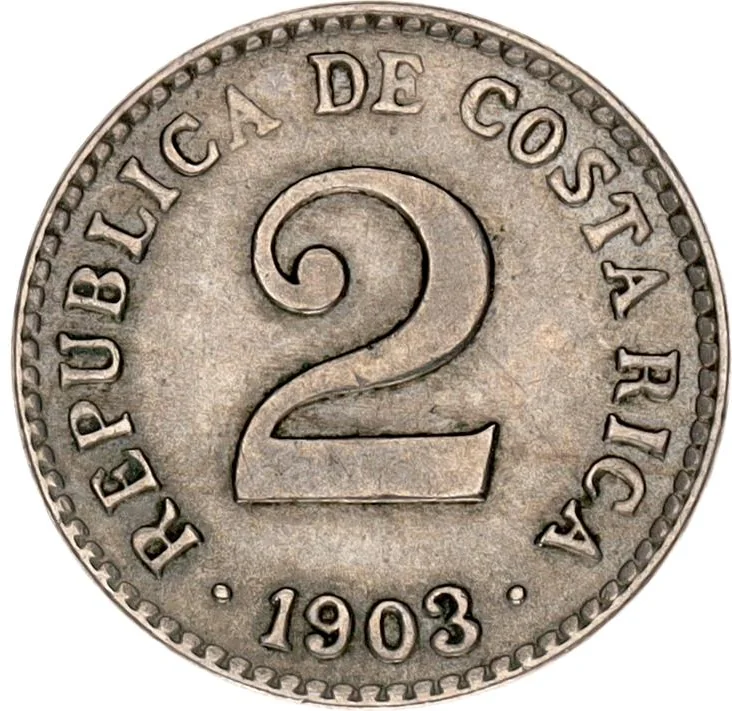
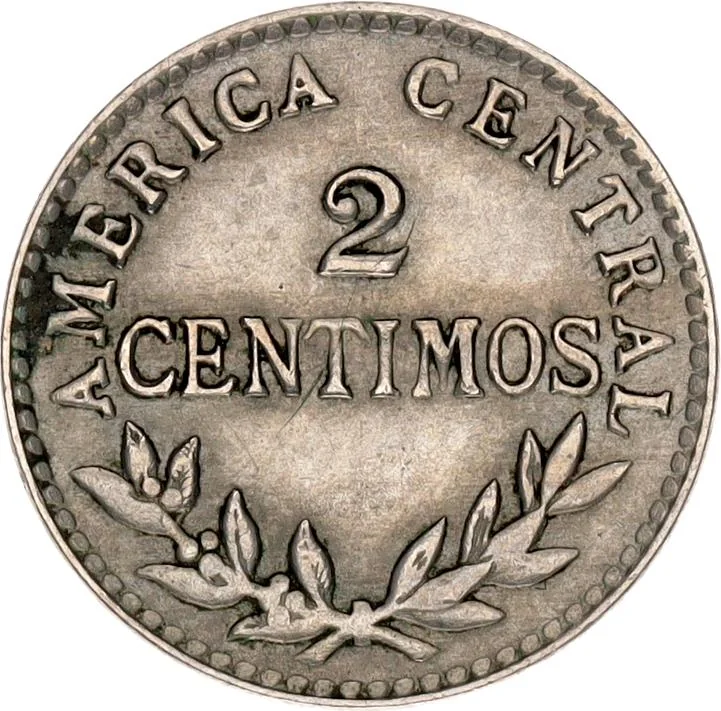
2 Centimos – Costa Rica
Costa Rica
Context
Year: 1903
Issuer: Costa Rica 
Period:
(1848—1948)
Currency:
(since 1896)
Demonetized: Yes
Total mintage: 630,000
References
KM: #Click to copy to clipboard144
Numista: #20992
Value
Exchange value: 0.02 CRC
Obverse
Reverse
Edge
Mints
| Name | Mark |
|---|---|
| United States Mint of Philadelphia | — |
Mintings
| Year | Mint Mark | Mintage | Quality | Collection |
|---|---|---|---|---|
| 1903 | — | 630,000 |
Historical background
In 1903, Costa Rica’s currency system was in a state of transition and practical duality. The official currency was the silver Costa Rican peso, introduced in the 1890s to replace the historically used Central American Republic real. However, the silver peso faced significant challenges, including periodic devaluation and fluctuating international silver prices. More importantly, for major international trade, particularly with British investors involved in the crucial banana and coffee exports, the gold-backed British pound sterling and, to a lesser extent, the US dollar, were often preferred as more stable stores of value. This created a de facto bimetallic system where high-value transactions were anchored in gold-standard currencies.
The instability of the silver peso was a source of economic concern. Costa Rica, like many nations, felt the impact of the global shift toward the gold standard in the late 19th century. The depreciation of silver meant the peso’s exchange rate against gold-backed currencies was volatile, complicating foreign debt payments and international commerce. This period followed the government's earlier struggles with paper money, as "billetes de ley" issued in the 1880s had led to inflation, leaving a lingering public distrust in fiduciary currency.
Consequently, the year 1903 fell within a broader period of monetary reform that would culminate in 1905. The government, under President Ascensión Esquivel Ibarra, was actively laying the groundwork to abandon the silver standard entirely. This effort aimed to stabilize the economy, attract foreign investment, and simplify trade by pegging the national currency to gold. Thus, the currency situation in 1903 was one of a silver-based system in its final years, with authorities preparing for the definitive move to the gold-colón standard, which was formally established with the creation of the colón (named after Christopher Columbus) at a fixed rate to the pound sterling and US dollar just a few years later.
The instability of the silver peso was a source of economic concern. Costa Rica, like many nations, felt the impact of the global shift toward the gold standard in the late 19th century. The depreciation of silver meant the peso’s exchange rate against gold-backed currencies was volatile, complicating foreign debt payments and international commerce. This period followed the government's earlier struggles with paper money, as "billetes de ley" issued in the 1880s had led to inflation, leaving a lingering public distrust in fiduciary currency.
Consequently, the year 1903 fell within a broader period of monetary reform that would culminate in 1905. The government, under President Ascensión Esquivel Ibarra, was actively laying the groundwork to abandon the silver standard entirely. This effort aimed to stabilize the economy, attract foreign investment, and simplify trade by pegging the national currency to gold. Thus, the currency situation in 1903 was one of a silver-based system in its final years, with authorities preparing for the definitive move to the gold-colón standard, which was formally established with the creation of the colón (named after Christopher Columbus) at a fixed rate to the pound sterling and US dollar just a few years later.
🌟 Limited