

½ Franc – France
France
Context
Years: 1809–1814
Issuer: France 
Ruler: Napoleon I
Currency:
(1795—1959)
Demonetization: 17 June 1868
Total mintage: 12,154,309
Material
References
KM: #Click to copy to clipboard691
Numista: #2098
Value
Bullion value: $6.49
Obverse
Description:
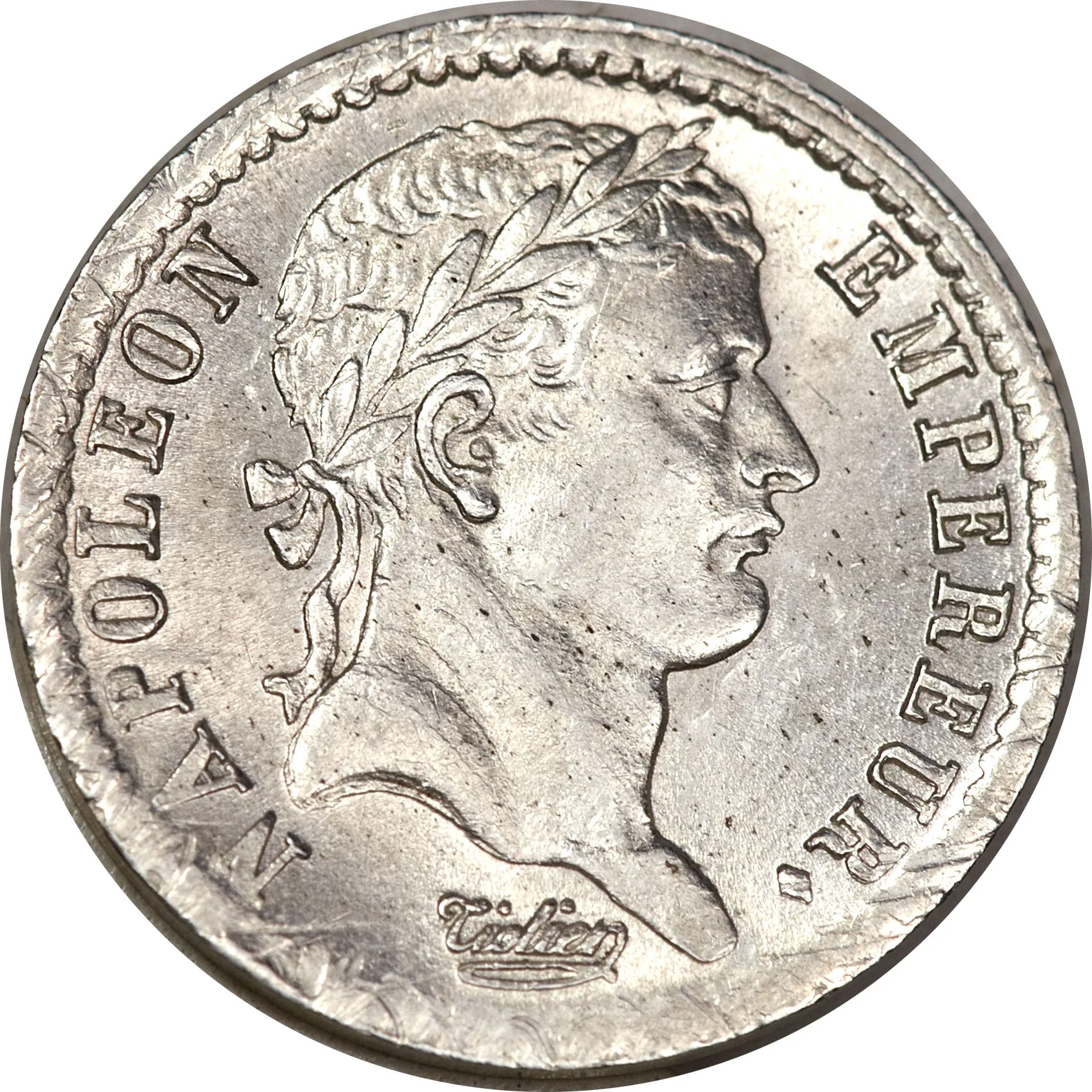
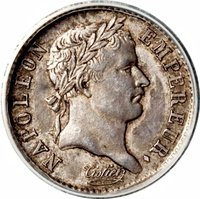
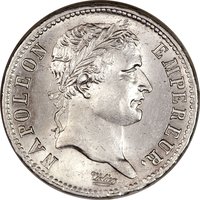
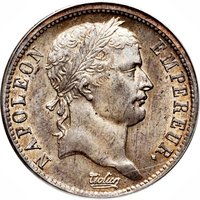
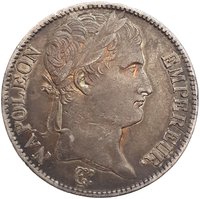
Napoleon laureate bust right. Script: Tiolier.
Inscription:
NAPOLEON EMPEREUR.
Tiolier
Tiolier
Translation:
Napoleon Emperor.
Script: Latin
Language: French
Engraver: Pierre-Joseph Tiolier
Reverse
Description:
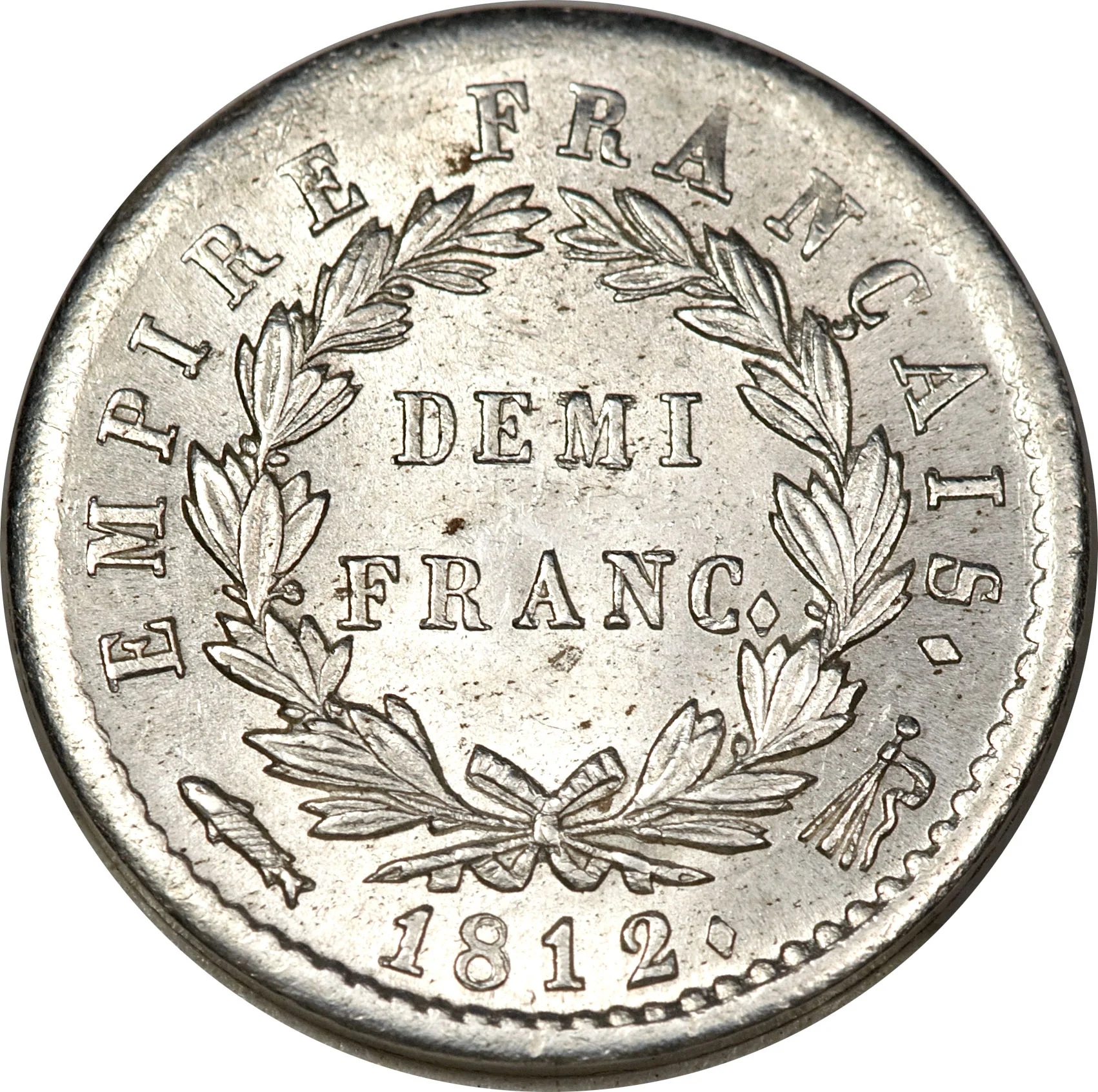
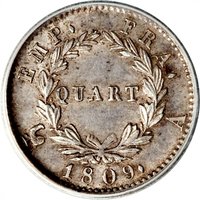
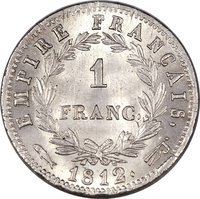
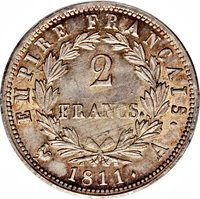
A (Paris rooster)
Inscription:
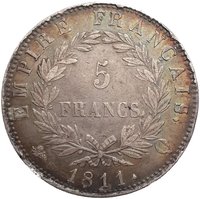
EMPIRE FRANÇAIS.
DEMI
FRANC.
1812.
DEMI
FRANC.
1812.
Translation:
FRENCH EMPIRE.
HALF
FRANC.
1812.
HALF
FRANC.
1812.
Script: Latin
Language: French
Engraver: Pierre-Joseph Tiolier
Edge
Plain
Mints
| Name | Mark |
|---|---|
| Royal Dutch Mint | — |
| Monnaie de Paris | A |
| Rouen | B |
| Strasbourg | BB |
| Genoa | CL |
| Lyon | D |
| Poitiers | G |
| La Rochelle | H |
| Limoges | I |
| Bordeaux | K |
| Bayonne | L |
| Toulouse | M |
| Marseille | MA |
| Perpignan | Q |
| Nantes | T |
| Turin | U |
| Lille | W |
Mintings
| Year | Mint Mark | Mintage | Quality | Collection |
|---|---|---|---|---|
| 1809 | A | 1,679,429 | ||
| 1809 | B | 14,000 | ||
| 1809 | Q | 69,525 | ||
| 1809 | U | 5,841 | ||
| 1809 | W | 313,712 | ||
| 1809 | D | 43,031 | ||
| 1809 | K | 42,716 | ||
| 1809 | M | 21,142 | ||
| 1809 | MA | 3,170 | ||
| 1810 | A | 1,362,232 | ||
| 1810 | B | 284,495 | ||
| 1810 | BB | 10,727 | ||
| 1810 | D | 70,494 | ||
| 1810 | H | 3,557 | ||
| 1810 | K | 41,244 | ||
| 1810 | L | 55,010 | ||
| 1810 | M | 32,988 | ||
| 1810 | MA | 10,478 | ||
| 1810 | W | 203,984 | ||
| 1811 | A | 1,859,998 | ||
| 1811 | B | 251,610 | ||
| 1811 | BB | 36,921 | ||
| 1811 | D | 220,060 | ||
| 1811 | H | 120,212 | ||
| 1811 | I | 133,525 | ||
| 1811 | Q | 126,082 | ||
| 1811 | T | 114,190 | ||
| 1811 | U | 38,734 | ||
| 1811 | W | 246,316 | ||
| 1811 | K | 16,916 | ||
| 1811 | L | 94,720 | ||
| 1811 | M | 48,492 | ||
| 1811 | MA | 68,874 | ||
| 1812 | A | 1,719,834 | ||
| 1812 | D | 154,931 | ||
| 1812 | H | 269,589 | ||
| 1812 | I | 136,510 | ||
| 1812 | K | 34,012 | ||
| 1812 | L | 52,295 | ||
| 1812 | M | 104,748 | ||
| 1812 | MA | 51,897 | ||
| 1812 | Q | 106,160 | ||
| 1812 | T | 80,790 | ||
| 1812 | Utrecht | 5,070 | ||
| 1812 | W | — | ||
| 1812 | B | 192,143 | ||
| 1813 | A | 627,154 | ||
| 1813 | CL | 8,361 | ||
| 1813 | D | — | ||
| 1813 | H | 137,827 | ||
| 1813 | I | 96,918 | ||
| 1813 | K | 58,345 | ||
| 1813 | L | 43,979 | ||
| 1813 | M | 158,503 | ||
| 1813 | MA | 70,103 | ||
| 1813 | Q | 44,476 | ||
| 1813 | T | 52,581 | ||
| 1813 | Utrecht | 6,846 | ||
| 1813 | W | 154,326 | ||
| 1814 | A | 106,620 | ||
| 1814 | M | 35,866 |
Historical background
In 1809, France's currency situation was fundamentally shaped by Napoleon Bonaparte's ongoing efforts to stabilize the nation's finances after the chaos of the Revolution. The official currency was the Franc Germinal, established by the law of 7 Germinal, Year XI (1803), which created a bimetallic system based on a fixed ratio between gold and silver. This law defined the franc as containing 4.5 grams of fine silver or 0.290322 grams of fine gold, providing a stable and reliable currency that would earn international respect for decades. The Banque de France, which Napoleon had firmly brought under state control, held the exclusive right to issue banknotes, primarily in Paris.
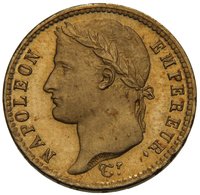
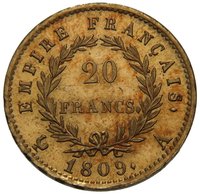
However, the practical reality in 1809 was strained by the constant financial demands of the Continental System and the Peninsular War. While the Franc Germinal was sound in theory, the government's need to fund its military campaigns led to increased reliance on the Banque de France for credit, creating inflationary pressures. Furthermore, coinage, particularly gold coins like the 20-franc napoléon, was often hoarded or exported due to uncertainty, leading to occasional shortages of specie in daily circulation. The value of the banknotes themselves fluctuated outside major cities, as public trust in paper money remained cautious.
Regionally, the situation was complex due to Napoleon's expanding empire. While the franc was the legal tender in France's core territories, annexed regions and satellite states often operated with their own local currencies, though they were increasingly aligned with the French monetary system. The overarching goal was to use the stable Franc Germinal as an instrument of economic hegemony, challenging British financial power. Thus, in 1809, the currency was a point of both domestic strength and underlying tension—a well-designed system tested by the relentless costs of empire and war.
However, the practical reality in 1809 was strained by the constant financial demands of the Continental System and the Peninsular War. While the Franc Germinal was sound in theory, the government's need to fund its military campaigns led to increased reliance on the Banque de France for credit, creating inflationary pressures. Furthermore, coinage, particularly gold coins like the 20-franc napoléon, was often hoarded or exported due to uncertainty, leading to occasional shortages of specie in daily circulation. The value of the banknotes themselves fluctuated outside major cities, as public trust in paper money remained cautious.
Regionally, the situation was complex due to Napoleon's expanding empire. While the franc was the legal tender in France's core territories, annexed regions and satellite states often operated with their own local currencies, though they were increasingly aligned with the French monetary system. The overarching goal was to use the stable Franc Germinal as an instrument of economic hegemony, challenging British financial power. Thus, in 1809, the currency was a point of both domestic strength and underlying tension—a well-designed system tested by the relentless costs of empire and war.
Series: 1809 France circulation coins
🌱 Common