

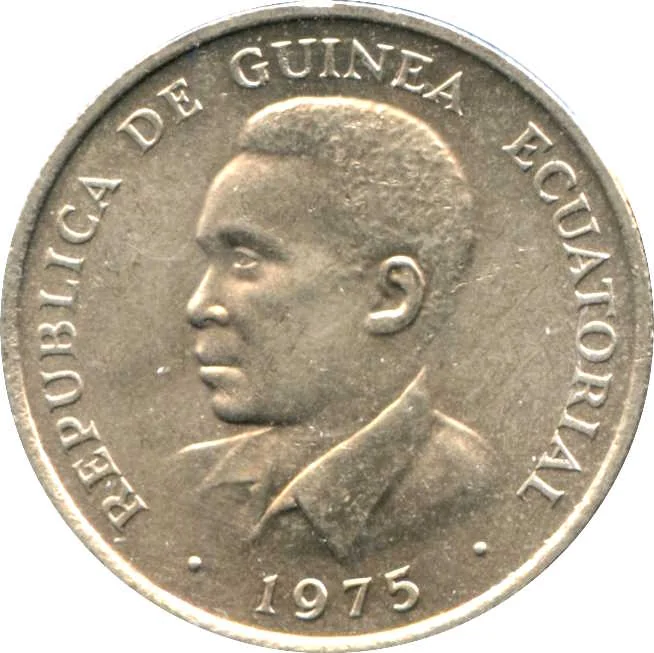
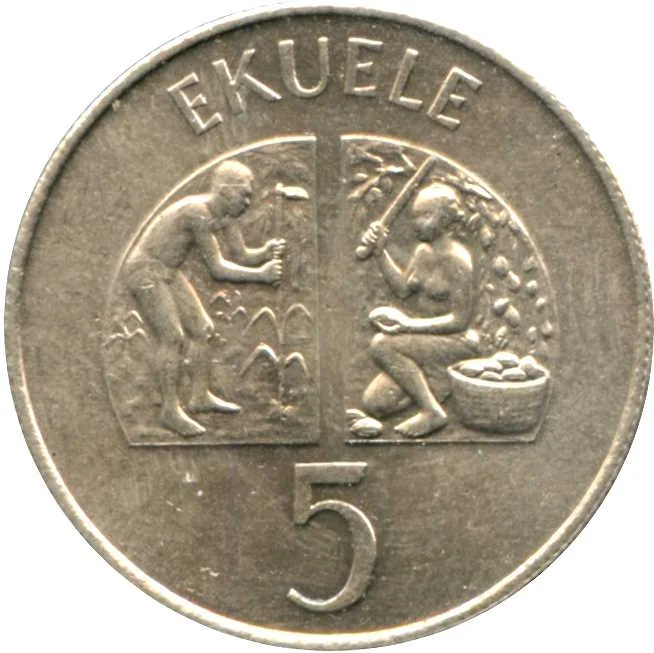
5 ekuele – Equatorial Guinea
Add to wishlist
Equatorial Guinea
Context
Year: 1975
Issuer: Equatorial Guinea
Period:
(since 1968)
Currency:
(1975—1985)
Demonetization: 1 January 1985
Total mintage: 2,800,000
Material
References
KM: #
Numista: #10926
Value
Exchange value: 5 GQE
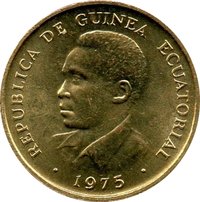
Obverse
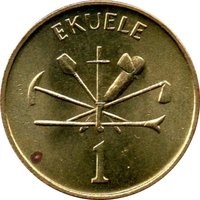
Reverse
Edge
Reeded
Categories
| Agriculture |
| Person> Politician |
Mints
| Name | Mark |
|---|---|
| Royal Mint | — |
Mintings
| Year | Mint Mark | Mintage | Quality | Collection |
|---|---|---|---|---|
| 1975 | — | 2,800,000 |
Historical background
In 1975, Equatorial Guinea's currency situation was fundamentally defined by its political reality under the brutal dictatorship of Francisco Macías Nguema. Having seized power in 1968 after independence from Spain, Macías systematically dismantled the state and economy. The national currency, the ekuele (later renamed the ekwele), which had replaced the Spanish peseta in 1969, was severely undermined by catastrophic economic policies. Cocoa and coffee production, the country's main exports, collapsed due to the forced exile or murder of skilled plantation workers and the nationalization of foreign-owned assets, destroying the formal economy's foundation.
Consequently, the currency's value and utility eroded dramatically. Hyperinflation took hold as the government, lacking revenue, resorted to printing money without backing. The formal banking system had largely ceased to function, and the ekwele's use was confined to a shrinking official sector. A vast black market emerged where foreign currencies, particularly the Spanish peseta and the CFA franc used in neighboring countries, became the preferred mediums for any significant transaction. Barter also became common as trust in the national currency evaporated.
Therefore, the currency situation in 1975 was not one of monetary policy in a conventional sense, but a direct reflection of state failure. The ekwele existed in name, but it was increasingly worthless and irrelevant for most daily survival. The real "currency situation" was one of economic fragmentation, reliance on scarce foreign notes, and a retreat into subsistence and barter, all set against a backdrop of terror and isolation that would persist until Macías's overthrow in 1979.
Consequently, the currency's value and utility eroded dramatically. Hyperinflation took hold as the government, lacking revenue, resorted to printing money without backing. The formal banking system had largely ceased to function, and the ekwele's use was confined to a shrinking official sector. A vast black market emerged where foreign currencies, particularly the Spanish peseta and the CFA franc used in neighboring countries, became the preferred mediums for any significant transaction. Barter also became common as trust in the national currency evaporated.
Therefore, the currency situation in 1975 was not one of monetary policy in a conventional sense, but a direct reflection of state failure. The ekwele existed in name, but it was increasingly worthless and irrelevant for most daily survival. The real "currency situation" was one of economic fragmentation, reliance on scarce foreign notes, and a retreat into subsistence and barter, all set against a backdrop of terror and isolation that would persist until Macías's overthrow in 1979.
🌱 Fairly Common