

1 franc – France
Add to wishlist
France
Context
Years: 1816–1824
Issuer: France
Ruler: Louis XVIII
Currency:
(1795—1959)
Demonetization: 17 June 1868
Total mintage: 4,383,619
Material
References
KM: #
Numista: #2092
Value
Bullion value: $11.46
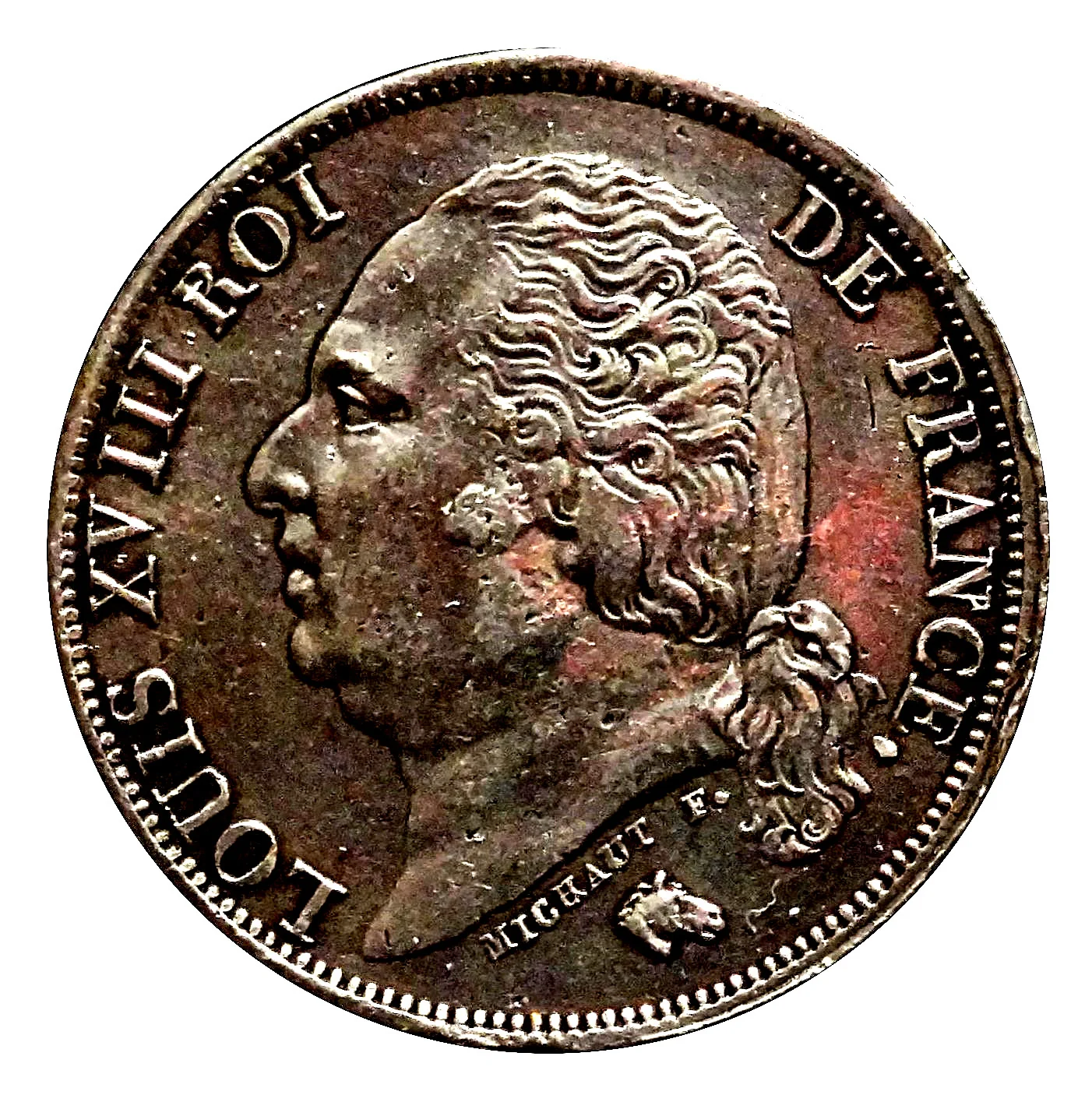
Obverse
Description:
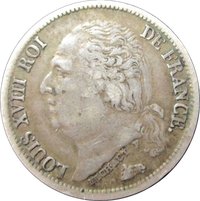
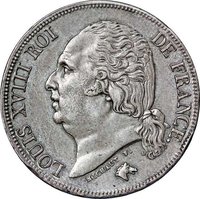
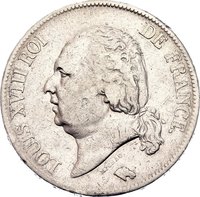
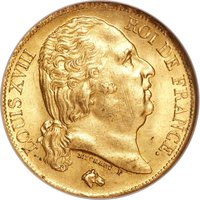
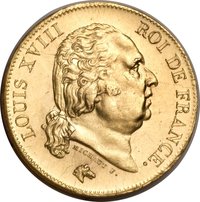
Louis XVIII facing left, ribbon in hair; below "MICHAUT. F." and Tiolier's horse head mark.
Inscription:
LOUIS XVIII ROI DE FRANCE.
Translation:
Louis XVIII King of France.
Script: Latin
Language: French
Engraver: Auguste-François Michaut
Reverse
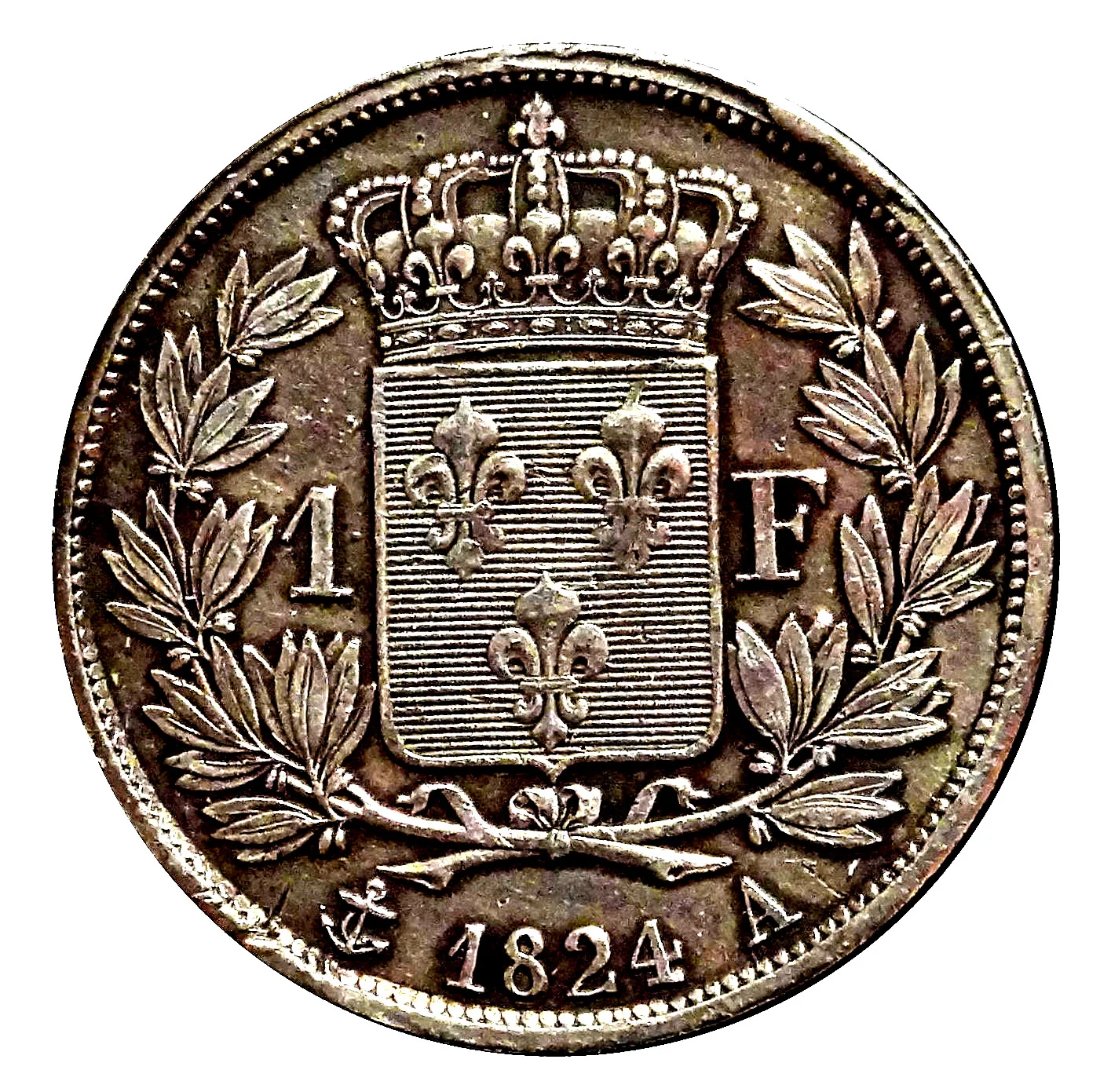
Description:
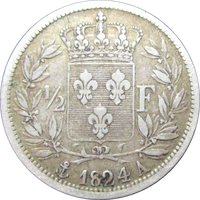
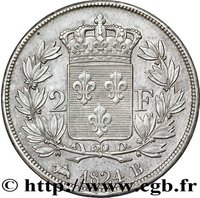
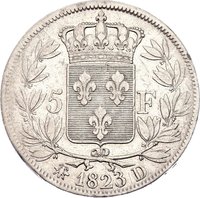
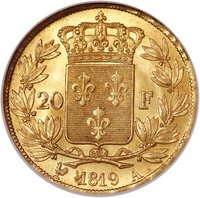
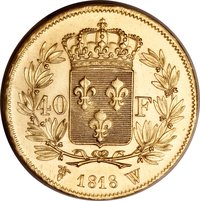
A crowned French shield within an open laurel wreath coronet; below, "1824" between a fleur-de-lis and the letter "A".
Inscription:
1 F
1824 A
1824 A
Script: Latin
Engraver: Auguste-François Michaut
Edge
Mints
| Name | Mark |
|---|---|
| Monnaie de Paris | A |
| Rouen | B |
| Lyon | D |
| La Rochelle | H |
| Limoges | I |
| Bordeaux | K |
| Bayonne | L |
| Toulouse | M |
| Marseille | MA |
| Perpignan | Q |
| Nantes | T |
| Lille | W |
Mintings
| Year | Mint Mark | Mintage | Quality | Collection |
|---|---|---|---|---|
| 1816 | I | 5,035 | ||
| 1816 | L | 5,752 | ||
| 1816 | B | 16,459 | ||
| 1816 | M | 70,394 | ||
| 1816 | Q | 25,007 | ||
| 1816 | T | 2,234 | ||
| 1816 | W | 14,750 | ||
| 1816 | A | 253,099 | ||
| 1817 | A | 178,258 | ||
| 1817 | B | 31,006 | ||
| 1817 | K | 307,166 | ||
| 1817 | L | 5,035 | ||
| 1817 | M | 20,805 | ||
| 1817 | Q | 5,039 | ||
| 1817 | W | 18,674 | ||
| 1817 | D | 5,356 | ||
| 1817 | H | 47,990 | ||
| 1818 | A | 60,233 | ||
| 1818 | B | 3,860 | ||
| 1818 | H | 8,465 | ||
| 1818 | L | 1,444 | ||
| 1818 | T | 1,722 | ||
| 1818 | W | 16,119 | ||
| 1819 | W | 23,505 | ||
| 1819 | A | 26,856 | ||
| 1819 | B | 10,166 | ||
| 1819 | H | 8,111 | ||
| 1819 | Q | 13,074 | ||
| 1819 | T | 4,082 | ||
| 1820 | K | 20,164 | ||
| 1820 | Q | 21,809 | ||
| 1820 | W | 13,478 | ||
| 1820 | A | 28,468 | ||
| 1820 | B | 15,773 | ||
| 1820 | H | 6,667 | ||
| 1821 | A | 99,834 | ||
| 1821 | H | 5,047 | ||
| 1821 | Q | 4,930 | ||
| 1821 | W | 199,751 | ||
| 1822 | A | 628,168 | ||
| 1822 | B | 30,942 | ||
| 1822 | H | 15,933 | ||
| 1822 | Q | 3,832 | ||
| 1822 | W | 60,807 | ||
| 1823 | A | 359,908 | ||
| 1823 | B | 7,571 | ||
| 1823 | D | 3,479 | ||
| 1823 | H | 13,475 | ||
| 1823 | I | 5,243 | ||
| 1823 | K | 5,161 | ||
| 1823 | L | 35,447 | ||
| 1823 | M | 35,833 | ||
| 1823 | Q | 33,387 | ||
| 1823 | W | 276,931 | ||
| 1824 | D | 29,592 | ||
| 1824 | H | 33,102 | ||
| 1824 | I | 33,411 | ||
| 1824 | K | 122,685 | ||
| 1824 | L | 53,653 | ||
| 1824 | M | 59,275 | ||
| 1824 | A | 417,198 | ||
| 1824 | B | 65,563 | ||
| 1824 | MA | 7,197 | ||
| 1824 | Q | 52,271 | ||
| 1824 | W | 387,938 |
Historical background
In 1816, France was grappling with the profound monetary instability left in the wake of the Napoleonic Wars and the Revolution. The preceding decades had seen the collapse of the ancien régime livre, the hyperinflation of the paper assignats, and the introduction of the franc germinal by Napoleon in 1803. While the franc germinal established a stable bimetallic system (defining the franc in terms of fixed weights of gold and silver), the financial demands of constant warfare led Napoleon to effectively abandon this standard. By 1816, the country's coinage was severely depleted, and a chaotic mix of old and new coins, along with depreciated paper money, crippled commerce and public finance.
Recognizing that monetary order was essential for economic recovery and political legitimacy, the restored Bourbon monarchy, under King Louis XVIII, took decisive action. The law of April 28, 1816, formally re-established the franc germinal as the sole legal tender, definitively rejecting the inflationary paper experiments of the past. This was not merely a technical reform but a symbolic return to the principles of sound money, intended to restore domestic confidence and facilitate France's re-entry into the international financial system. The law also laid the groundwork for the creation of a new central bank, which would become the Banque de France, tasked with issuing convertible banknotes to supplement metallic currency.
Thus, the currency situation in 1816 marked a pivotal moment of stabilization and restoration. The government's actions successfully ended the monetary chaos, anchoring the French economy to a reliable bimetallic standard that would endure for over half a century. This "franc de germinal" became the bedrock of French financial strength throughout the 19th century, fostering the industrial expansion and economic modernization that followed.
Recognizing that monetary order was essential for economic recovery and political legitimacy, the restored Bourbon monarchy, under King Louis XVIII, took decisive action. The law of April 28, 1816, formally re-established the franc germinal as the sole legal tender, definitively rejecting the inflationary paper experiments of the past. This was not merely a technical reform but a symbolic return to the principles of sound money, intended to restore domestic confidence and facilitate France's re-entry into the international financial system. The law also laid the groundwork for the creation of a new central bank, which would become the Banque de France, tasked with issuing convertible banknotes to supplement metallic currency.
Thus, the currency situation in 1816 marked a pivotal moment of stabilization and restoration. The government's actions successfully ended the monetary chaos, anchoring the French economy to a reliable bimetallic standard that would endure for over half a century. This "franc de germinal" became the bedrock of French financial strength throughout the 19th century, fostering the industrial expansion and economic modernization that followed.
Series: 1816 France circulation coins
🌟 Uncommon