


Obverse
Description:
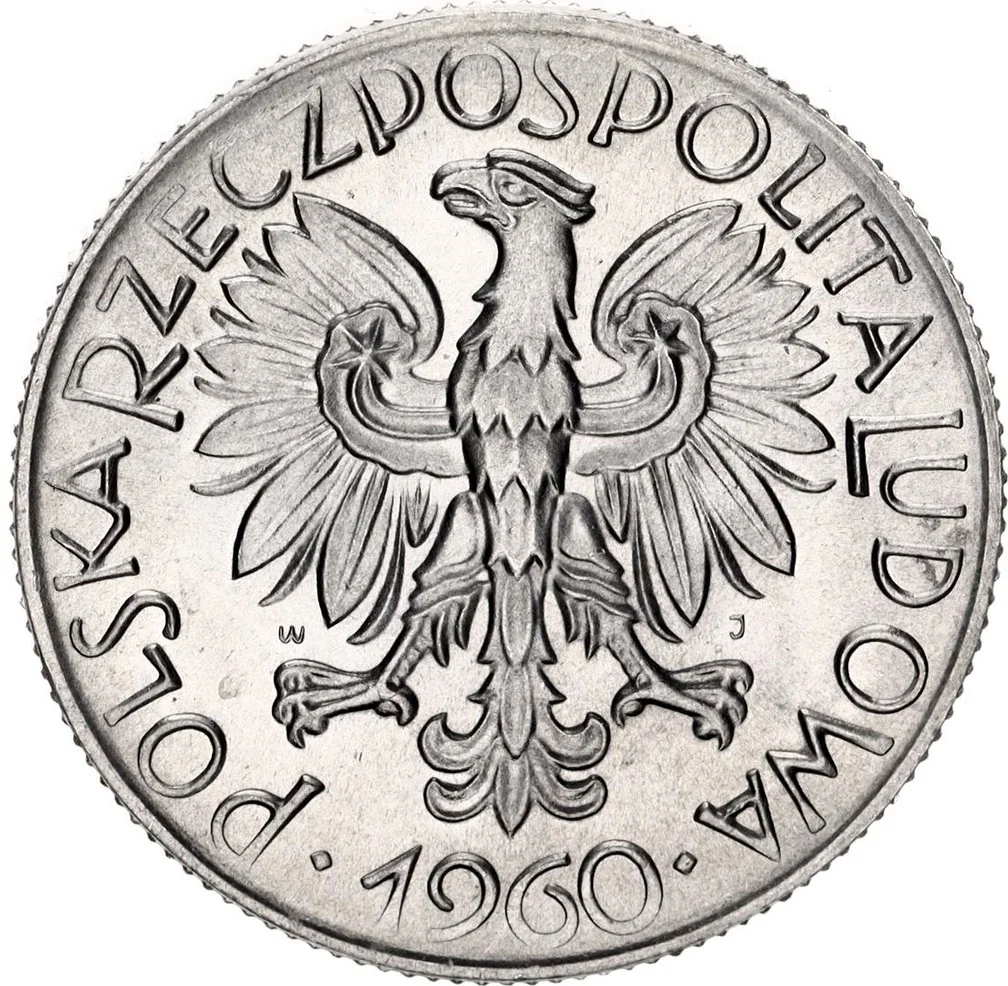
Polish coat of arms, engraver's initials flanking.
Inscription:
POLSKA RZECZPOSPOLITA LUDOWA
W J
MW
·1974·
W J
MW
·1974·
Translation:
Polish People's Republic
W J
MW
·1974·
W J
MW
·1974·
Script: Latin
Language: Polish
Engraver: Wojciech Jastrzębowski
Reverse
Description:
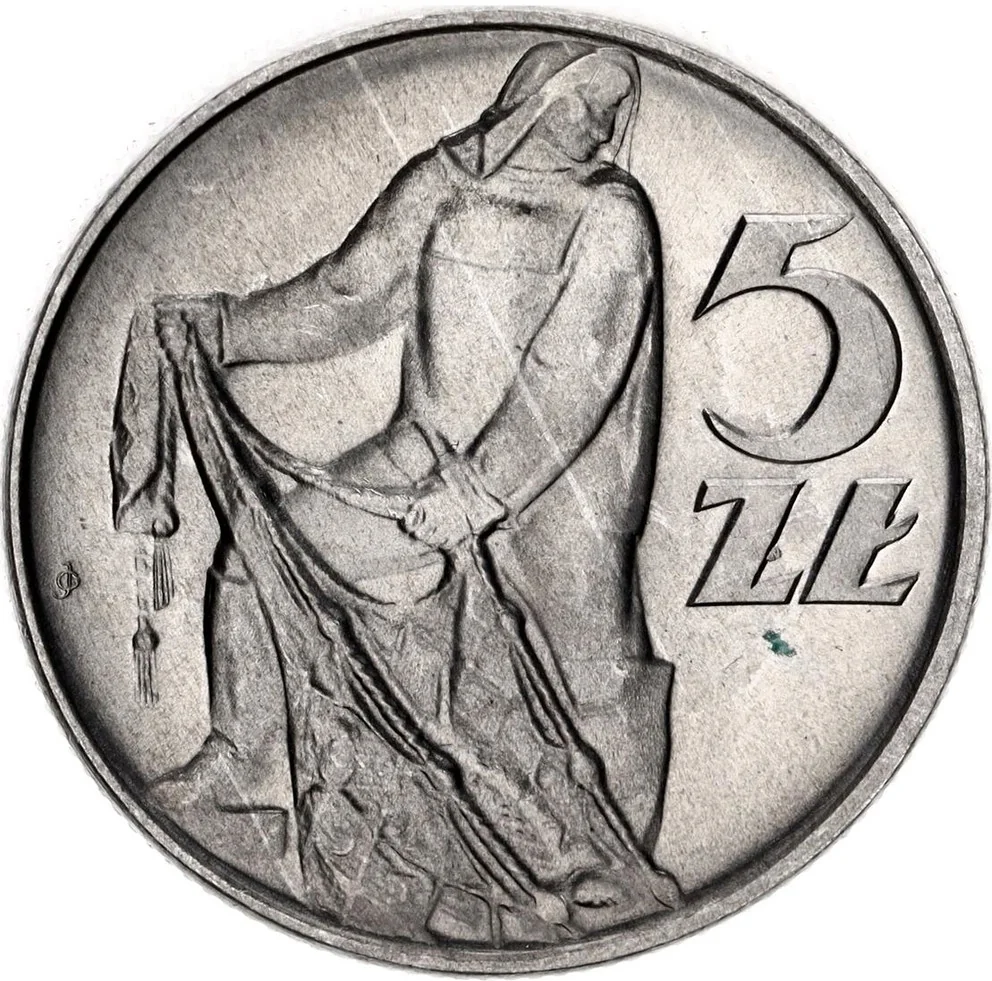
Fisherman with net. Denomination on right.
Inscription:
5
ZŁ
JG
ZŁ
JG
Translation:
5 ZŁOTYCH
Script: Latin
Language: Polish
Engraver: Józef Gosławski
Edge
Reeded
Mints
| Name | Mark |
|---|---|
| Mint of Poland | (MW) |
Mintings
| Year | Mint Mark | Mintage | Quality | Collection |
|---|---|---|---|---|
| 1958 | — | 428,000 | ||
| 1959 | — | 56,810,733 | ||
| 1960 | — | 16,300,881 | ||
| 1971 | MW | 1,000,000 | ||
| 1973 | MW | 5,000,000 | ||
| 1974 | MW | 46,000,000 |
Historical background
In 1958, Poland’s currency situation was defined by the rigid, state-controlled system of the communist era, operating within the framework of the Council for Mutual Economic Assistance (COMECON). The official currency was the złoty, but its value was set by administrative decree rather than market forces. A complex system of exchange rates existed: an official, highly overvalued rate used for statistical purposes and some state accounting, and separate, more realistic rates for foreign tourists and special transactions. For ordinary Poles, access to hard currencies like US dollars was illegal on the open market, giving rise to a pervasive black market where the złoty traded at a fraction of its official value.
Economically, the period followed the upheavals of the mid-1950s, including the Polish October of 1956, which had brought a degree of political liberalization but no fundamental reform of the centralized economy. While some market-style experiments were introduced in agriculture and small-scale trade, the monetary and financial system remained a tool of central planning. The government, led by Władysław Gomułka, maintained strict currency controls to isolate the domestic economy, prevent capital flight, and direct all foreign trade through state channels. The złoty’s artificial stability was maintained by subsidies and controls, masking underlying inflationary pressures and chronic shortages of consumer goods.
Internationally, the złoty was a non-convertible currency, meaning it could not be freely exchanged for other currencies outside the Soviet bloc. Trade with Western nations was hampered by this lack of convertibility, often requiring complex barter agreements. Within the Soviet bloc, trade was conducted through bilateral clearing agreements using the "transferable ruble," an artificial accounting unit. Thus, in 1958, Poland’s currency was not an instrument of international commerce but a mechanism of domestic control, symbolizing the isolation and inefficiencies of a command economy struggling to meet the needs of its population.
Economically, the period followed the upheavals of the mid-1950s, including the Polish October of 1956, which had brought a degree of political liberalization but no fundamental reform of the centralized economy. While some market-style experiments were introduced in agriculture and small-scale trade, the monetary and financial system remained a tool of central planning. The government, led by Władysław Gomułka, maintained strict currency controls to isolate the domestic economy, prevent capital flight, and direct all foreign trade through state channels. The złoty’s artificial stability was maintained by subsidies and controls, masking underlying inflationary pressures and chronic shortages of consumer goods.
Internationally, the złoty was a non-convertible currency, meaning it could not be freely exchanged for other currencies outside the Soviet bloc. Trade with Western nations was hampered by this lack of convertibility, often requiring complex barter agreements. Within the Soviet bloc, trade was conducted through bilateral clearing agreements using the "transferable ruble," an artificial accounting unit. Thus, in 1958, Poland’s currency was not an instrument of international commerce but a mechanism of domestic control, symbolizing the isolation and inefficiencies of a command economy struggling to meet the needs of its population.
🌱 Very Common