

10 groszys – Poland
Add to wishlist
Poland
Obverse
Description:
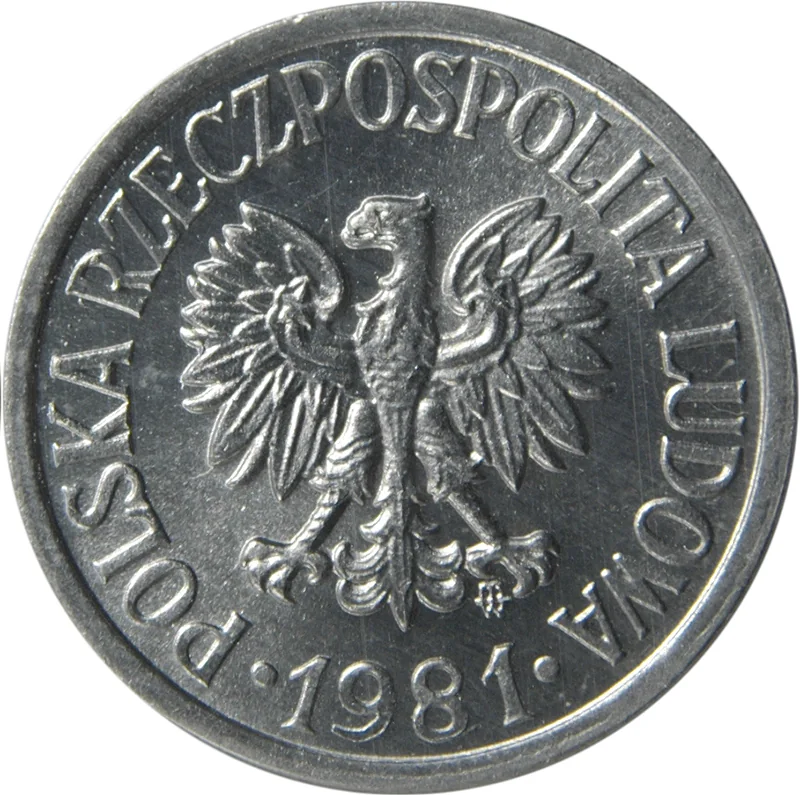
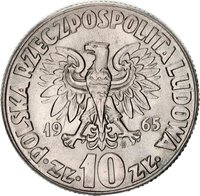
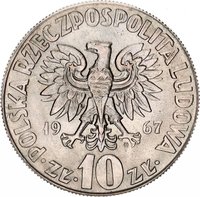
The Polish national coat of arms, the White Eagle, with the date below.
Inscription:
POLSKA RZECZPOSPOLITA LUDOWA
MW
·1981·
MW
·1981·
Translation:
Polish People's Republic
MW
·1981·
MW
·1981·
Script: Latin
Language: Polish
Engraver: Andrej Peter
Reverse
Description:
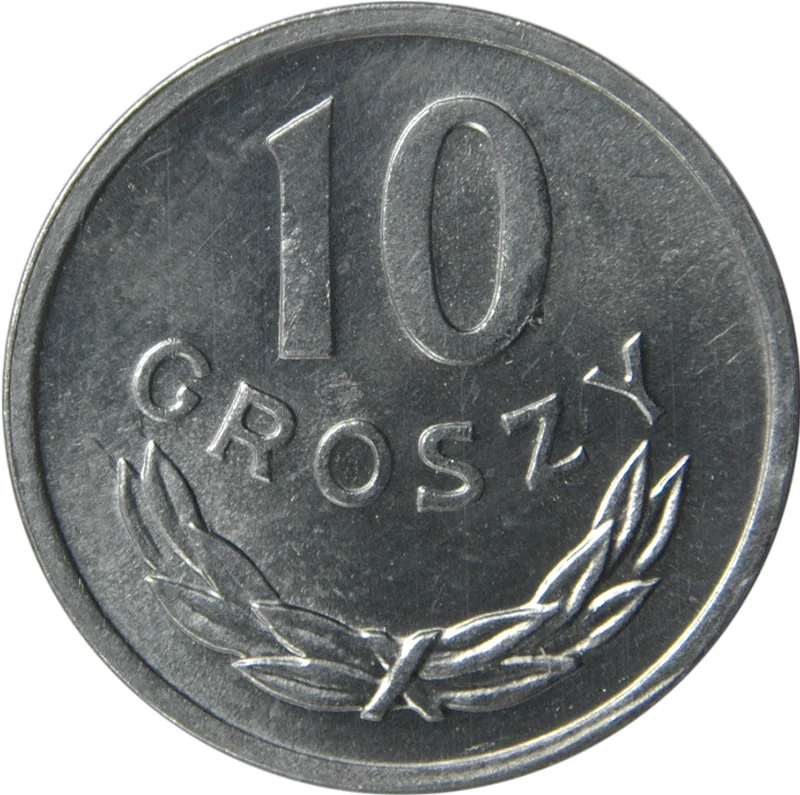
Denomination over laurel wreath.
Inscription:
10
GROSZY
GROSZY
Script: Latin
Engraver: Andrej Peter
Edge
Plain
Mints
| Name | Mark |
|---|---|
| Kremnica | — |
| Mint of Poland | — |
Mintings
| Year | Mint Mark | Mintage | Quality | Collection |
|---|---|---|---|---|
| 1961 | — | 73,400,000 | ||
| 1962 | — | 25,362,181 | ||
| 1963 | — | 40,433,538 | ||
| 1965 | MW | 50,521,000 | ||
| 1966 | MW | 70,749,000 | ||
| 1967 | MW | 62,059,000 | ||
| 1968 | MW | 62,204,000 | ||
| 1969 | MW | 71,566,000 | ||
| 1970 | MW | 38,844,000 | ||
| 1971 | MW | 50,000,000 | ||
| 1972 | MW | 60,000,000 | ||
| 1973 | MW | 80,000,000 | ||
| 1973 | — | — | ||
| 1974 | — | 50,000,000 | ||
| 1975 | MW | 50,000,000 | ||
| 1976 | MW | 100,000,000 | ||
| 1977 | MW | 100,000,000 | ||
| 1978 | MW | 71,204,000 | ||
| 1979 | MW | 5,000 | Proof | |
| 1979 | MW | 73,191,000 | ||
| 1980 | MW | 60,623,000 | ||
| 1980 | MW | 5,000 | Proof | |
| 1981 | MW | 70,000,000 | ||
| 1981 | MW | 5,000 | Proof | |
| 1983 | MW | 9,600,000 | ||
| 1985 | MW | 9,957,000 |
Historical background
In 1961, Poland's currency situation was defined by the rigid, state-controlled monetary system of the centrally planned economy. The official currency was the złoty (PLZ), which was non-convertible on international markets and whose value was administratively set by the government rather than determined by exchange mechanisms. The state maintained a complex system of multiple, artificial exchange rates for different types of transactions, creating a significant disconnect between the official rate and the currency's actual purchasing power or scarcity.
This system existed alongside a pervasive black market for foreign currency, particularly US dollars and West German marks, which operated at rates many times higher than the official ones. Access to hard currency was severely restricted for ordinary citizens, reserved primarily for the ruling elite, trusted state traders, and those receiving remittances from abroad. The złoty's primary function was as an internal accounting unit within the planned economy, facilitating the allocation of resources according to state directives rather than responding to market signals.
The year fell within a period of relative, but fragile, stability following the monetary reform of 1950, which had introduced a new złoty to replace the heavily devalued post-war currency. However, underlying economic inefficiencies, chronic shortages of consumer goods, and suppressed inflation were persistent issues. The currency regime of 1961 effectively insulated Poland from global financial flows but at the cost of economic stagnation, limited foreign trade flexibility, and the creation of a dual economy where access to hard currency became a key determinant of personal wealth and access to luxury or Western goods.
This system existed alongside a pervasive black market for foreign currency, particularly US dollars and West German marks, which operated at rates many times higher than the official ones. Access to hard currency was severely restricted for ordinary citizens, reserved primarily for the ruling elite, trusted state traders, and those receiving remittances from abroad. The złoty's primary function was as an internal accounting unit within the planned economy, facilitating the allocation of resources according to state directives rather than responding to market signals.
The year fell within a period of relative, but fragile, stability following the monetary reform of 1950, which had introduced a new złoty to replace the heavily devalued post-war currency. However, underlying economic inefficiencies, chronic shortages of consumer goods, and suppressed inflation were persistent issues. The currency regime of 1961 effectively insulated Poland from global financial flows but at the cost of economic stagnation, limited foreign trade flexibility, and the creation of a dual economy where access to hard currency became a key determinant of personal wealth and access to luxury or Western goods.
🌱 Very Common