

Obverse
Description:
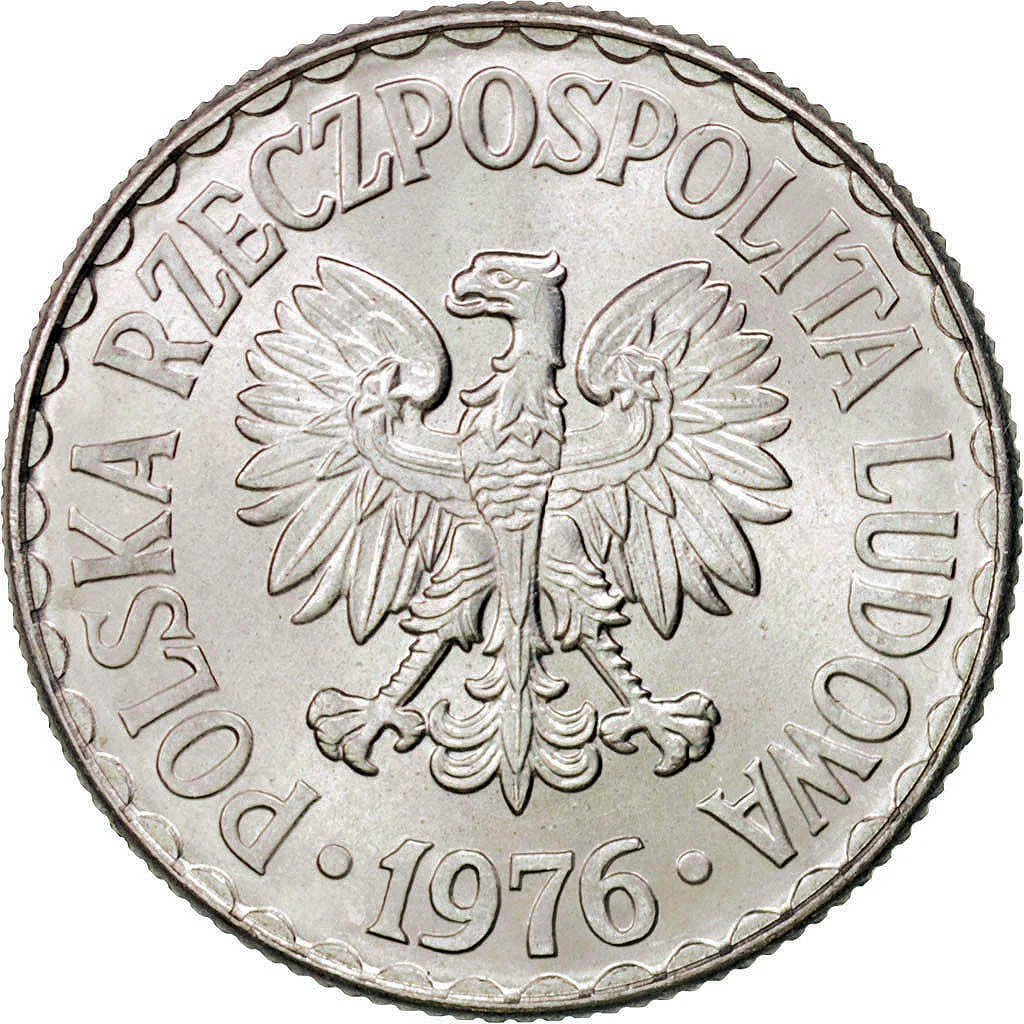
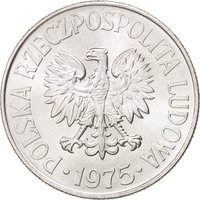
The White Eagle, Poland's national coat of arms, with mintmark if present under its right claw.
Inscription:
POLSKA RZECZPOSPOLITA LUDOWA
·1976·
·1976·
Translation:
Polish People's Republic
·1976·
·1976·
Script: Latin
Language: Polish
Engraver: Andrej Peter
Reverse
Description:
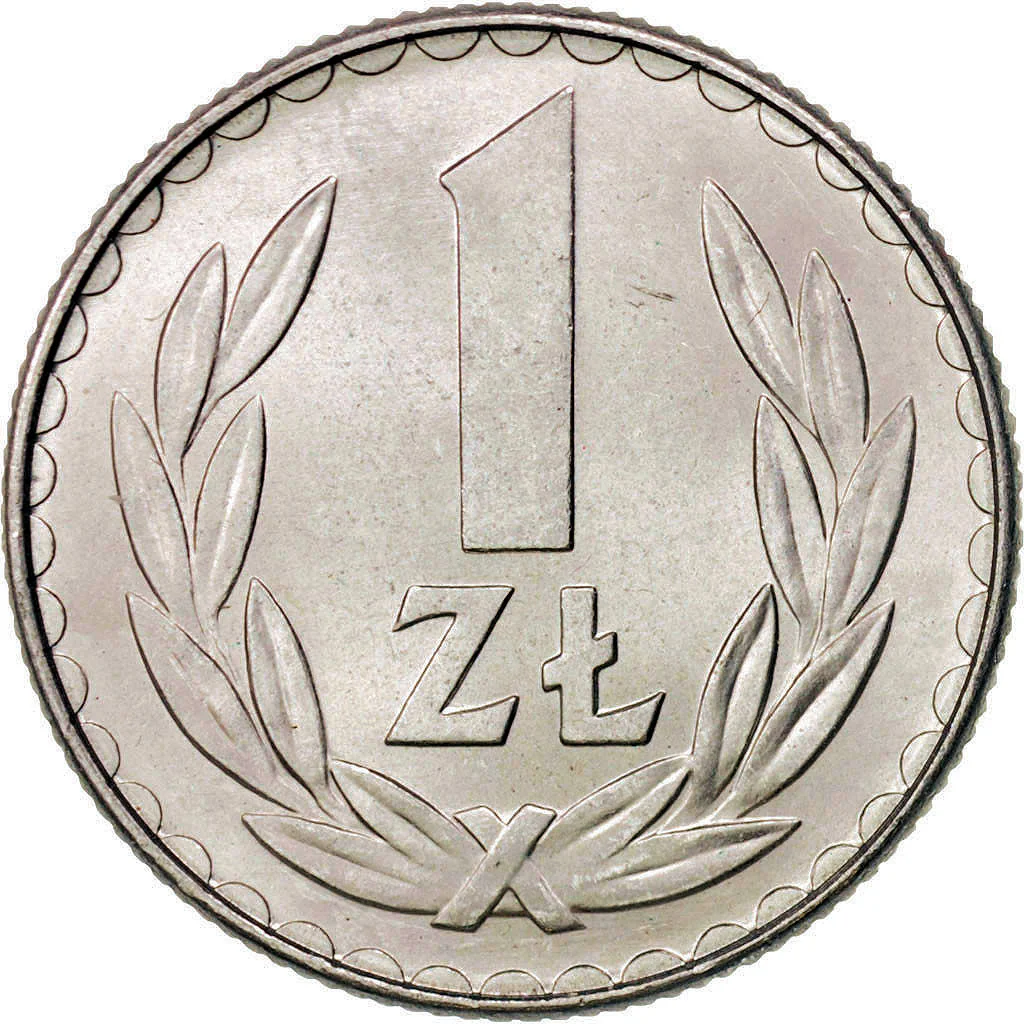
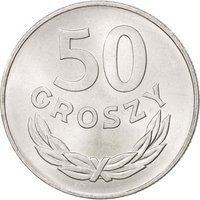
Wreath value, small rim circles.
Inscription:
1
ZŁ
ZŁ
Translation:
1 ZŁOTY
Script: Latin
Language: Polish
Engraver: Andrej Peter
Edge
Reeded
Mints
| Name | Mark |
|---|---|
| Kremnica | — |
| Mint of Poland | — |
| Mint of Poland | (MW) |
Mintings
| Year | Mint Mark | Mintage | Quality | Collection |
|---|---|---|---|---|
| 1957 | — | 58,631,470 | ||
| 1965 | MW | 15,015,000 | ||
| 1966 | MW | 18,185,000 | ||
| 1967 | MW | 1,002,000 | ||
| 1968 | MW | 1,176,000 | ||
| 1969 | MW | 3,024,000 | ||
| 1970 | MW | 6,016,000 | ||
| 1971 | MW | 6,000,000 | ||
| 1972 | MW | 7,000,000 | ||
| 1973 | MW | 15,000,000 | ||
| 1974 | MW | 42,000,000 | ||
| 1975 | MW | 33,000,000 | ||
| 1975 | — | 22,000,000 | ||
| 1976 | — | 22,000,000 | ||
| 1977 | MW | 65,000,000 | ||
| 1978 | — | 16,400,000 | ||
| 1978 | MW | 80,000,000 | ||
| 1980 | MW | 100,002,000 | ||
| 1981 | MW | 4,082,000 | ||
| 1982 | MW | 59,643,000 | ||
| 1983 | MW | 49,636,076 | ||
| 1984 | MW | 61,036,000 | ||
| 1985 | MW | 167,939,100 |
Historical background
In 1957, Poland’s currency situation was a direct legacy of the severe economic distortions and hyperinflation of the early post-war and Stalinist years. The official currency, the złoty, was fundamentally unstable and existed within a complex multi-tier system. Officially fixed at an artificial, state-mandated exchange rate, the złoty was grossly overvalued, which crippled legitimate foreign trade. Alongside this, a thriving black market for hard currencies like the US dollar operated, where the złoty traded for a fraction of its official value. This created a dual economy where access to foreign currency was a critical determinant of access to quality goods, often through special state-run stores (Pewex and Baltona) that sold imported items for dollars, bypassing the regular, shortage-plagued economy.
The situation was a pressing concern for Władysław Gomułka’s government, which had come to power in 1956 promising reforms under the banner of the "Polish October." While some de-Stalinization occurred, comprehensive monetary reform was delayed due to its immense social risk and the lack of sufficient foreign exchange reserves. The government feared that a sudden devaluation or currency redenomination without adequate goods to back it up would trigger public unrest and wipe out savings. Instead, 1957 was a year of cautious stabilization attempts within the existing flawed framework, focusing on modest price adjustments and seeking Western credits to ease the shortage of hard currency, rather than a radical overhaul of the monetary system.
Consequently, the core problems persisted throughout 1957: a vast disparity between official and black-market exchange rates, a złoty that was not convertible, and a monetary overhang from the previous period of repressed inflation. This unstable environment severely hampered meaningful economic planning and foreign investment. The fundamental currency reform needed to address these issues would not materialize until the much more dramatic changes of the 1980s and the post-communist transformation, making the 1957 situation a characteristic example of the chronic monetary weaknesses within the centrally planned economy.
The situation was a pressing concern for Władysław Gomułka’s government, which had come to power in 1956 promising reforms under the banner of the "Polish October." While some de-Stalinization occurred, comprehensive monetary reform was delayed due to its immense social risk and the lack of sufficient foreign exchange reserves. The government feared that a sudden devaluation or currency redenomination without adequate goods to back it up would trigger public unrest and wipe out savings. Instead, 1957 was a year of cautious stabilization attempts within the existing flawed framework, focusing on modest price adjustments and seeking Western credits to ease the shortage of hard currency, rather than a radical overhaul of the monetary system.
Consequently, the core problems persisted throughout 1957: a vast disparity between official and black-market exchange rates, a złoty that was not convertible, and a monetary overhang from the previous period of repressed inflation. This unstable environment severely hampered meaningful economic planning and foreign investment. The fundamental currency reform needed to address these issues would not materialize until the much more dramatic changes of the 1980s and the post-communist transformation, making the 1957 situation a characteristic example of the chronic monetary weaknesses within the centrally planned economy.
🌱 Very Common