

25 Cents – British Honduras
Belize
Context
Years: 1911–1919
Country: Belize 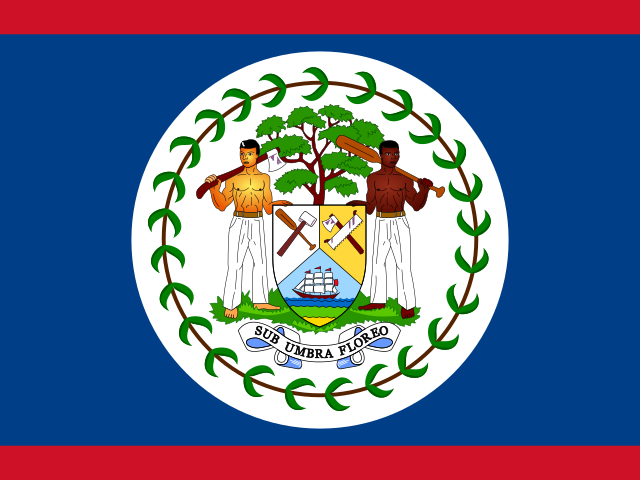
Issuer: British Honduras
Ruler: George V
Currency:
(1885—1973)
Total mintage: 54,000
Material
References
KM: #Click to copy to clipboard17
Numista: #20554
Value
Bullion value: $15.28
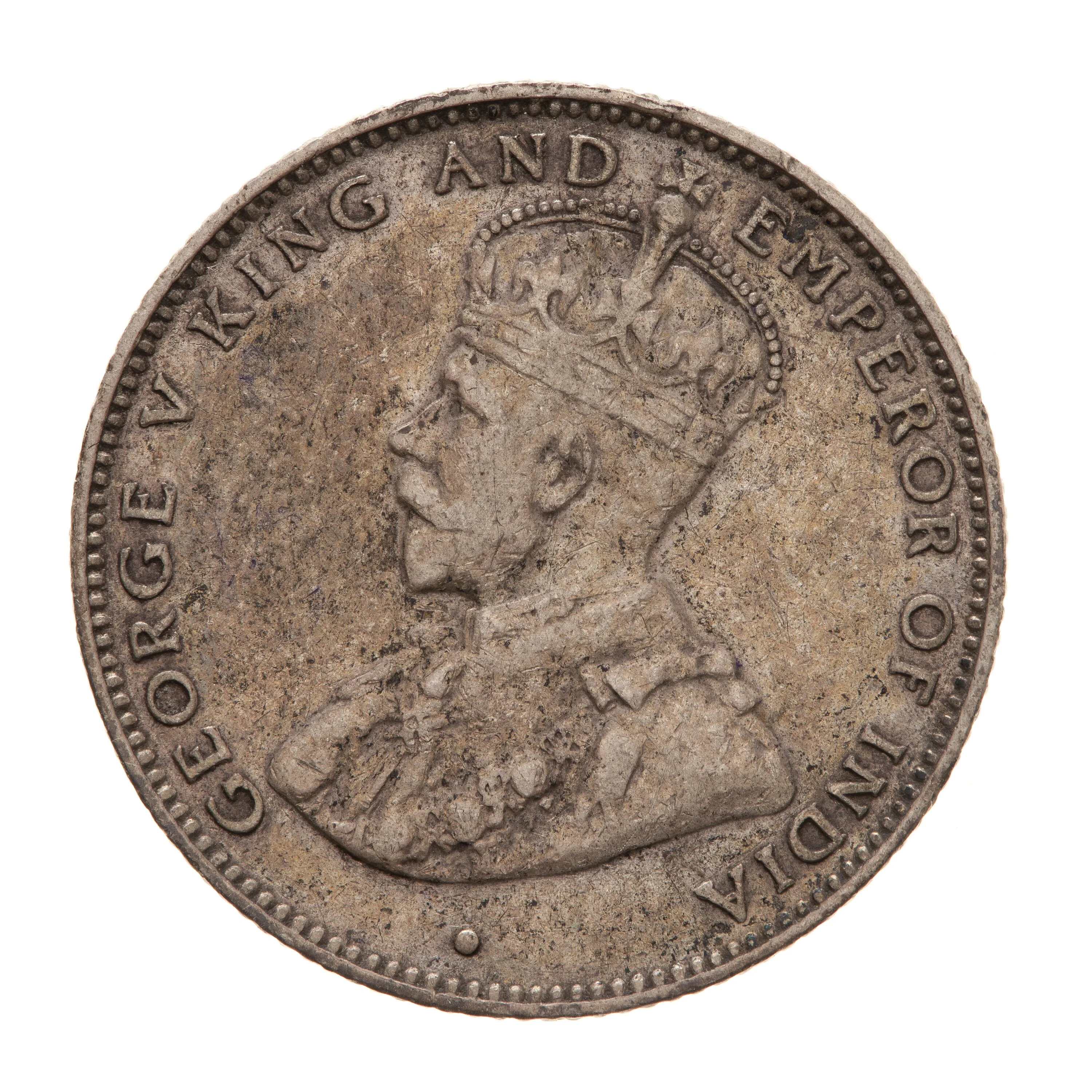
Obverse
Description:
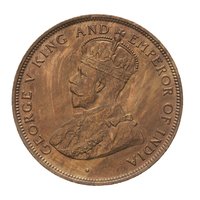
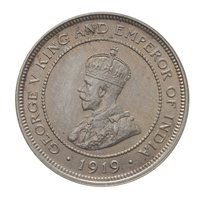
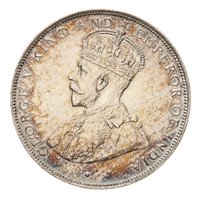
George V left-facing crowned bust.
Inscription:
· GEORGE V KING AND EMPEROR OF INDIA
B.M.
B.M.
Translation:
GEORGE V KING AND EMPEROR OF INDIA
B.M.
B.M.
Script: Latin
Language: English
Engraver: Edgar Bertram MacKennal
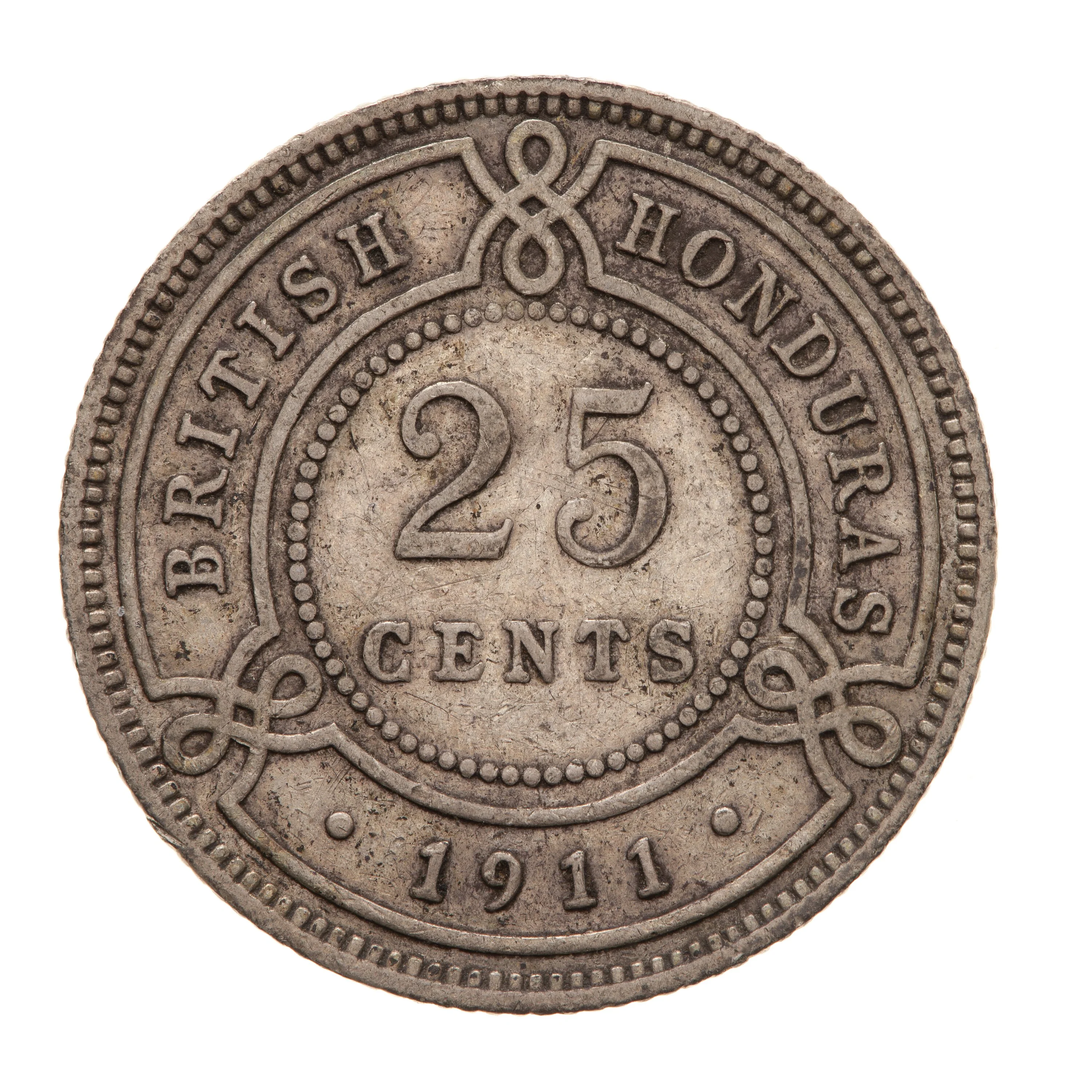
Reverse
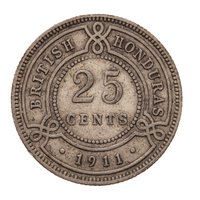
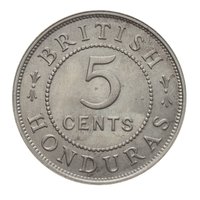
Description:
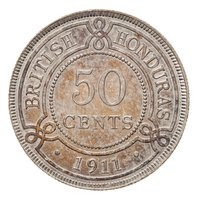
Central beaded circle, toothed rim.
Inscription:
BRITISH HONDURAS
25
CENTS
· 1911 ·
25
CENTS
· 1911 ·
Script: Latin
Edge
Reeded
Categories
| Person> Monarch |
| Mustache/Beard |
| Symbol> Crown |
Mints
| Name | Mark |
|---|---|
| Royal Mint (Tower Hill) | — |
Mintings
| Year | Mint Mark | Mintage | Quality | Collection |
|---|---|---|---|---|
| 1911 | — | 14,000 | ||
| 1919 | — | 40,000 |
Historical background
In 1911, the currency situation in British Honduras (modern-day Belize) was characterized by a complex and somewhat chaotic system of multiple, concurrently circulating currencies, all tied to external economies. The official unit of account was the British Honduran dollar, pegged at a fixed rate of 4 shillings 2 pence sterling. However, physical British Honduran banknotes and coins were scarce. The day-to-day medium of exchange was dominated by the Mexican silver peso, which circulated widely due to strong historical trade links with Mexico and the neighbouring Yucatán. Alongside these, US gold and silver dollars, and to a lesser extent British sovereigns and sterling, were also in common use for commerce and government transactions.
This multiplicity created practical challenges. The value of these foreign coins fluctuated on international markets, but within the colony, they were assigned fixed legal tender values by proclamation. Merchants and the public had to constantly navigate between different coinage systems, leading to inefficiencies and the risk of confusion or loss in exchange. The government's revenue was collected in whatever specie was tendered, complicating treasury operations. Furthermore, the reliance on the Mexican peso was a point of concern for colonial authorities, as it tied the local economy to the monetary stability of another nation.
The situation in 1911 represented the tail end of this system. Pressures for reform were building, driven by the desire for a stable, unified currency controlled by the colony. This would culminate just a few years later, in 1894, when the British Honduras dollar was officially placed on a sterling gold standard, and in the 1910s with the establishment of a local Board of Commissioners of Currency, which began issuing distinctive British Honduras notes and coins, gradually displacing the Mexican currency and simplifying the monetary landscape.
This multiplicity created practical challenges. The value of these foreign coins fluctuated on international markets, but within the colony, they were assigned fixed legal tender values by proclamation. Merchants and the public had to constantly navigate between different coinage systems, leading to inefficiencies and the risk of confusion or loss in exchange. The government's revenue was collected in whatever specie was tendered, complicating treasury operations. Furthermore, the reliance on the Mexican peso was a point of concern for colonial authorities, as it tied the local economy to the monetary stability of another nation.
The situation in 1911 represented the tail end of this system. Pressures for reform were building, driven by the desire for a stable, unified currency controlled by the colony. This would culminate just a few years later, in 1894, when the British Honduras dollar was officially placed on a sterling gold standard, and in the 1910s with the establishment of a local Board of Commissioners of Currency, which began issuing distinctive British Honduras notes and coins, gradually displacing the Mexican currency and simplifying the monetary landscape.
⭐ Somewhat Rare