

2 Francs – Belgium
Belgium
Context
Year: 1887
Issuer: Belgium 
Ruler: Leopold II
Currency:
(1832—2001)
Demonetization: 30 July 1932
Total mintage: 150,000
Material
References
KM: #Click to copy to clipboard31
Numista: #20448
Value
Exchange value: 2 BEF
Bullion value: $24.22
Obverse
Description:
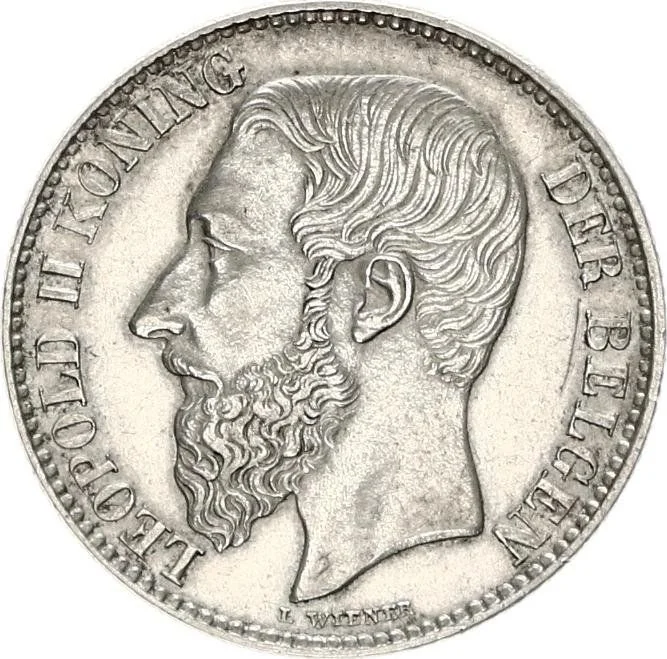
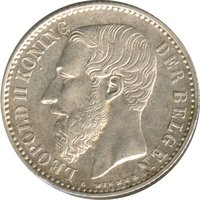
Leopold II of Belgium in left profile, Dutch motto encircling. Designer below.
Inscription:
LEOPOLD II KONING DER BELGEN
L WIENER
L WIENER
Translation:
Leopold II King of the Belgians
L Wiener
L Wiener
Script: Latin
Language: Dutch
Engraver: Léopold Wiener
Reverse
Description:
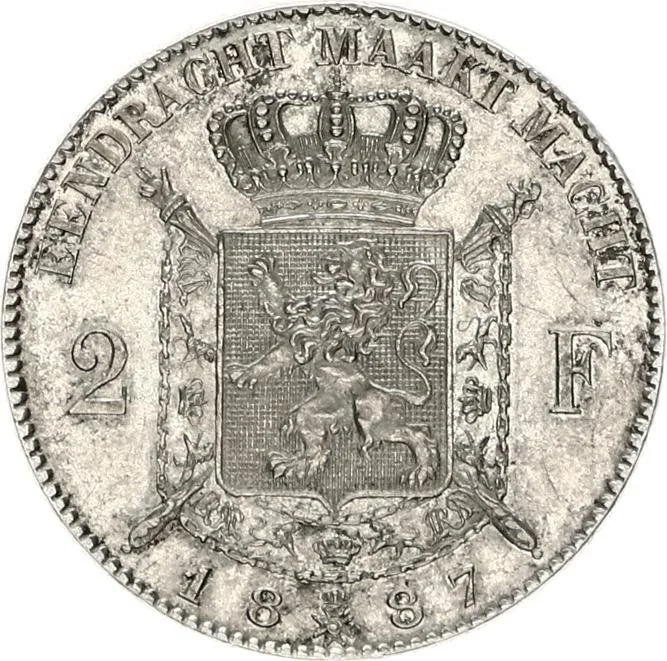
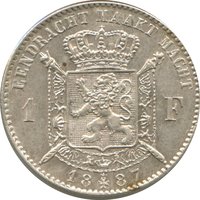
The Belgian coat of arms divides the motto (Dutch above) and the date below.
Inscription:
EENDRACHT MAAKT MACHT
2 F
1887
2 F
1887
Translation:
Unity makes strength
2 F
1887
2 F
1887
Script: Latin
Language: Dutch
Engraver: Léopold Wiener
Edge
Reeded
Categories
| Symbol> Crown |
| Symbols> Coat of Arms |
Mints
| Name | Mark |
|---|---|
| Royal Mint of Belgium | — |
Mintings
| Year | Mint Mark | Mintage | Quality | Collection |
|---|---|---|---|---|
| 1887 | — | 150,000 |
Historical background
In 1887, Belgium was operating under the Latin Monetary Union (LMU), a system it had helped found in 1865. This agreement standardized coinage between several European nations (Belgium, France, Italy, and Switzerland, with others joining later), allowing gold and silver coins from any member country to circulate freely across borders. The Belgian franc was pegged to the French franc and backed by a bimetallic standard, meaning its value was legally defined in terms of both gold and silver at a fixed ratio. This system aimed to facilitate trade and stabilize currencies, but by 1887 it was under significant strain.
The core problem was that the fixed mint ratio between gold and silver did not match their fluctuating market values. A global surge in silver production, particularly from new mines in the Americas, was causing the metal's market price to fall. This created an arbitrage opportunity: people could sell silver for gold on the open market and then mint it into LMU coins at the more favourable official rate, leading to a flood of silver coinage and a drain of gold from national treasuries. Belgium, as a small, trade-dependent economy, was highly vulnerable to these speculative flows, which threatened its gold reserves and the stability of its currency.
Consequently, by 1887, Belgium, following France's lead, had moved to a "limping gold standard" in practice. It limited the free minting of silver, effectively putting the nation on a gold standard while allowing existing silver coins to remain in circulation as subsidiary currency. This period was one of transition and uncertainty, marked by debates about the sustainability of the LMU and the need for monetary reform. The situation highlighted Belgium's deep economic interdependence with its neighbours and the challenges of maintaining a multinational monetary system in the face of asymmetric economic shocks.
The core problem was that the fixed mint ratio between gold and silver did not match their fluctuating market values. A global surge in silver production, particularly from new mines in the Americas, was causing the metal's market price to fall. This created an arbitrage opportunity: people could sell silver for gold on the open market and then mint it into LMU coins at the more favourable official rate, leading to a flood of silver coinage and a drain of gold from national treasuries. Belgium, as a small, trade-dependent economy, was highly vulnerable to these speculative flows, which threatened its gold reserves and the stability of its currency.
Consequently, by 1887, Belgium, following France's lead, had moved to a "limping gold standard" in practice. It limited the free minting of silver, effectively putting the nation on a gold standard while allowing existing silver coins to remain in circulation as subsidiary currency. This period was one of transition and uncertainty, marked by debates about the sustainability of the LMU and the need for monetary reform. The situation highlighted Belgium's deep economic interdependence with its neighbours and the challenges of maintaining a multinational monetary system in the face of asymmetric economic shocks.
🌟 Limited