

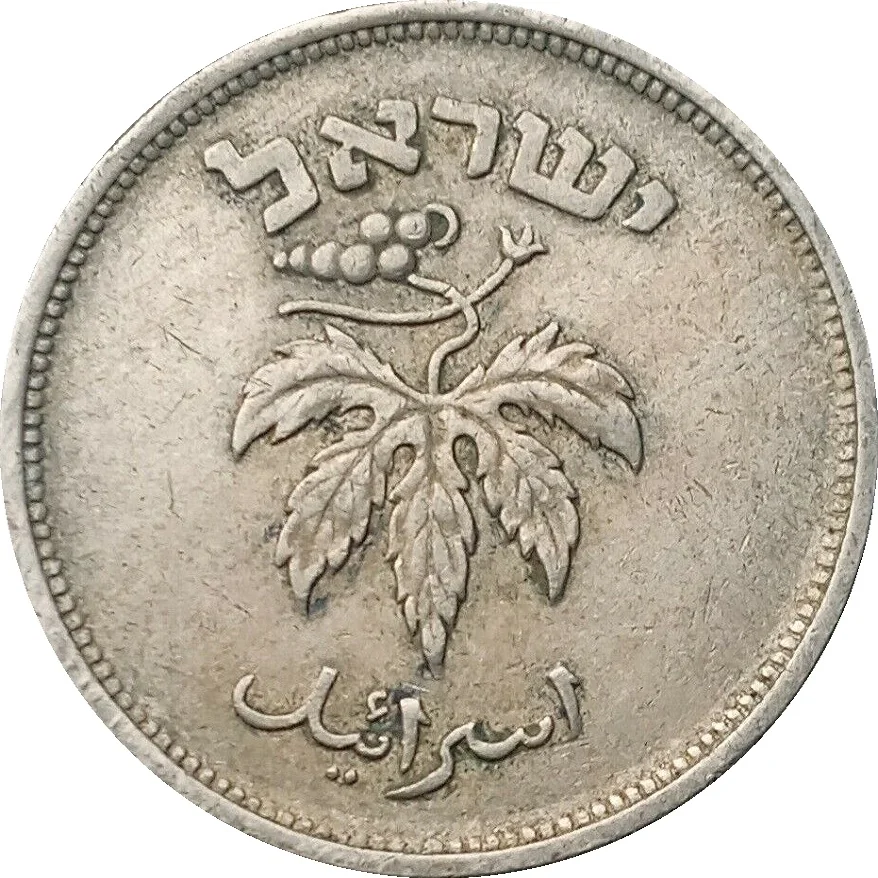
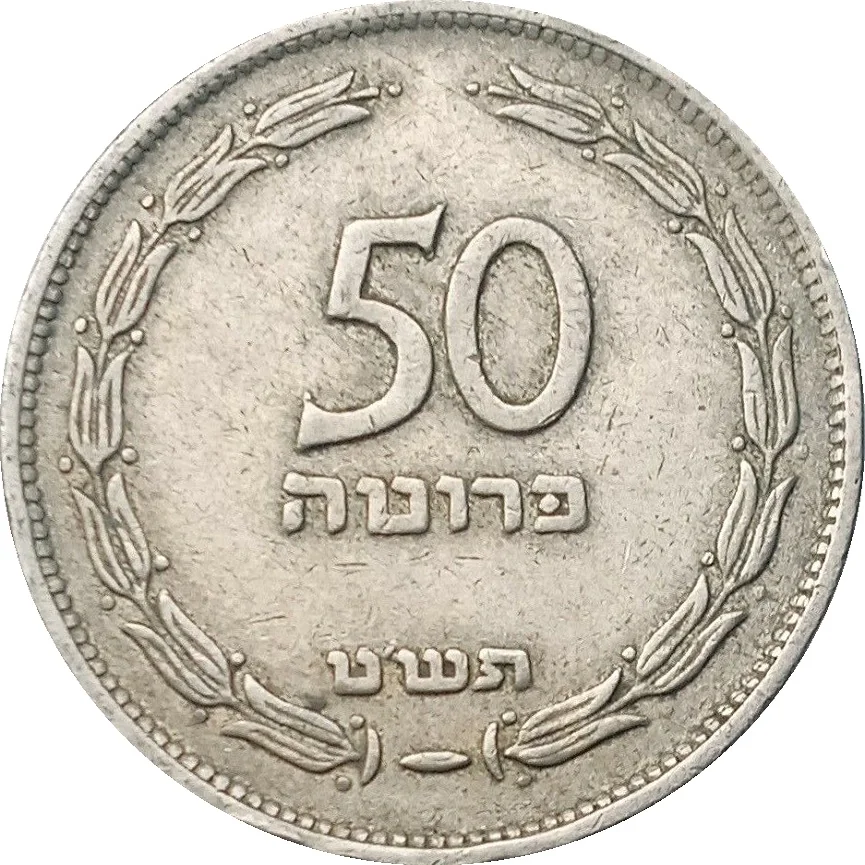
50 Prutas – Israel
Israel
Context
Years: 1949–1954
Issuer: Israel 
Period:
(since 1948)
Currency:
(1949—1960)
Demonetization: 22 February 1980
Total mintage: 6,290,000
Material
References
KM: #Click to copy to clipboard13.1
Numista: #2033
Value
Exchange value: 0.050 ILP
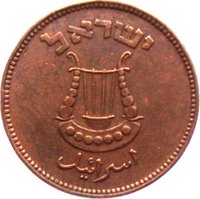
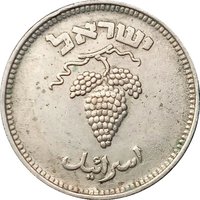
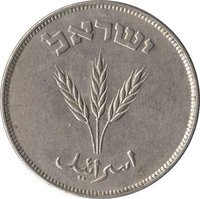
Obverse
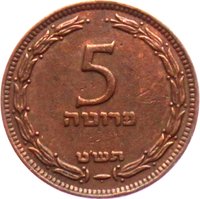
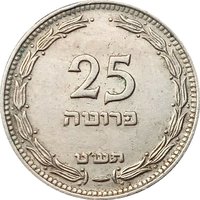
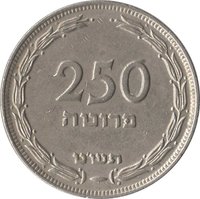
Reverse
Edge
Reeded edge: KM# 13.1Smooth edge: KM#: 13.2
Mints
| Name | Mark |
|---|---|
| Government Printer - Israel Mint | — |
| Heaton and Sons / The Mint Birmingham | — |
| Kings Norton Metal Company | • |
Mintings
| Year | Mint Mark | Mintage | Quality | Collection |
|---|---|---|---|---|
| 1949 | — | 20,000 | Proof | |
| 1949 | — | 6,020,000 | ||
| 1954 | — | 250,000 |
Historical background
In 1949, the newly established State of Israel faced a complex and precarious currency situation. Upon independence in May 1948, the country operated with a dual-currency system: the British Palestine Pound (PP), issued by the Anglo-Palestine Bank (which would soon become Bank Leumi), and a parallel Palestinian Pound issued by the British Mandate authorities. This arrangement was unstable, reflecting the transitional nature of the state's early economy, which was strained by the costs of the War of Independence and the absorption of massive immigration.
Recognizing the need for monetary sovereignty, the Israeli government passed the "Currency Law" on August 16, 1948, which introduced the Israeli Pound (Lira Yisraelit) as the official currency. However, the transition was gradual. For over a year, the old Palestine Pound and the new Israeli Pound circulated side-by-side at par (1:1), both pegged to the British Pound Sterling. This period of overlap lasted until 1949, effectively making the Israeli Pound a direct successor, rebranded to assert national identity but not yet representing a fully independent monetary policy.
The economic backdrop of 1949 was one of severe austerity. The government, led by Prime Minister David Ben-Gurion, was forced to implement strict rationing and price controls to manage dire shortages of food and consumer goods. While the currency reform was a necessary step toward economic independence, the Israeli Pound remained fragile. Its value was artificially maintained, and the pressures of reconstruction, defense spending, and population growth would soon lead to significant devaluation, setting the stage for the ongoing economic challenges of the 1950s.
Recognizing the need for monetary sovereignty, the Israeli government passed the "Currency Law" on August 16, 1948, which introduced the Israeli Pound (Lira Yisraelit) as the official currency. However, the transition was gradual. For over a year, the old Palestine Pound and the new Israeli Pound circulated side-by-side at par (1:1), both pegged to the British Pound Sterling. This period of overlap lasted until 1949, effectively making the Israeli Pound a direct successor, rebranded to assert national identity but not yet representing a fully independent monetary policy.
The economic backdrop of 1949 was one of severe austerity. The government, led by Prime Minister David Ben-Gurion, was forced to implement strict rationing and price controls to manage dire shortages of food and consumer goods. While the currency reform was a necessary step toward economic independence, the Israeli Pound remained fragile. Its value was artificially maintained, and the pressures of reconstruction, defense spending, and population growth would soon lead to significant devaluation, setting the stage for the ongoing economic challenges of the 1950s.
Series: 1949 Israel circulation coins
🌱 Very Common