

1 Paisa – Nepal
Nepal
Context
Years: 1902–1911
Issuer: Nepal 
Ruler: Prithvi Bir Bikram Shah
Currency:
(1546—1932)
Demonetized: Yes
Material
References
KM: #Click to copy to clipboard629
Numista: #20296
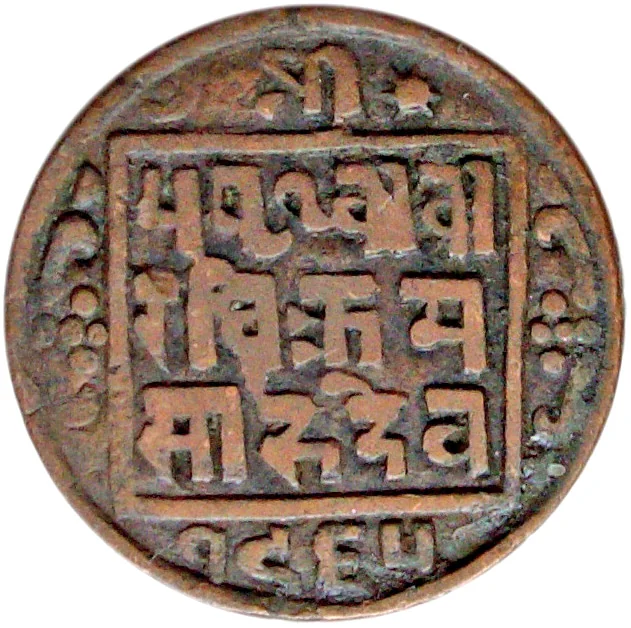
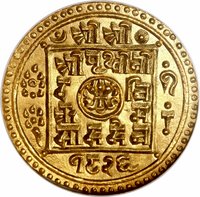
Obverse
Description:
Top: Crescent, श्री, Sun within square (King: Prithvi Vir Vikram Shah Dev). Year numerals below square.
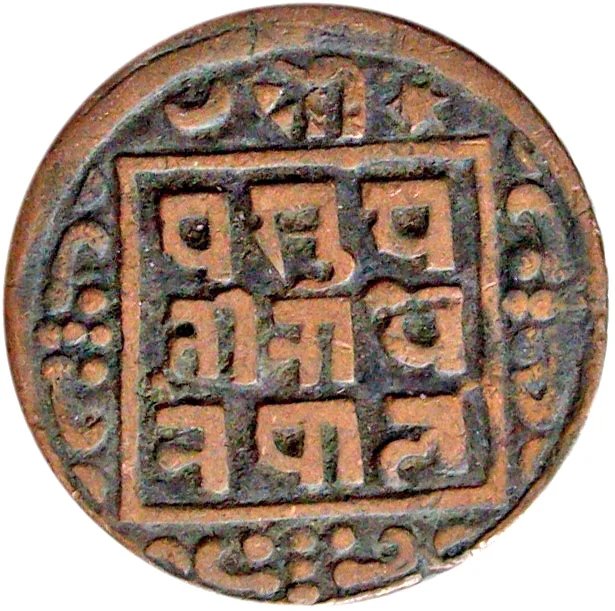
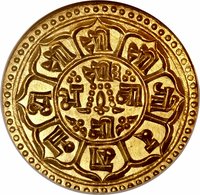
Reverse
Description:
Crescent, sun, and "श्री" within square (Pasupatinath, Nepal).
Inscription:
श्री
प सु प
ती ना थ
ने पा ल
प सु प
ती ना थ
ने पा ल
Translation:
Shri
Pa Su Pa
Ti Na Tha
Ne Pa La
Pa Su Pa
Ti Na Tha
Ne Pa La
Language: Sanskrit
Edge
Plain
Mintings
| Year | Mint Mark | Mintage | Quality | Collection |
|---|---|---|---|---|
| 1902 | — | — | ||
| 1903 | — | — | ||
| 1905 | — | — | ||
| 1906 | — | — | ||
| 1907 | — | — | ||
| 1908 | — | — | ||
| 1909 | — | — | ||
| 1910 | — | — | ||
| 1911 | — | — |
Historical background
In 1902, Nepal’s currency system was a complex and dualistic structure, firmly under the control of the autocratic Rana dynasty. The country operated on a bimetallic standard, but one that was uniquely segregated. The official state currency, used for government transactions and external trade, was the silver Mohar and its subdivisions. However, alongside this, a system of copper coins (Dams and Paisa) circulated widely for everyday local trade. The critical feature was that these two systems had no fixed legal exchange rate between them, leading to fluctuating and often exploitative conversion practices by money-changers (Sarrafs), which created significant inconvenience and uncertainty in the domestic economy.
This period also saw Nepal's monetary policy deeply influenced by its economic relationship with British India. The Nepalese Rupee (the term for the larger silver unit) was deliberately kept on a par with the Indian Rupee to facilitate cross-border trade, which was vital for the landlocked kingdom. A substantial portion of state revenue came from the pensions of Nepalese Gurkha soldiers serving in the British Indian Army, paid in Indian currency. This influx necessitated a stable exchange, but it also made Nepal's economy peripherally dependent on British India's monetary stability and policies.
Internally, the currency situation reflected the Rana regime's isolationist and conservative governance. While neighboring countries were modernizing their minting techniques, Nepal's coins were still struck using traditional hammer methods at the mint in Kathmandu. There was no central bank; the treasury (Gol Khana) managed coinage primarily for state revenue rather than economic development. Consequently, in 1902, Nepal's currency system was not a tool for national economic integration but rather a mechanism of control, characterized by internal complexity, external dependency, and technological stagnation, mirroring the broader political climate of the era.
This period also saw Nepal's monetary policy deeply influenced by its economic relationship with British India. The Nepalese Rupee (the term for the larger silver unit) was deliberately kept on a par with the Indian Rupee to facilitate cross-border trade, which was vital for the landlocked kingdom. A substantial portion of state revenue came from the pensions of Nepalese Gurkha soldiers serving in the British Indian Army, paid in Indian currency. This influx necessitated a stable exchange, but it also made Nepal's economy peripherally dependent on British India's monetary stability and policies.
Internally, the currency situation reflected the Rana regime's isolationist and conservative governance. While neighboring countries were modernizing their minting techniques, Nepal's coins were still struck using traditional hammer methods at the mint in Kathmandu. There was no central bank; the treasury (Gol Khana) managed coinage primarily for state revenue rather than economic development. Consequently, in 1902, Nepal's currency system was not a tool for national economic integration but rather a mechanism of control, characterized by internal complexity, external dependency, and technological stagnation, mirroring the broader political climate of the era.

🌱 Fairly Common