

20 centavos – Colombia
Add to wishlist
Colombia
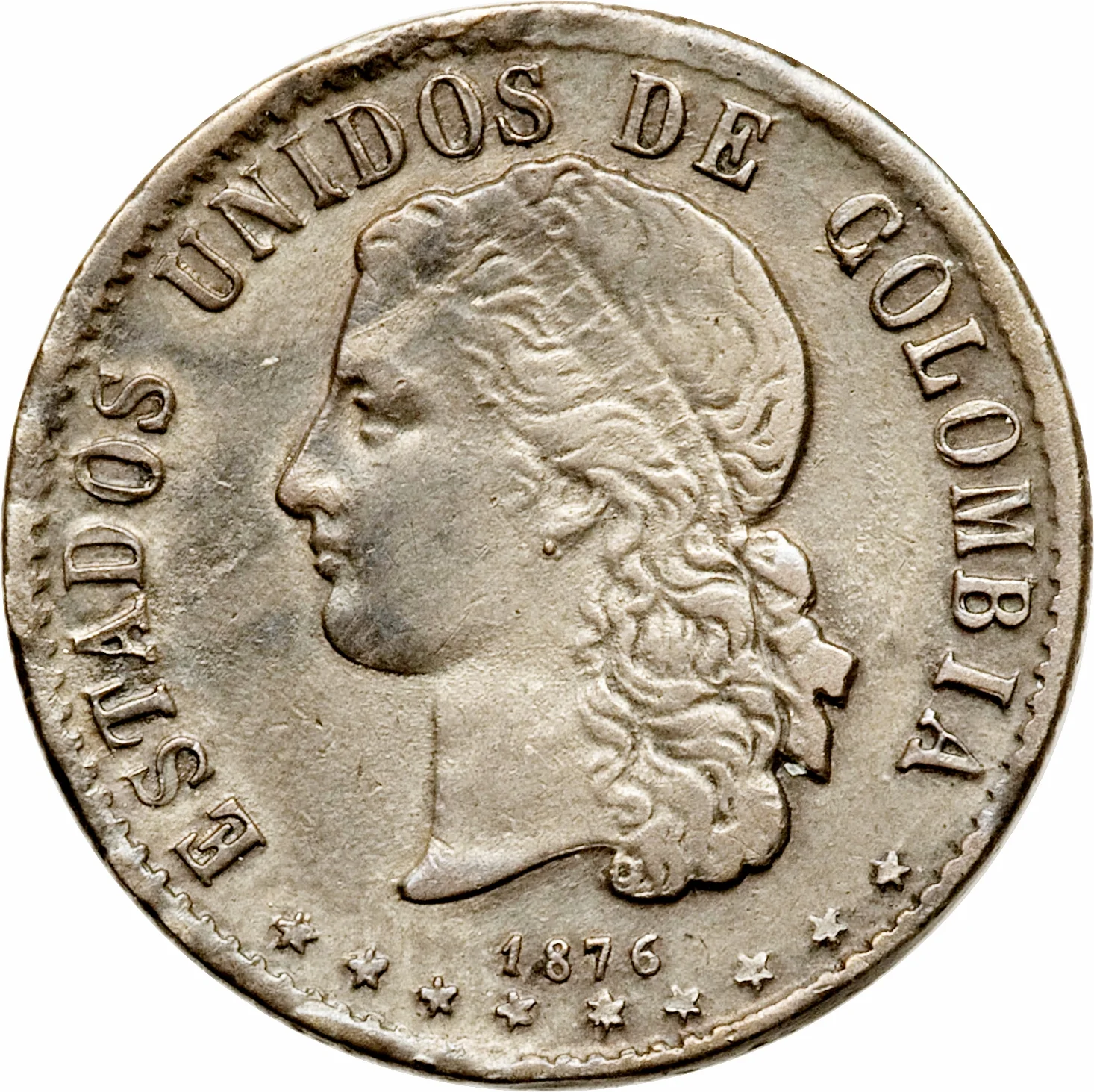
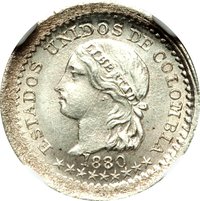
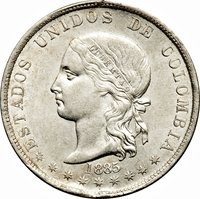
Obverse
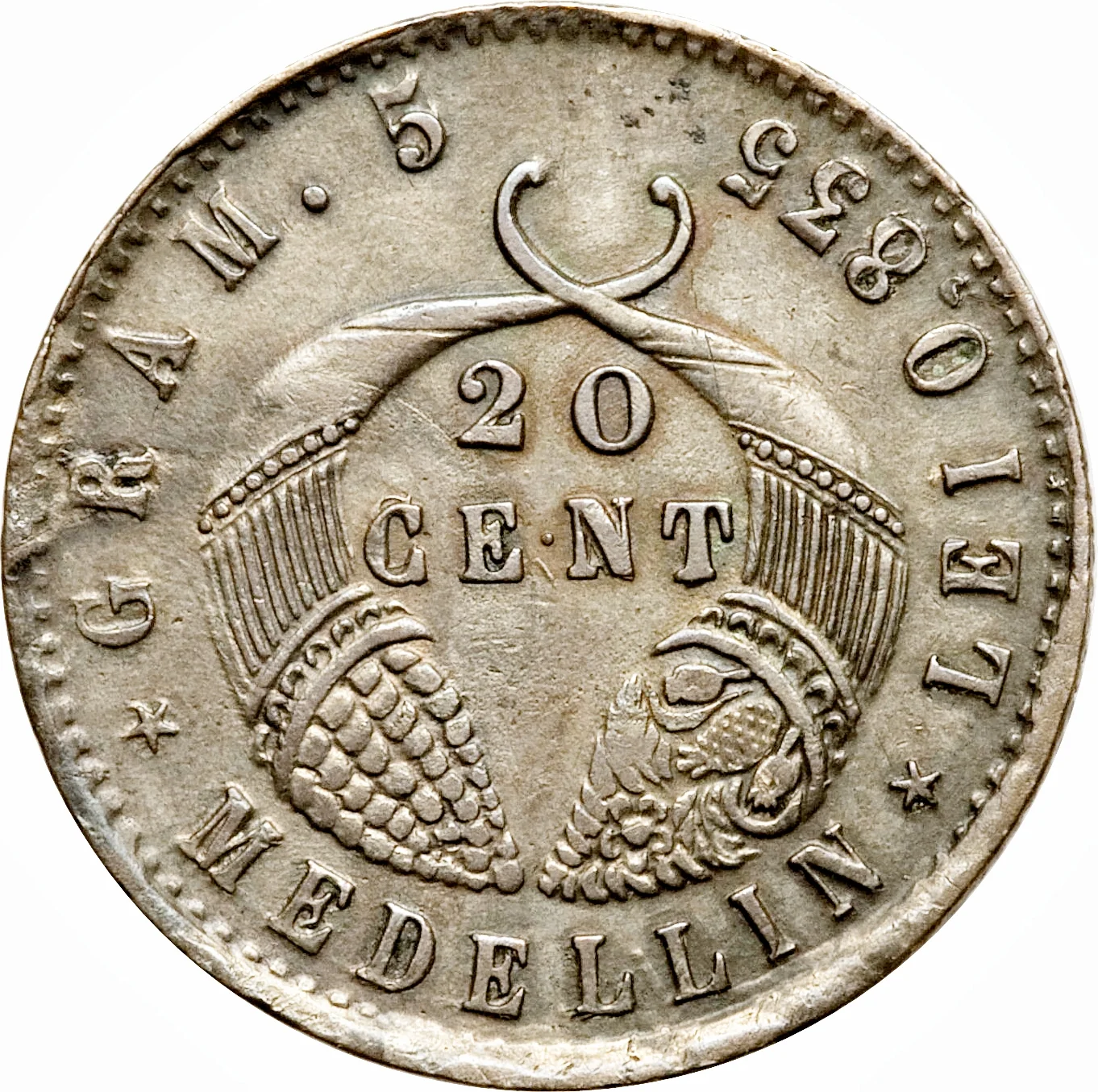
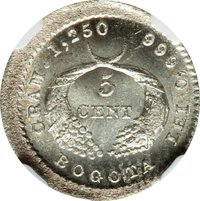
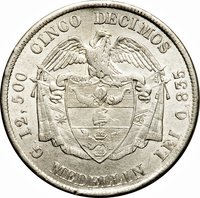
Reverse
Description:
Value centered between two stylized cornucopias.
Inscription:
GRAMOS 5
20
CENT
MEDELLIN LEI 0.835
20
CENT
MEDELLIN LEI 0.835
Script: Latin
Edge
Mintings
| Year | Mint Mark | Mintage | Quality | Collection |
|---|---|---|---|---|
| 1875 | — | — | ||
| 1876 | — | — | ||
| 1877 | — | — | ||
| 1882 | — | — | ||
| 1884 | — | — | ||
| 1885 | — | — |
Historical background
In 1875, Colombia was navigating a complex and fragmented monetary landscape as a young republic, still grappling with the economic and administrative legacies of its colonial past and mid-century political instability. The country operated without a unified national currency; instead, a heterogeneous mix of coins circulated. These included silver and gold coins minted in the colonial era, foreign coins (particularly from Peru, Bolivia, and France), and a limited supply of coins issued by the nascent federal government. This lack of standardization created significant challenges for commerce, as the value of coins depended not only on their metallic content but also on their origin and wear, leading to confusion and inefficiency in daily transactions.
The monetary system was fundamentally bimetallic, based on both gold and silver, but without a fixed legal ratio between the two metals that aligned with their market values. This often led to the disappearance of one metal from circulation (Gresham's Law), as individuals would hoard or export the undervalued coinage. Furthermore, the government faced chronic fiscal deficits and had limited capacity to mint sufficient coinage to meet the economy's needs, leading to a scarcity of small-denomination currency that hampered retail trade. The banking system was in its infancy, and paper money, while issued by some private banks, was not yet a trusted or widespread medium of exchange, especially outside major commercial centers like Bogotá or Medellín.
This chaotic currency situation reflected the broader struggles of state-building in the United States of Colombia (1863-1886), a highly decentralized federal system where monetary authority was not yet firmly consolidated. The disparate coinage acted as a brake on economic integration and national market formation. Consequently, the 1870s set the stage for future monetary reforms, which would culminate in the subsequent decades with the establishment of the Banco Nacional (1880), the formal adoption of the gold standard (1907), and the eventual creation of a single, managed national currency under a stronger central state.
The monetary system was fundamentally bimetallic, based on both gold and silver, but without a fixed legal ratio between the two metals that aligned with their market values. This often led to the disappearance of one metal from circulation (Gresham's Law), as individuals would hoard or export the undervalued coinage. Furthermore, the government faced chronic fiscal deficits and had limited capacity to mint sufficient coinage to meet the economy's needs, leading to a scarcity of small-denomination currency that hampered retail trade. The banking system was in its infancy, and paper money, while issued by some private banks, was not yet a trusted or widespread medium of exchange, especially outside major commercial centers like Bogotá or Medellín.
This chaotic currency situation reflected the broader struggles of state-building in the United States of Colombia (1863-1886), a highly decentralized federal system where monetary authority was not yet firmly consolidated. The disparate coinage acted as a brake on economic integration and national market formation. Consequently, the 1870s set the stage for future monetary reforms, which would culminate in the subsequent decades with the establishment of the Banco Nacional (1880), the formal adoption of the gold standard (1907), and the eventual creation of a single, managed national currency under a stronger central state.
⭐ Rare