

20 forint – Hungary
Add to wishlist
Hungary
Context
Years: 1982–1989
Issuer: Hungary
Period:
(1949—1989)
Currency:
(since 1946)
Demonetization: 30 June 1995
Total mintage: 120,498,000
Material
Diameter: 26.8 mm
Weight: 7.05 g
Thickness: 1.75 mm
Shape: Round
Composition: Copper-nickel
Technique: Milled
Alignment: Medal alignment
flip
References
KM: #
Numista: #1995
Value
Exchange value: 20 HUF
Inflation-adjusted value: 1085.93 HUF
Obverse
Description:
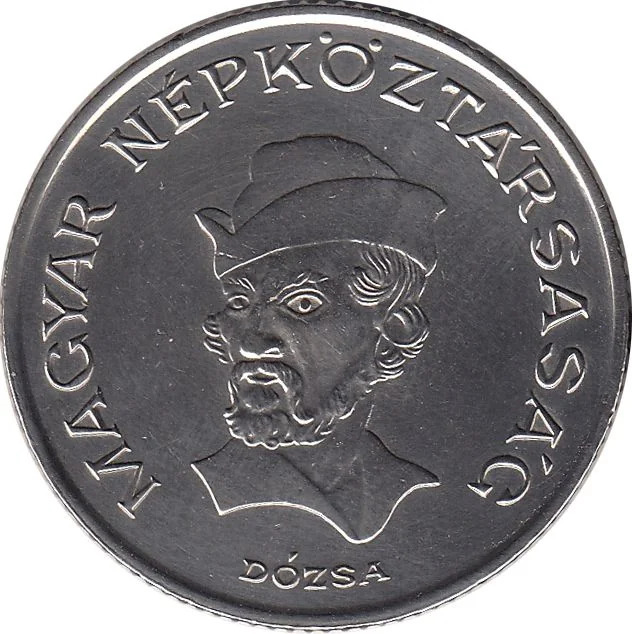
Dózsa's head in hat, facing left.
Inscription:
MAGYAR NÉPKÖZTÁRSASÁG
DÓZSA
DÓZSA
Translation:
Hungarian People's Republic
Dózsa
Dózsa
Script: Latin
Language: Hungarian
Engraver: György Bognár
Reverse
Description:
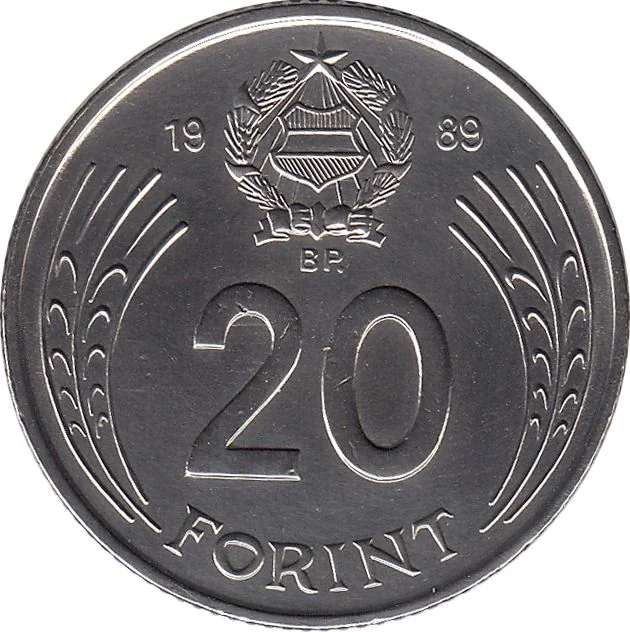
Denomination centered, encircled by a wreath below the socialist coat of arms, splits the date.
Inscription:
19 84
BP.
20
FORINT
BP.
20
FORINT
Script: Latin
Engraver: György Bognár
Edge
Milled
Categories
| Mustache/Beard |
| Symbols> Coat of Arms |
| Person> Politician |
| Object> Hat |
| Symbol> Wreath |
Mints
| Name | Mark |
|---|---|
| Hungarian mint | BP. |
Mintings
Historical background
By 1982, Hungary's currency situation was a critical symptom of its deepening economic crisis within the Eastern Bloc. The country was burdened by a massive hard currency debt, estimated at nearly $9 billion, owed primarily to Western creditors. This debt stemmed from the 1970s strategy of borrowing heavily to finance imports of Western technology and consumer goods, intended to modernize industry and maintain living standards without implementing meaningful market reforms. The plan failed as global recession and rising interest rates made debt servicing crippling, consuming a large portion of the country's hard currency earnings from exports.
Internally, the Hungarian Forint (HUF) existed in a complex multi-tiered system. The official, government-set exchange rate was artificially strong and bore little relation to economic reality, used mainly for accounting purposes. Alongside this, a series of non-convertible "tourist" and "commercial" rates created a fragmented currency landscape. Most tellingly, a thriving black market for foreign currency, especially US dollars and Deutsche Marks, operated where the Forint traded at a fraction of its official value. This disparity highlighted the severe lack of confidence in the national currency and the scarcity of convertible currency needed for vital imports.
The state's response combined austerity and controlled devaluation. Living standards declined as subsidies were cut and prices rose. The National Bank of Hungary managed a series of deliberate, incremental devaluations of the Forint's official rate throughout the early 1980s in a futile attempt to narrow the gap with black market rates and boost exports. However, without comprehensive systemic reform, these were stopgap measures. The currency predicament of 1982 thus encapsulated Hungary's precarious position: it was the most indebted and market-oriented socialist state, straining under the contradictions of a planned economy while inching toward the more radical reforms that would define the latter half of the decade.
Internally, the Hungarian Forint (HUF) existed in a complex multi-tiered system. The official, government-set exchange rate was artificially strong and bore little relation to economic reality, used mainly for accounting purposes. Alongside this, a series of non-convertible "tourist" and "commercial" rates created a fragmented currency landscape. Most tellingly, a thriving black market for foreign currency, especially US dollars and Deutsche Marks, operated where the Forint traded at a fraction of its official value. This disparity highlighted the severe lack of confidence in the national currency and the scarcity of convertible currency needed for vital imports.
The state's response combined austerity and controlled devaluation. Living standards declined as subsidies were cut and prices rose. The National Bank of Hungary managed a series of deliberate, incremental devaluations of the Forint's official rate throughout the early 1980s in a futile attempt to narrow the gap with black market rates and boost exports. However, without comprehensive systemic reform, these were stopgap measures. The currency predicament of 1982 thus encapsulated Hungary's precarious position: it was the most indebted and market-oriented socialist state, straining under the contradictions of a planned economy while inching toward the more radical reforms that would define the latter half of the decade.
🌱 Very Common