

Obverse
Description:
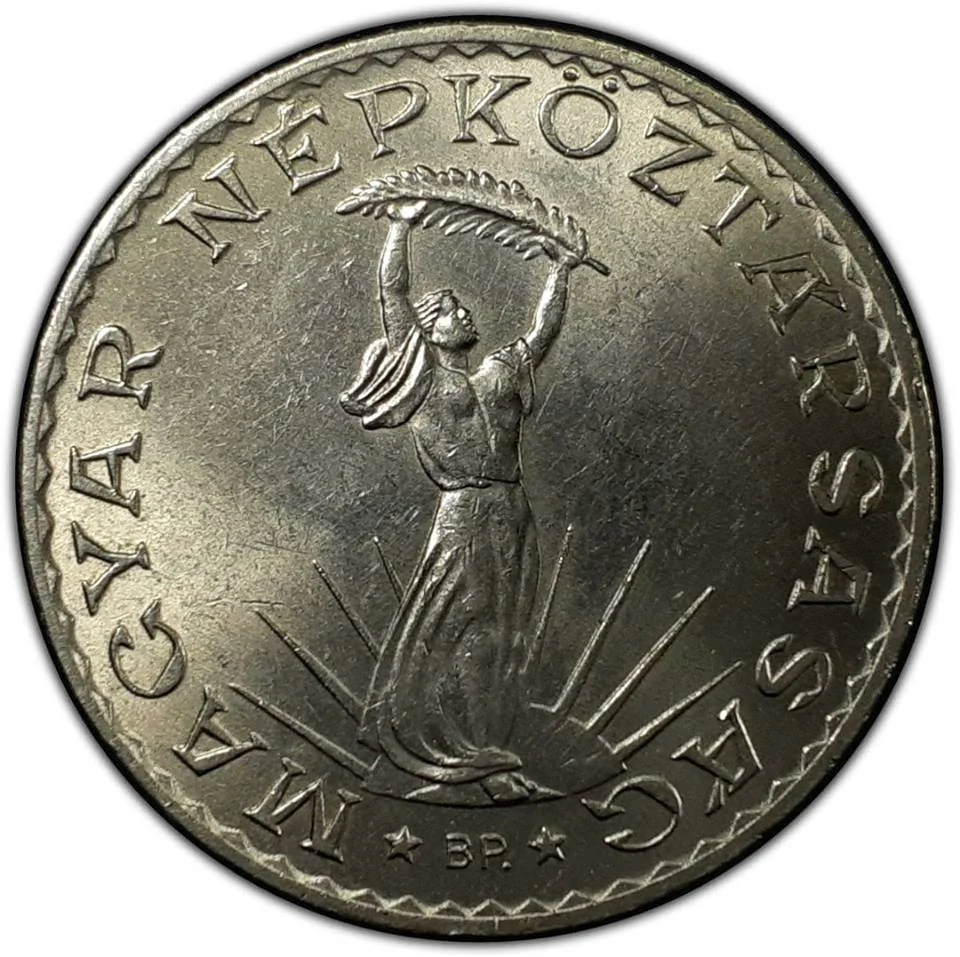
Statue of Liberty; Strobl monument (a woman raising a frond, sunburst behind).
Inscription:
MAGYAR NÉPKÖZTÁRSASÁG
* BP. *
* BP. *
Translation:
HUNGARIAN PEOPLE'S REPUBLIC
* BUDAPEST *
* BUDAPEST *
Script: Latin
Language: Hungarian
Engraver: Dezső Kovács
Reverse
Description:
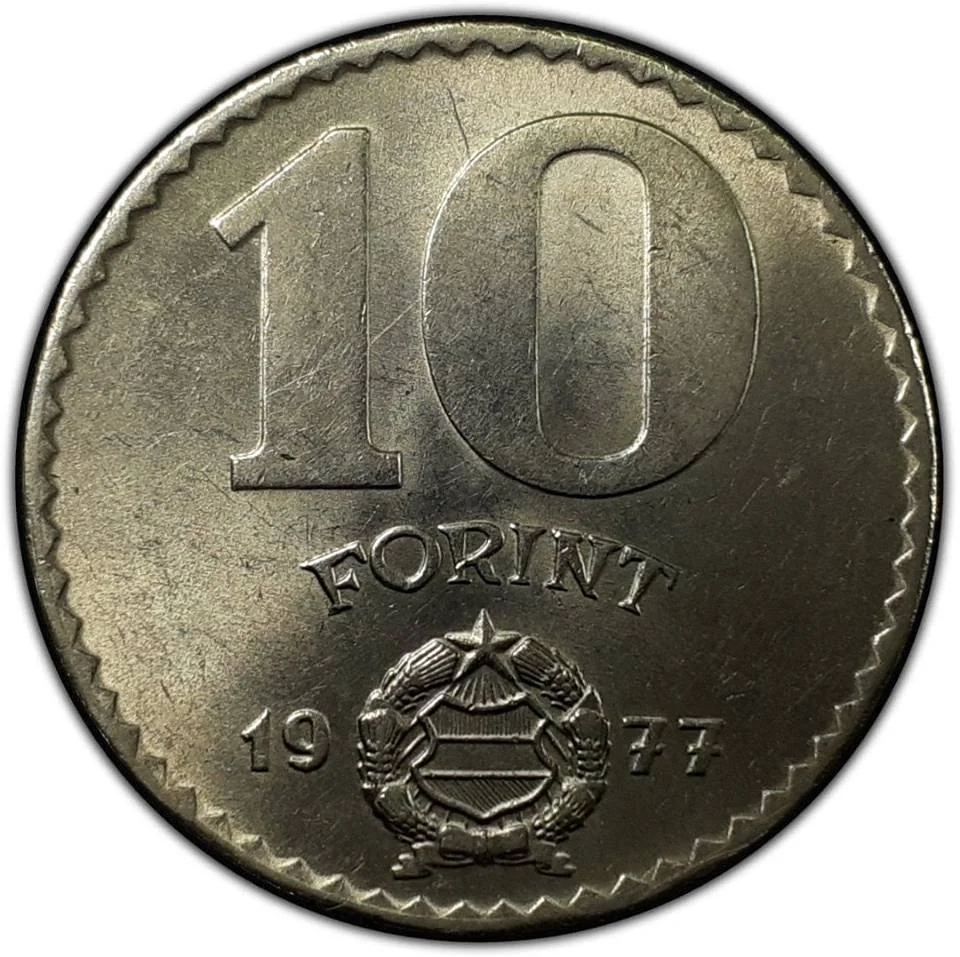
Shield divides date and denomination.
Inscription:
10
FORINT
1977
FORINT
1977
Script: Latin
Engraver: Sándor Boldogfai Farkas
Edge
Smooth with imprints
Legend:
>>X<< -X- >>X<< -X- >>X<< -X- >>X<< -X- >>X<< -X- >>X<< -X- >>X<< -X- >>X<< -X-
Mints
| Name | Mark |
|---|---|
| Hungarian mint | BP. |
Mintings
Historical background
In 1971, Hungary operated under the constraints of a centrally planned economy and was a member of the Council for Mutual Economic Assistance (COMECON), the Soviet-led economic bloc. The official currency, the forint (HUF), was non-convertible, meaning it could not be freely exchanged for Western hard currencies like the US dollar or Deutsche Mark. Its value was set administratively by the Hungarian National Bank and bore little relation to market forces, with an official exchange rate artificially pegged to the Soviet ruble. This system created a stark divide between the domestic economy and international trade, isolating the forint from global financial markets.
Internally, the currency situation was characterized by chronic shortages and suppressed inflation, known as "monetary overhang." While prices for basic necessities were kept stable by state subsidies, wages increased, leading to excess purchasing power that could not be spent due to a lack of desirable goods in state shops. This accumulation of forints in savings accounts created latent inflationary pressure. Furthermore, a complex system of multiple exchange rates existed for different types of transactions, complicating foreign trade calculations and encouraging a burgeoning black market where hard currencies commanded a significant premium over the official rate.
The year 1971 itself was part of a transitional period leading to Hungary's "New Economic Mechanism" (NEM), introduced in 1968. While the NEM had decentralized some economic decisions, the fundamental currency controls remained rigid. The collapse of the Bretton Woods system in the West that same year, with the US suspending gold convertibility, introduced new global monetary instability. However, its direct impact on Hungary was muted due to the country's insulated, non-convertible currency regime, which prioritized planned trade within COMECON and maintained strict control over all foreign exchange transactions.
Internally, the currency situation was characterized by chronic shortages and suppressed inflation, known as "monetary overhang." While prices for basic necessities were kept stable by state subsidies, wages increased, leading to excess purchasing power that could not be spent due to a lack of desirable goods in state shops. This accumulation of forints in savings accounts created latent inflationary pressure. Furthermore, a complex system of multiple exchange rates existed for different types of transactions, complicating foreign trade calculations and encouraging a burgeoning black market where hard currencies commanded a significant premium over the official rate.
The year 1971 itself was part of a transitional period leading to Hungary's "New Economic Mechanism" (NEM), introduced in 1968. While the NEM had decentralized some economic decisions, the fundamental currency controls remained rigid. The collapse of the Bretton Woods system in the West that same year, with the US suspending gold convertibility, introduced new global monetary instability. However, its direct impact on Hungary was muted due to the country's insulated, non-convertible currency regime, which prioritized planned trade within COMECON and maintained strict control over all foreign exchange transactions.
🌱 Very Common