

600 Bahts (King Rama IX) – Thailand
Non-circulating coins
Commemoration: 60th Birthday of King Rama IX
Series: 60th Anniversary of Rama IX
Thailand
Context
Year: 1987
Thai Year: 2530
Issuer: Thailand 
Ruler: Bhumibol Adulyadej
Currency:
(since 1897)
Total mintage: 5,300
Material
References
Y: #Click to copy to clipboard199
Numista: #199120
Value
Exchange value: 600 THB = $19.32
Bullion value: $80.00
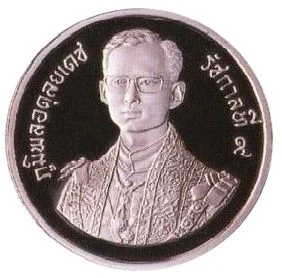
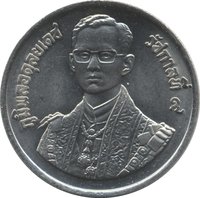
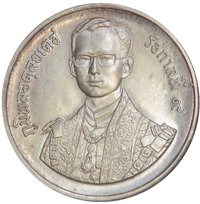
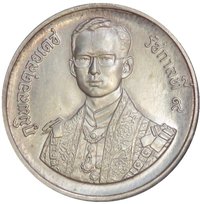
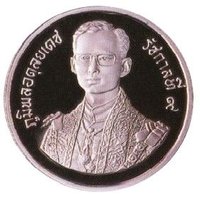
Obverse
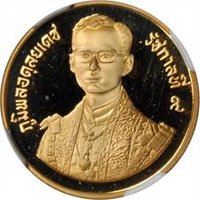
Description:
Uniformed bust, facing viewer.
Script: Thai
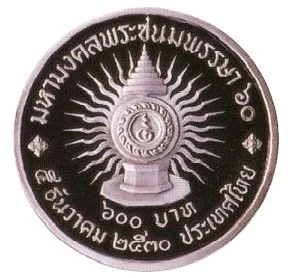
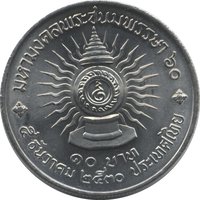
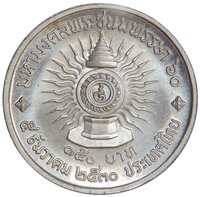
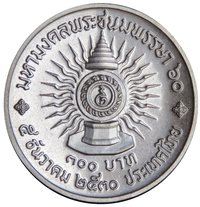
Reverse
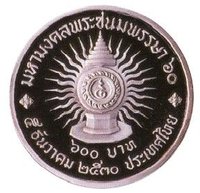
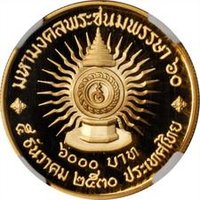
Description:
Crowned sun emblem
Script: Thai
Edge
Reeded.
Categories
| Person> Monarch |
| Event> Birth anniversary |
Mintings
| Year | Mint Mark | Mintage | Quality | Collection |
|---|---|---|---|---|
| 1987 | — | 4,300 | ||
| 1987 | — | 1,000 | Proof |
Historical background
In 1987, Thailand's currency, the baht, operated under a tightly managed fixed exchange rate system, pegged to a basket of currencies dominated by the US dollar. This policy, administered by the Bank of Thailand, provided a crucial anchor for stability during a period of significant economic transition. The country was in the early stages of an export-led boom, fueled by foreign direct investment and a growing manufacturing sector. The stable baht was instrumental in this growth, as it reduced exchange rate risk for international traders and investors, providing a predictable environment for the burgeoning "Asian Tiger" economy.
However, this stability came with inherent pressures and policy challenges. The peg required constant intervention by the central bank to maintain the baht's value within a narrow band. As Thailand's trade surplus grew and foreign capital flooded in, upward pressure on the currency mounted. The Bank of Thailand was compelled to actively buy foreign exchange (primarily US dollars) to prevent the baht from appreciating, which led to a rapid expansion of the country's foreign reserves. This intervention, while successful in maintaining the peg, also increased the domestic money supply, sowing the seeds for future inflationary concerns and asset bubbles.
Thus, the currency situation in 1987 was one of controlled success masking underlying tensions. The fixed exchange rate was widely seen as a cornerstone of Thailand's economic confidence and growth trajectory, fostering a period of remarkable prosperity. Yet, the very mechanisms that ensured stability—the accumulation of reserves and the management of capital inflows—were creating imbalances. These imbalances would accumulate over the next decade, eventually contributing to the severe pressures that culminated in the forced float of the baht and the Asian Financial Crisis of 1997.
However, this stability came with inherent pressures and policy challenges. The peg required constant intervention by the central bank to maintain the baht's value within a narrow band. As Thailand's trade surplus grew and foreign capital flooded in, upward pressure on the currency mounted. The Bank of Thailand was compelled to actively buy foreign exchange (primarily US dollars) to prevent the baht from appreciating, which led to a rapid expansion of the country's foreign reserves. This intervention, while successful in maintaining the peg, also increased the domestic money supply, sowing the seeds for future inflationary concerns and asset bubbles.
Thus, the currency situation in 1987 was one of controlled success masking underlying tensions. The fixed exchange rate was widely seen as a cornerstone of Thailand's economic confidence and growth trajectory, fostering a period of remarkable prosperity. Yet, the very mechanisms that ensured stability—the accumulation of reserves and the management of capital inflows—were creating imbalances. These imbalances would accumulate over the next decade, eventually contributing to the severe pressures that culminated in the forced float of the baht and the Asian Financial Crisis of 1997.
Series: 60th Anniversary of Rama IX
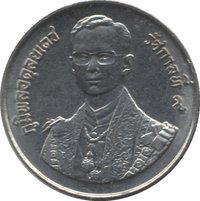
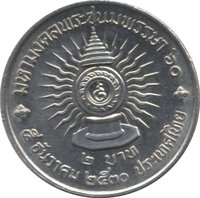


✨ Legendary