

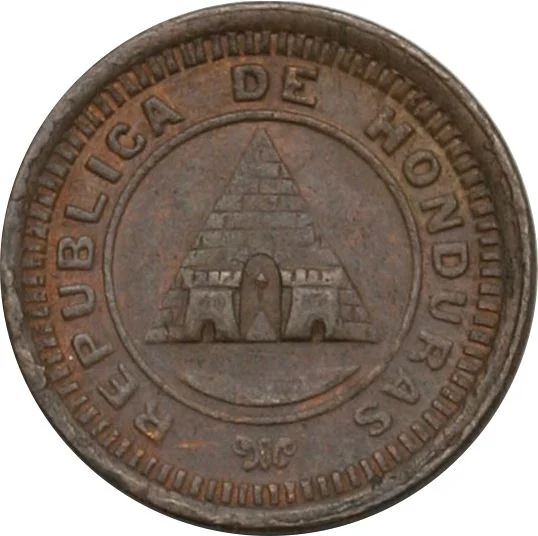
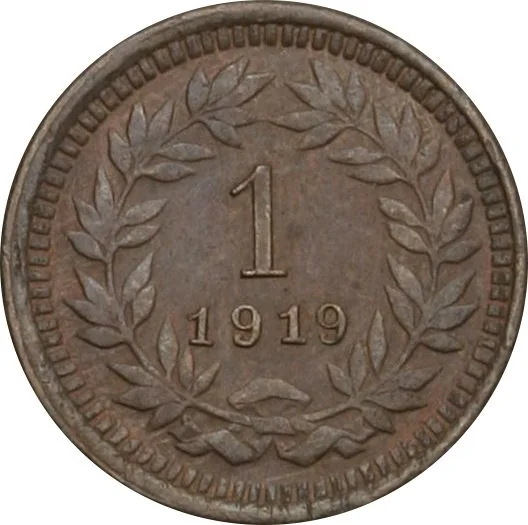
1 centavo – Honduras
Add to wishlist
Honduras
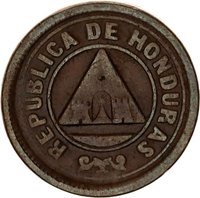
Obverse
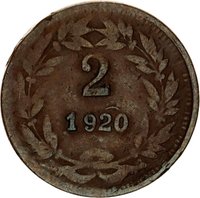
Reverse
Edge
Categories
| Symbols> Coat of Arms |
| Symbol> Wreath |
Mints
| Name | Mark |
|---|---|
| Casa Nacional de la Moneda | — |
Mintings
| Year | Mint Mark | Mintage | Quality | Collection |
|---|---|---|---|---|
| 1919 | — | 168,000 | ||
| 1920 | — | 30,000 |
Historical background
In 1919, Honduras operated under a complex and unstable currency system, a legacy of its 19th-century economic struggles. The primary circulating medium was the silver Honduran peso, but its value and availability were inconsistent. More critically, the country was deeply integrated into the monetary sphere of the British pound sterling due to the dominant economic presence of foreign, particularly American, banana companies like the United Fruit Company. These corporations conducted large-scale business in sterling, which influenced national finance and trade balances, while the government itself had sterling-denominated debts. This created a dualistic system where the domestic economy used pesos, but the export sector and international obligations revolved around sterling.
The period during and immediately after World War I exacerbated these monetary challenges. Global disruptions in trade and silver markets caused inflationary pressures, making the silver peso's value volatile. Furthermore, Honduras, like many Latin American nations, faced a severe shortage of hard currency (specie) as international gold and silver flows were disrupted. This scarcity hampered government finances and commercial transactions, leading to increased use of paper money and banknotes issued by private banks, which further complicated the monetary landscape with questions of trust and convertibility.
Consequently, 1919 found Honduras at a monetary crossroads, grappling with the inadequacies of its existing system. The instability of the silver peso, the scarcity of specie, dependency on foreign currency, and the proliferation of private banknotes all highlighted the need for reform. This environment set the stage for the major monetary transformation that would follow just seven years later: the creation of the Honduran lempira in 1926, which established a new, stable national currency pegged to the US dollar, finally consolidating and modernizing the country's financial system.
The period during and immediately after World War I exacerbated these monetary challenges. Global disruptions in trade and silver markets caused inflationary pressures, making the silver peso's value volatile. Furthermore, Honduras, like many Latin American nations, faced a severe shortage of hard currency (specie) as international gold and silver flows were disrupted. This scarcity hampered government finances and commercial transactions, leading to increased use of paper money and banknotes issued by private banks, which further complicated the monetary landscape with questions of trust and convertibility.
Consequently, 1919 found Honduras at a monetary crossroads, grappling with the inadequacies of its existing system. The instability of the silver peso, the scarcity of specie, dependency on foreign currency, and the proliferation of private banknotes all highlighted the need for reform. This environment set the stage for the major monetary transformation that would follow just seven years later: the creation of the Honduran lempira in 1926, which established a new, stable national currency pegged to the US dollar, finally consolidating and modernizing the country's financial system.
⭐ Rare