

1 minaltun – Ganja Khanate
Add to wishlist
Context
Year: 1800
Islamic (Hijri) Year:: 1214
Country: Caucasia
Issuer: Ganja Khanate
Currency:
Demonetized: Yes
Material
Diameter: 25 mm
Weight: 12.01 g
Silver Weight:: 12.01 g
Shape: Irregular round
Composition: Silver
Magnetic: No
References
Numista: #197888
Value
Bullion value: $30.69
Obverse
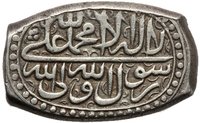
Description:
Arabic legend in dotted frame.
Inscription:
لا اله الا الله محمد رسول الله علي ولي الله
Translation:
There is no god but God, Muhammad is the Messenger of God, Ali is the Friend of God.
Language: Arabic
Reverse
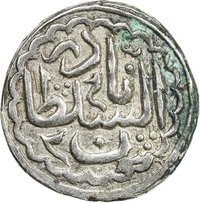
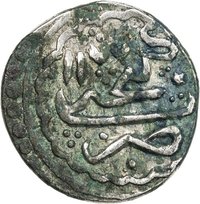
Description:
Arabic legend and date in dotted border, surrounded by blank space.
Inscription:
ضرب گنجه
١٢۱۴
١٢۱۴
Translation:
Struck at Ganja
1214
1214
Language: Persian
Edge
Plain
Mints
| Name | Mark |
|---|---|
| Ganja | — |
Mintings
| Year | Mint Mark | Mintage | Quality | Collection |
|---|---|---|---|---|
| 1800 | — | — |
Historical background
The Ganja Khanate, a semi-autonomous Georgian-Muslim polity under nominal Persian suzerainty in the South Caucasus, entered the 19th century with a currency system reflecting its contested geopolitical position. The primary circulating medium was the Persian silver abbasi and its subdivisions, a direct legacy of Qajar Iranian overlordship. However, the monetary landscape was highly fragmented, with Russian silver roubles and copper coins, Ottoman piastres, and even Georgian and Armenian coins from neighboring regions all circulating concurrently. This diversity was a direct result of Ganja's role as a commercial crossroads and the constant political-military pressure from its powerful neighbors, which flooded the zone with their own currencies.
Internally, the Khanate’s own minting capacity was limited and inconsistent. While some Ganja khans, notably Javad Khan (r. 1786-1804), are known to have struck coins bearing their names in Ganja city, these issues were sporadic and insufficient to standardize the economy. The coinage often imitated Persian types, asserting a degree of autonomy while acknowledging the prevailing monetary standard. The lack of a strong, unified currency exacerbated local trade difficulties, as exchange rates between the multitude of coins were unstable and often exploitative, favoring merchants and money-changers.
This chaotic monetary environment reached its abrupt end with the Russian Empire's final annexation of the khanate in 1804, following Javad Khan's death in battle. Imperial Russia quickly moved to impose its own monetary system, demonetizing Persian coins and formally integrating the region into the Russian economic sphere. Thus, the currency situation of 1800 represents the final chapter of Ganja's pre-Russian existence—a complex, hybrid system that was less a symbol of sovereignty and more a tangible indicator of a fragile khanate caught between empires.
Internally, the Khanate’s own minting capacity was limited and inconsistent. While some Ganja khans, notably Javad Khan (r. 1786-1804), are known to have struck coins bearing their names in Ganja city, these issues were sporadic and insufficient to standardize the economy. The coinage often imitated Persian types, asserting a degree of autonomy while acknowledging the prevailing monetary standard. The lack of a strong, unified currency exacerbated local trade difficulties, as exchange rates between the multitude of coins were unstable and often exploitative, favoring merchants and money-changers.
This chaotic monetary environment reached its abrupt end with the Russian Empire's final annexation of the khanate in 1804, following Javad Khan's death in battle. Imperial Russia quickly moved to impose its own monetary system, demonetizing Persian coins and formally integrating the region into the Russian economic sphere. Thus, the currency situation of 1800 represents the final chapter of Ganja's pre-Russian existence—a complex, hybrid system that was less a symbol of sovereignty and more a tangible indicator of a fragile khanate caught between empires.
✨ Legendary