

25 poisha – Bangladesh
Add to wishlist
Bangladesh
Context
Years: 1977–1994
Issuer: Bangladesh
Period:
(since 1971)
Currency:
(since 1972)
Total mintage: 992,818,000
Material
References
KM: #
Numista: #1977
Value
Exchange value: 0.25 BDT
Obverse
Description:
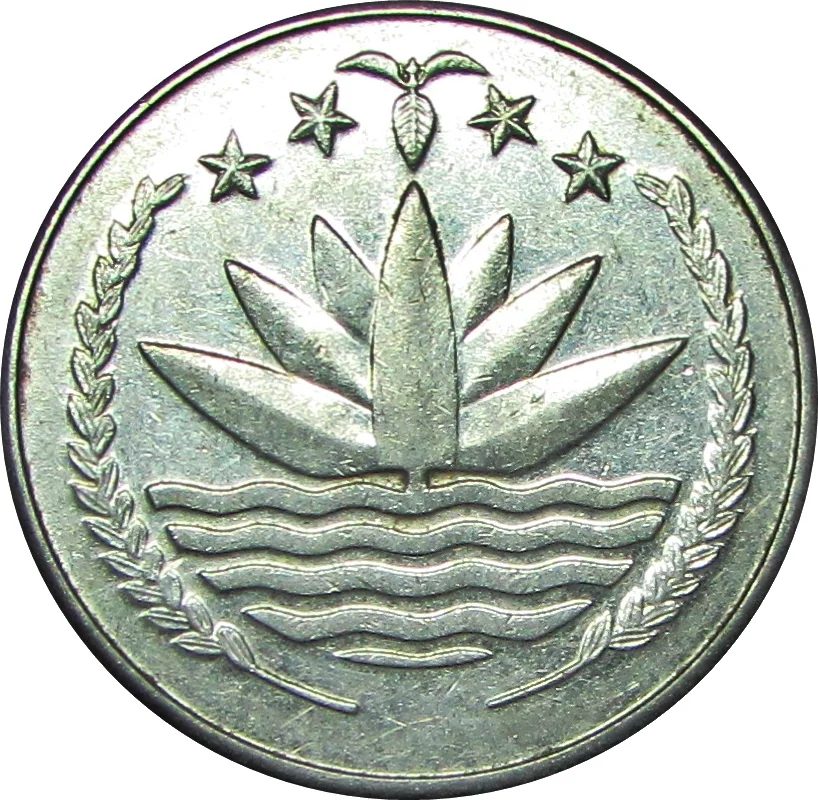
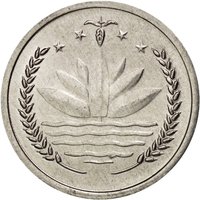
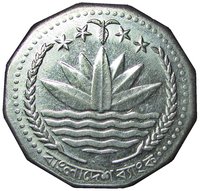
Bangladesh's national emblem features a water lily framed by rice sheaves, topped with a tea leaf clover and four stars symbolizing the 1972 constitutional principles: nationalism, secularism, socialism, and democracy.
Reverse
Edge
Reeded
Mints
| Name | Mark |
|---|---|
| Royal Canadian Mint of Ottawa | — |
Mintings
| Year | Mint Mark | Mintage | Quality | Collection |
|---|---|---|---|---|
| 1977 | — | 45,300,000 | ||
| 1978 | — | 66,750,000 | ||
| 1979 | — | 56,704,000 | ||
| 1980 | — | 228,992,000 | ||
| 1981 | — | 45,072,000 | ||
| 1983 | — | 96,128,000 | ||
| 1984 | — | 203,872,000 | ||
| 1991 | — | 250,000,000 | ||
| 1994 | — | — |
Historical background
In 1977, Bangladesh's currency situation was characterized by the continued use of the Bangladeshi Taka (BDT), which had been introduced in 1972 following independence. The currency operated under a fixed exchange rate system, pegged to a basket of major trading partners' currencies, though with a heavy implicit weight on the British Pound and the US Dollar. This period followed a decade of significant economic disruption from the 1971 Liberation War and subsequent famine, leaving the economy fragile and heavily dependent on foreign aid and concessional loans. The government, under President Ziaur Rahman, was focused on stabilization and encouraging agricultural and industrial production, but the taka faced persistent pressure due to trade deficits and low foreign exchange reserves.
A critical feature of the 1977 monetary landscape was the existence of a dual exchange rate system. Alongside the official fixed rate, a semi-official secondary market, often referred to as the "Bonus Voucher" system, operated for certain transactions like exports of jute and leather goods. Exporters in these sectors received vouchers that could be sold at a premium to importers, effectively creating a more depreciated market-driven exchange rate for a portion of foreign exchange transactions. This mechanism was a pragmatic, albeit complex, attempt to boost export earnings and attract remittances by offering a higher effective return, while still maintaining the formal peg for essential imports and debt servicing.
Overall, the currency situation in 1977 reflected a transitional economy grappling with balance of payments challenges. The fixed peg provided nominal stability but required strict controls and was often misaligned with the currency's real value, leading to pressures on reserves. The partial liberalization through the dual exchange rate was a step toward addressing these distortions, setting the stage for more significant reforms in the following decade. The period was thus one of managed adjustment, where monetary policy was tightly constrained by the need to finance development and maintain essential imports in a resource-scarce environment.
A critical feature of the 1977 monetary landscape was the existence of a dual exchange rate system. Alongside the official fixed rate, a semi-official secondary market, often referred to as the "Bonus Voucher" system, operated for certain transactions like exports of jute and leather goods. Exporters in these sectors received vouchers that could be sold at a premium to importers, effectively creating a more depreciated market-driven exchange rate for a portion of foreign exchange transactions. This mechanism was a pragmatic, albeit complex, attempt to boost export earnings and attract remittances by offering a higher effective return, while still maintaining the formal peg for essential imports and debt servicing.
Overall, the currency situation in 1977 reflected a transitional economy grappling with balance of payments challenges. The fixed peg provided nominal stability but required strict controls and was often misaligned with the currency's real value, leading to pressures on reserves. The partial liberalization through the dual exchange rate was a step toward addressing these distortions, setting the stage for more significant reforms in the following decade. The period was thus one of managed adjustment, where monetary policy was tightly constrained by the need to finance development and maintain essential imports in a resource-scarce environment.
🌱 Very Common