

Obverse
Description:
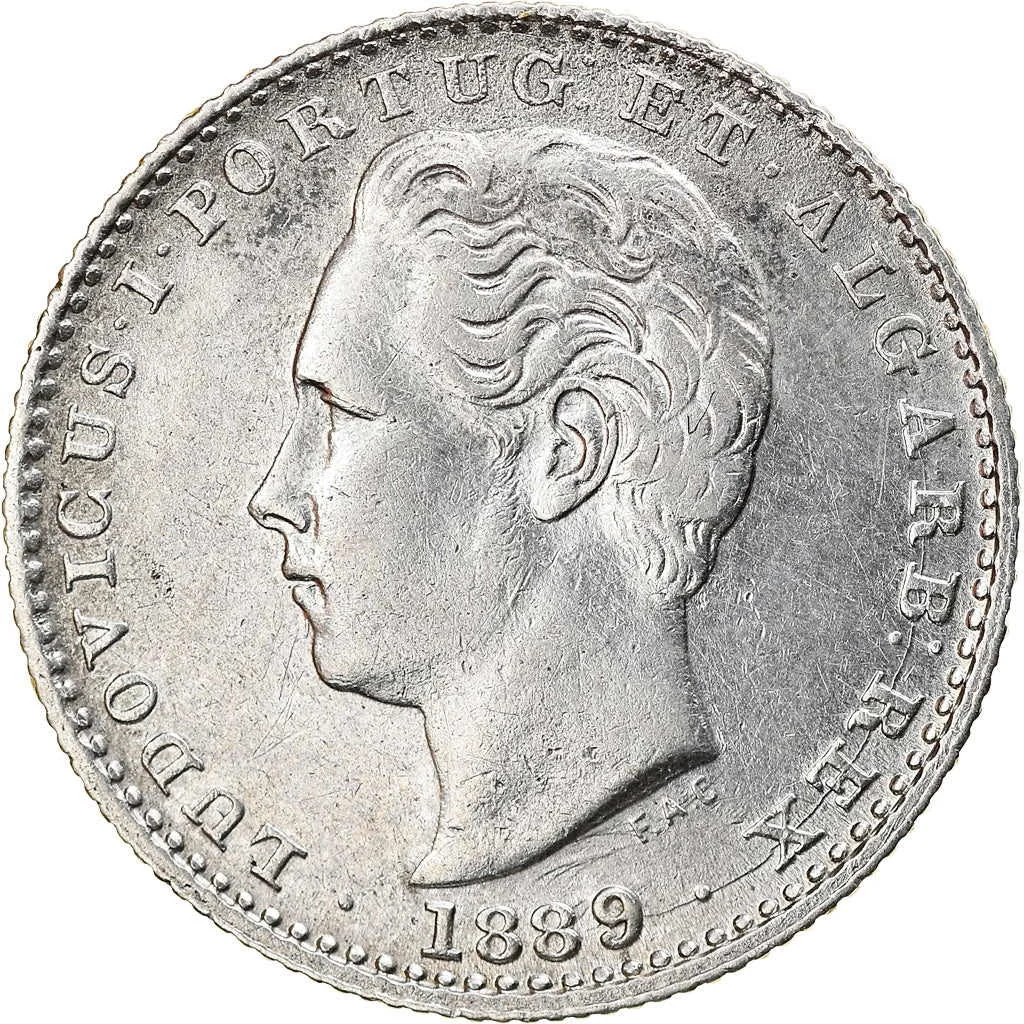
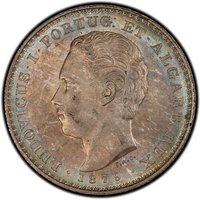
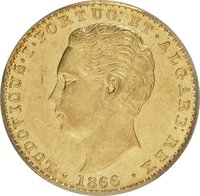
Luís I of Portugal, left-facing effigy.
Inscription:
LUDOVICUS·I·PORTUG: ET·ALGARB: REX
F.A.C.
· 1889 ·
F.A.C.
· 1889 ·
Translation:
Louis I of Portugal and the Algarve, King
By the Grace of God, Faithful King
1889
By the Grace of God, Faithful King
1889
Script: Latin
Languages: Portuguese, Latin
Engraver: Frederico Augusto de Campos
Reverse
Description:
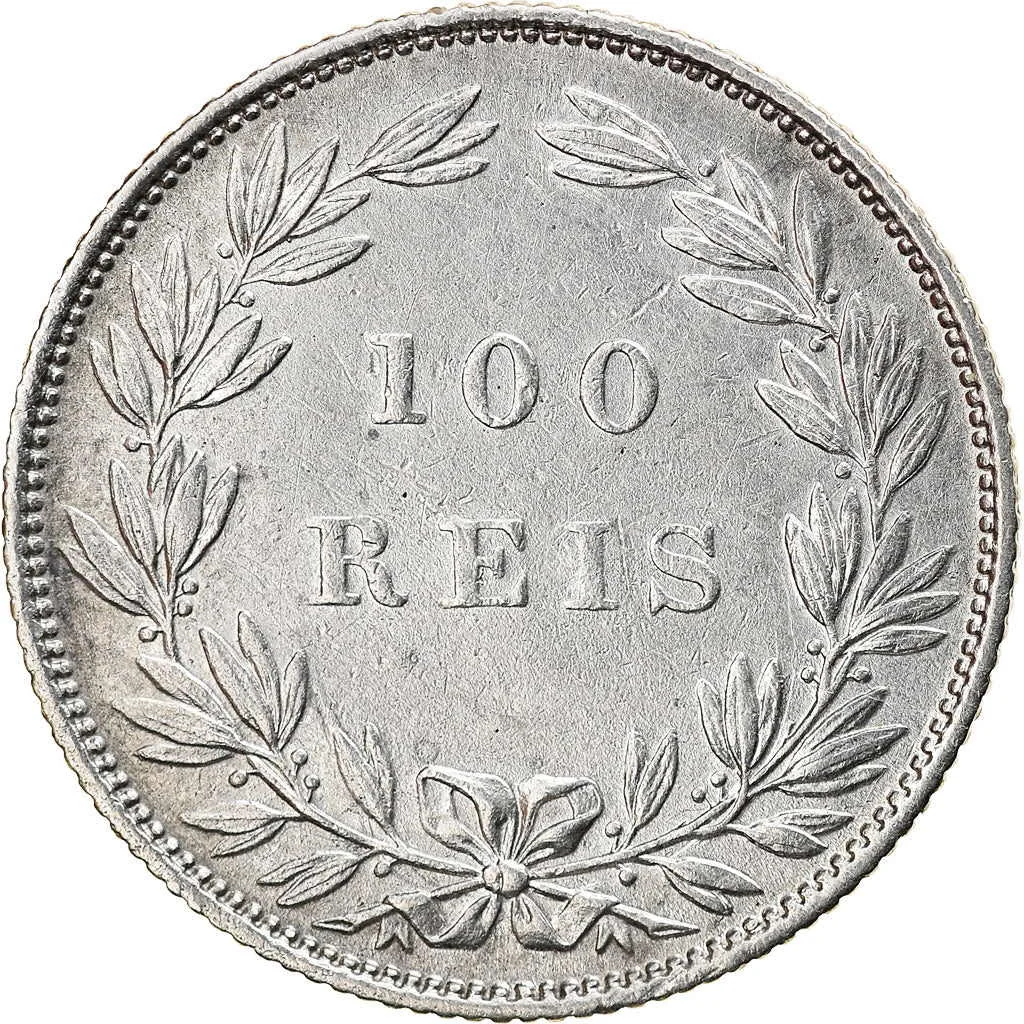
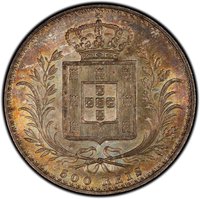
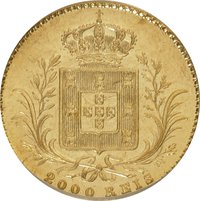
Wreath denomination
Inscription:
100
REIS
REIS
Script: Latin
Engraver: Frederico Augusto de Campos
Edge
Reeded
Mints
| Name | Mark |
|---|---|
| Imprensa Nacional - Casa da Moeda | — |
Mintings
| Year | Mint Mark | Mintage | Quality | Collection |
|---|---|---|---|---|
| 1864 | — | 198,000 | BU | |
| 1865 | — | 100,000 | BU | |
| 1866 | — | 10,000 | BU | |
| 1869 | — | 10,000 | ||
| 1869 | — | — | Proof | |
| 1871 | — | 60,000 | ||
| 1872 | — | 60,000 | ||
| 1874 | — | 170,000 | ||
| 1874 | — | — | Proof | |
| 1875 | — | 130,000 | ||
| 1876 | — | 220,000 | ||
| 1877 | — | 120,000 | ||
| 1877 | — | — | Proof | |
| 1878 | — | 30,000 | ||
| 1879 | — | 560,000 | ||
| 1879 | — | — | Proof | |
| 1880 | — | 440,000 | ||
| 1880 | — | — | Proof | |
| 1881 | — | — | ||
| 1886 | — | 750,000 | ||
| 1886 | — | — | Proof | |
| 1888 | — | 500,000 | ||
| 1889 | — | 1,500,000 |
Historical background
In 1864, Portugal's currency situation was characterized by a complex and often unstable monetary system, a legacy of its historical ties to Britain and domestic fiscal pressures. The country operated on a de facto gold standard, but its currency in widespread circulation was the milréis, a silver-based coin. However, the value of silver had been falling internationally since the mid-century, leading to a divergence between the face value of silver coins and their intrinsic bullion worth. This created significant problems with currency arbitrage and the flight of full-weight silver coins from circulation, leaving the economy with worn and underweight coinage, which hampered trade and confidence.
The government, under the reformist impetus of the Regeneration movement, had been attempting to modernize the system. A pivotal step came in 1854 with the official adoption of a gold standard, pegging the milréis to gold. Yet, the practical transition was incomplete. While gold coins were minted, silver and copper coins remained legal tender for daily transactions, creating a bimetallic friction. The year 1864 fell within a period of adjustment following the 1854 law, where the state was still grappling with standardizing the coinage, retiring old fractional currency, and managing public acceptance. Furthermore, extensive paper money issued by private banks, like the Banco de Portugal, circulated with varying degrees of trust, adding another layer of complexity.
Consequently, the monetary landscape in 1864 was one of transition and strain. Portugal was formally on a gold standard but struggled with the realities of a depreciating silver subsidiary coinage and an unreliable mix of older tokens. This instability reflected broader economic challenges, including substantial public debt. The situation would ultimately necessitate further reforms, most notably the 1891 decision to move to a pure gold standard and consolidate note-issuing power, steps that were deemed necessary to stabilize the currency and integrate Portugal more firmly into the international financial system.
The government, under the reformist impetus of the Regeneration movement, had been attempting to modernize the system. A pivotal step came in 1854 with the official adoption of a gold standard, pegging the milréis to gold. Yet, the practical transition was incomplete. While gold coins were minted, silver and copper coins remained legal tender for daily transactions, creating a bimetallic friction. The year 1864 fell within a period of adjustment following the 1854 law, where the state was still grappling with standardizing the coinage, retiring old fractional currency, and managing public acceptance. Furthermore, extensive paper money issued by private banks, like the Banco de Portugal, circulated with varying degrees of trust, adding another layer of complexity.
Consequently, the monetary landscape in 1864 was one of transition and strain. Portugal was formally on a gold standard but struggled with the realities of a depreciating silver subsidiary coinage and an unreliable mix of older tokens. This instability reflected broader economic challenges, including substantial public debt. The situation would ultimately necessitate further reforms, most notably the 1891 decision to move to a pure gold standard and consolidate note-issuing power, steps that were deemed necessary to stabilize the currency and integrate Portugal more firmly into the international financial system.
🌱 Common