

1 taka – Bangladesh
Add to wishlist
Circulating commemorative coins
Commemoration: FAO
Bangladesh
Context
Material
Diameter: 24.91 mm
Weight: 4.25 g
Thickness: 1.3 mm
Shape: Round
Composition: Stainless steel
Technique: Milled
Alignment: Medal alignment
flip
References
KM: #
Numista: #1976
Value
Exchange value: 1 BDT
Obverse
Description:
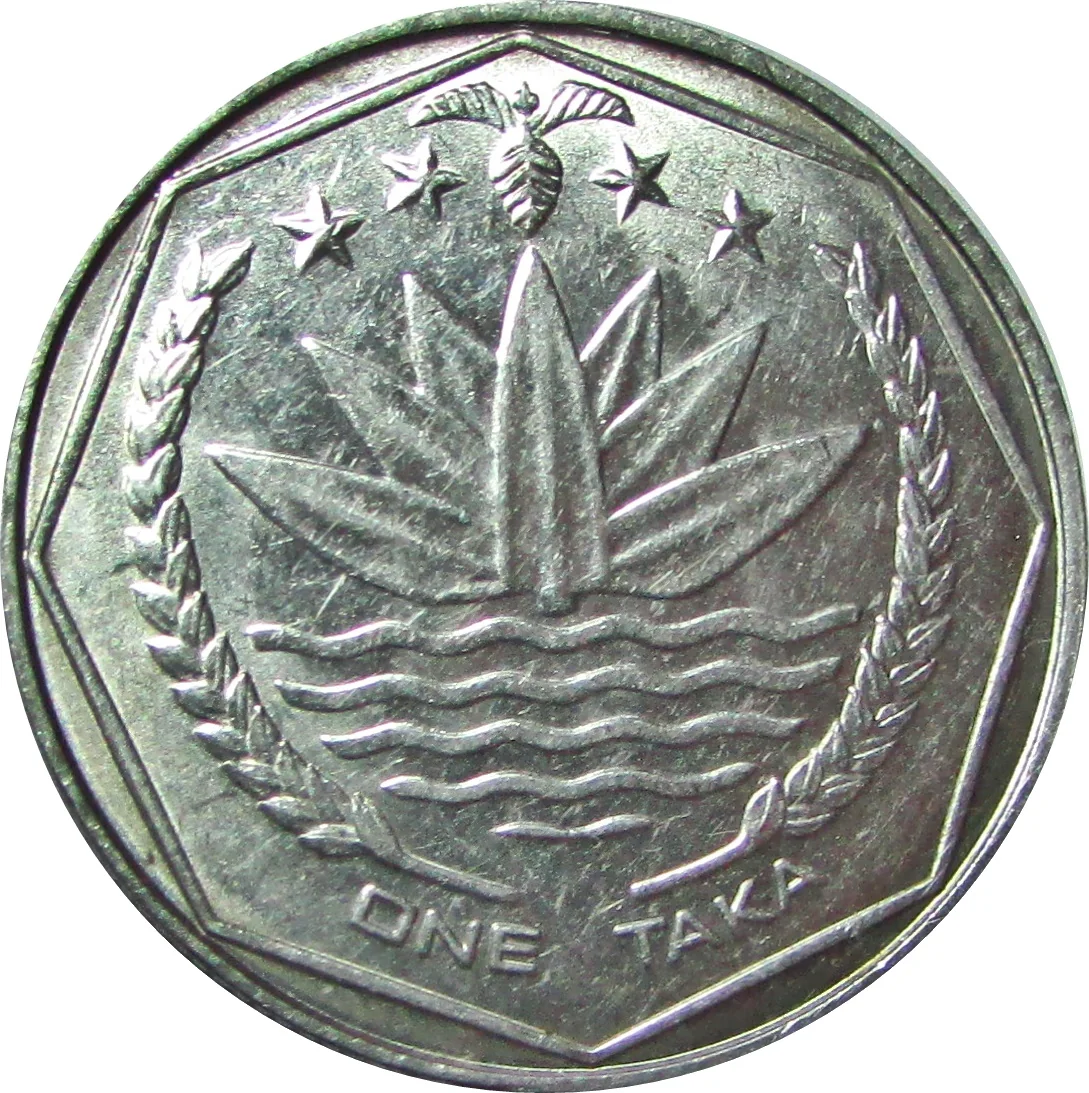
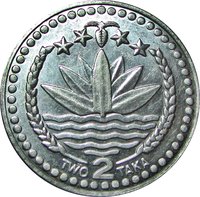
Bangladesh's national emblem: a water lily flanked by rice ears, topped with tea leaves and four stars symbolizing nationalism, secularism, socialism, and democracy. An octagon frames the design.
Inscription:
ONE TAKA
Script: Latin
Reverse
Description:
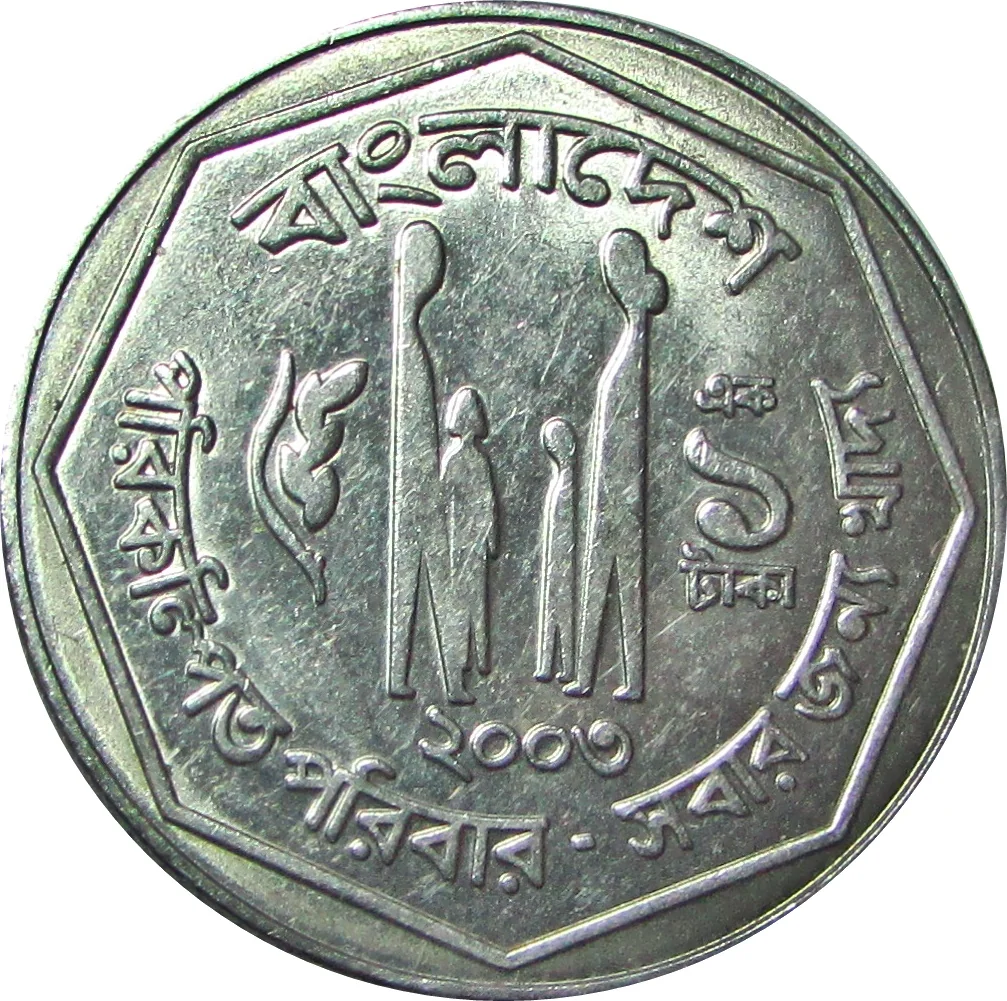
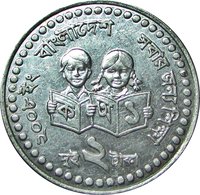
Stylized family of four in an octagon with the slogan "Planned Family—Food for All." Face value shown in numerals and words.
Inscription:
বাংলাদেশ
এক ১ টাকা
২০০৩
পরিকল্পিত পরিবার - সবার জন্য খাদ্য
এক ১ টাকা
২০০৩
পরিকল্পিত পরিবার - সবার জন্য খাদ্য
Translation:
Bangladesh
One 1 Taka
2003
Planned Family - Food for All
One 1 Taka
2003
Planned Family - Food for All
Script: Bengali
Language: Bengali
Edge
Reeded
Categories
| Symbols> Coat of Arms |
| Organization> FAO |
| Plants> Flower |
Mintings
| Year | Mint Mark | Mintage | Quality | Collection |
|---|---|---|---|---|
| 2001 | — | — | ||
| 2002 | — | — | ||
| 2003 | — | — | ||
| 2005 | — | — | ||
| 2007 | — | — |
Historical background
In 2001, Bangladesh's currency, the Taka (BDT), operated under a managed floating exchange rate system, a significant shift from the earlier fixed regime. The Bangladesh Bank (the central bank) intervened in the foreign exchange market to curb excessive volatility, but generally allowed market forces to influence the exchange rate against a basket of currencies of major trading partners. This period was characterized by relative stability for the Taka, though it faced persistent downward pressure due to structural economic factors. The exchange rate hovered around 55-57 BDT per US dollar, with the central bank utilizing its modest foreign exchange reserves to smooth out fluctuations and maintain export competitiveness.
The macroeconomic context presented challenges. The country ran a consistent trade deficit, financed largely by remittances from overseas workers and foreign aid. While remittance inflows were a crucial source of foreign currency and had begun a steady upward trend, they were not yet at the transformative levels seen in subsequent decades. Furthermore, the domestic financial sector was burdened with high levels of non-performing loans, which constrained credit and created underlying vulnerabilities. Inflation was a concern, typically ranging between 5-7%, influenced by both domestic demand and the cost of imported goods.
Politically, the year 2001 was marked by significant turbulence, culminating in a change of government following the October general elections. This political uncertainty contributed to a climate of cautious investment and occasional pressure on the Taka. The new government, taking office in the final quarter, inherited the ongoing challenges of a low-revenue, import-dependent economy. Consequently, the currency situation in 2001 was one of managed stability on the surface, but underscored by the enduring need to address fiscal deficits, strengthen the financial sector, and boost export diversification to ensure longer-term exchange rate resilience.
The macroeconomic context presented challenges. The country ran a consistent trade deficit, financed largely by remittances from overseas workers and foreign aid. While remittance inflows were a crucial source of foreign currency and had begun a steady upward trend, they were not yet at the transformative levels seen in subsequent decades. Furthermore, the domestic financial sector was burdened with high levels of non-performing loans, which constrained credit and created underlying vulnerabilities. Inflation was a concern, typically ranging between 5-7%, influenced by both domestic demand and the cost of imported goods.
Politically, the year 2001 was marked by significant turbulence, culminating in a change of government following the October general elections. This political uncertainty contributed to a climate of cautious investment and occasional pressure on the Taka. The new government, taking office in the final quarter, inherited the ongoing challenges of a low-revenue, import-dependent economy. Consequently, the currency situation in 2001 was one of managed stability on the surface, but underscored by the enduring need to address fiscal deficits, strengthen the financial sector, and boost export diversification to ensure longer-term exchange rate resilience.

🌱 Very Common