

2 taka – Bangladesh
Add to wishlist
Circulating commemorative coins
Commemoration: United Nations Literacy Decade
Bangladesh
Context
Years: 2004–2008
Issuer: Bangladesh
Period:
(since 1971)
Currency:
(since 1972)
Total mintage: 400,000,000
Material
Diameter: 26.03 mm
Weight: 7 g
Thickness: 1.9 mm
Shape: Round
Composition: Stainless steel
Technique: Milled
Alignment: Medal alignment

flip
References
KM: #
Numista: #1972
Value
Exchange value: 2 BDT
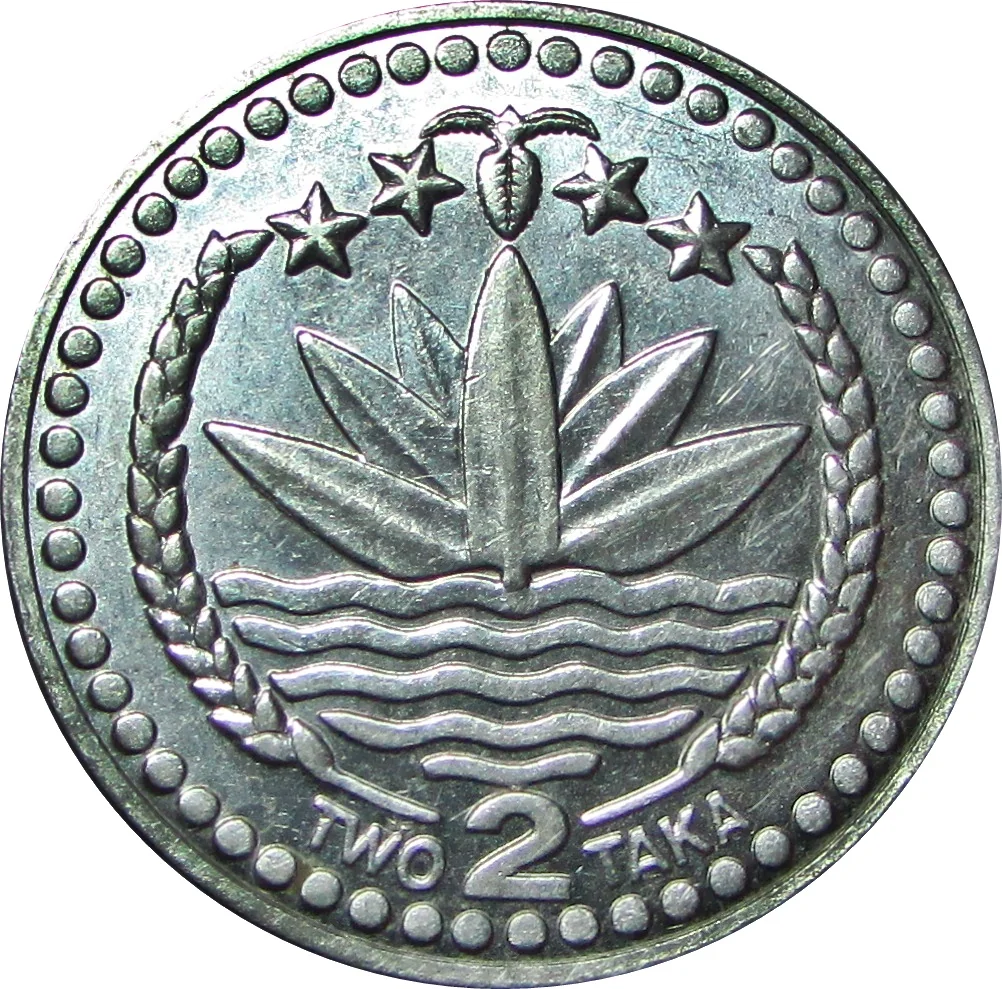
Obverse
Description:
Bangladesh's national emblem features a water lily framed by rice sheaves, topped with a tea leaf clover and four stars symbolizing the 1972 constitutional principles: nationalism, secularism, socialism, and democracy.
Inscription:
TWO 2 TAKA
Script: Latin
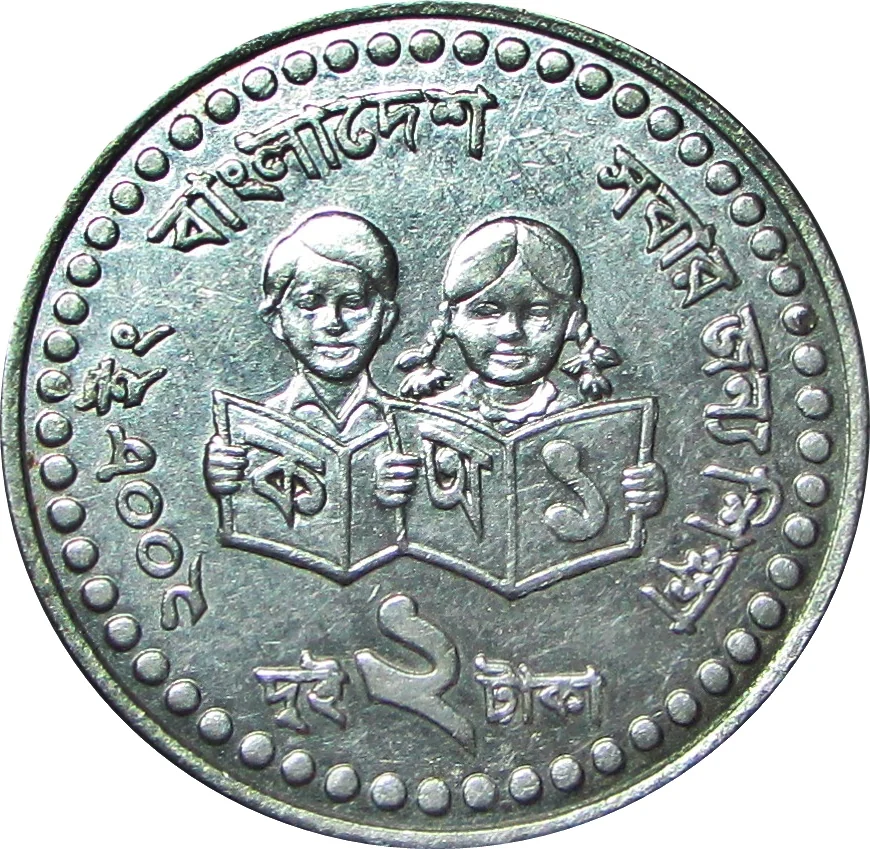
Reverse
Description:
A girl and boy read a book showing Bangla's first alphabets and number. Surrounding text includes the issue year (ইং GY), country name, and an education motto. The face value is at the bottom in figures and words.
Inscription:
২০০৮ ইং বাংলাদেশ সবার জন্য শিক্ষা
ক অ ১
দুই ২ টাকা
ক অ ১
দুই ২ টাকা
Translation:
2008 AD Bangladesh Education for All
Ka A 1
Two 2 Taka
Ka A 1
Two 2 Taka
Script: Bengali
Language: Bengali
Edge
Plain
Categories
| Education |
| Plants> Flower |
| Symbols> Coat of Arms |
Mintings
| Year | Mint Mark | Mintage | Quality | Collection |
|---|---|---|---|---|
| 2004 | — | 200,000,000 | ||
| 2008 | — | 200,000,000 |
Historical background
In 2004, Bangladesh's currency situation was characterized by relative stability under a managed floating exchange rate regime, a significant shift from the earlier era of a pegged system. The Bangladesh Bank (the central bank) had transitioned to a more market-oriented approach in 2003, allowing the Taka (BDT) to fluctuate within a band based on interbank market forces, though with active intervention to curb excessive volatility. This period saw moderate depreciation pressure, primarily driven by a widening trade deficit and rising import payments, particularly for oil and capital machinery. However, prudent foreign exchange reserve management, bolstered by steady growth in remittance inflows from overseas workers, provided a crucial buffer against external shocks.
The macroeconomic context was one of cautious optimism. Remittances, exceeding USD 3 billion for the first time in 2003-04, became a cornerstone of external sector strength, helping to finance the trade gap and build reserves, which stood at a comfortable level covering roughly three months of imports. Inflation was a concern, hovering around 6-7%, but was not yet at a crisis level. The currency stability was thus underpinned by these resilient remittance flows and a period of relative political calm, which supported investor sentiment and economic growth averaging above 5%.
Overall, the Taka in 2004 was in a phase of managed adjustment. While facing the typical pressures of a developing economy with a growing import bill, it avoided the severe crises seen in some contemporaries. The central bank's interventions were generally successful in smoothing out erratic movements, ensuring that depreciation was gradual and controlled. This stability provided a foundation for ongoing economic liberalization and supported the country's consistent, if unspectacular, GDP growth during that fiscal year.
The macroeconomic context was one of cautious optimism. Remittances, exceeding USD 3 billion for the first time in 2003-04, became a cornerstone of external sector strength, helping to finance the trade gap and build reserves, which stood at a comfortable level covering roughly three months of imports. Inflation was a concern, hovering around 6-7%, but was not yet at a crisis level. The currency stability was thus underpinned by these resilient remittance flows and a period of relative political calm, which supported investor sentiment and economic growth averaging above 5%.
Overall, the Taka in 2004 was in a phase of managed adjustment. While facing the typical pressures of a developing economy with a growing import bill, it avoided the severe crises seen in some contemporaries. The central bank's interventions were generally successful in smoothing out erratic movements, ensuring that depreciation was gradual and controlled. This stability provided a foundation for ongoing economic liberalization and supported the country's consistent, if unspectacular, GDP growth during that fiscal year.

🌱 Very Common