

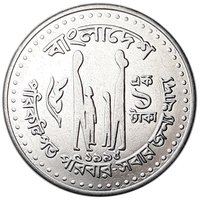
10 poisha – Bangladesh
Add to wishlist
Circulating commemorative coins
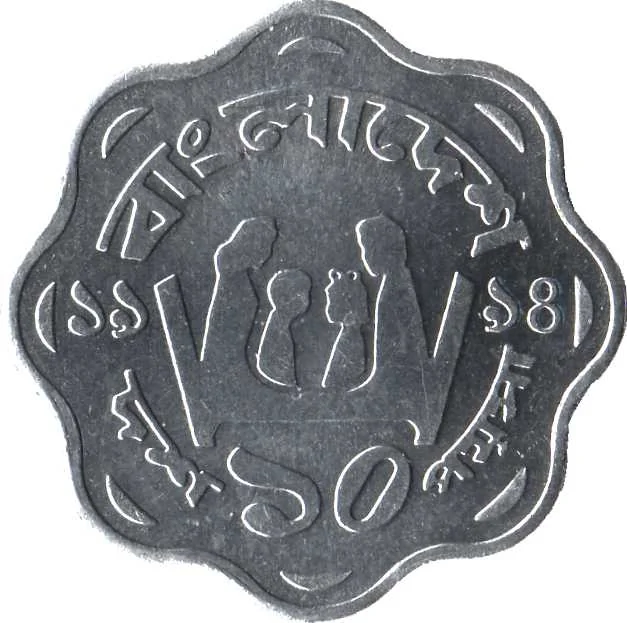
Commemoration: FAO
Bangladesh
Context
Years: 1983–1994
Issuer: Bangladesh
Period:
(since 1971)
Currency:
(since 1972)
Total mintage: 200,000,000
Material

References
KM: #
Numista: #1974
Value
Exchange value: 0.10 BDT
Obverse
Description:
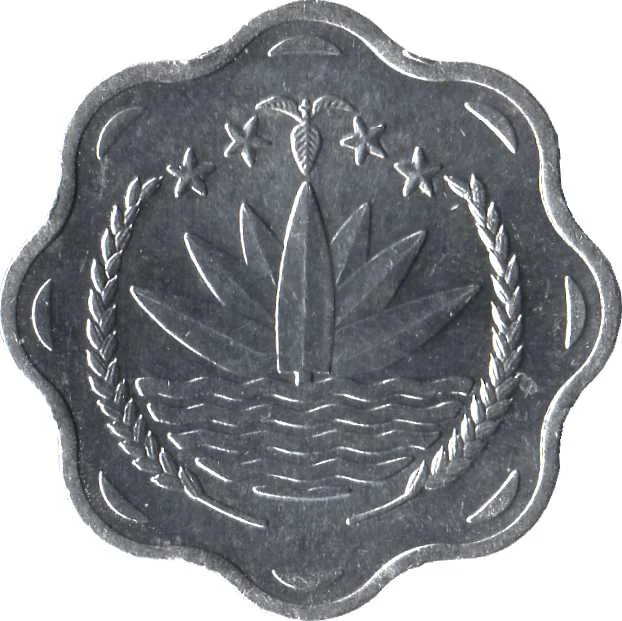
Bangladesh's national emblem features a water lily framed by rice sheaves, topped with a tea leaf clover and four stars symbolizing the 1972 constitutional principles: nationalism, secularism, socialism, and democracy.
Reverse
Edge
Plain
Categories
| Organization> FAO |
| Plants> Flower |
| Symbols> Coat of Arms |
Mintings
| Year | Mint Mark | Mintage | Quality | Collection |
|---|---|---|---|---|
| 1983 | — | 142,848,000 | ||
| 1994 | — | 57,152,000 |
Historical background
In 1983, Bangladesh's currency situation was characterized by a tightly controlled and managed exchange rate system under the regime of President H.M. Ershad. The country operated with a fixed exchange rate regime, where the value of the Bangladeshi Taka (BDT) was pegged to a basket of currencies of its major trading partners, though with a heavy de facto influence from the US Dollar. This system was administered by the Bangladesh Bank, which set official rates and maintained strict capital controls to manage the balance of payments and conserve scarce foreign exchange reserves. The official exchange rate was significantly overvalued, which, while intended to reduce the cost of essential imports like food and machinery, created a persistent gap with the market-driven value of the currency.
This overvaluation led to the proliferation of a vibrant black market for foreign currency, particularly US dollars. The disparity between the official rate (approximately 26-27 Taka per US Dollar in the early 1980s) and the black-market rate (which could be 10-15% higher) encouraged under-invoicing of exports and over-invoicing of imports, as well as remittance diversion through unofficial channels (hundi). The economy was heavily dependent on imports, and the overvalued Taka made exports like jute and ready-made garments less competitive internationally, exacerbating trade deficits. Foreign exchange reserves were perilously low, often covering only a few weeks of imports, keeping the economy vulnerable to external shocks.
The structural pressures of the early 1980s set the stage for significant, albeit gradual, reforms. Under guidance and pressure from international financial institutions like the International Monetary Fund (IMF) and the World Bank, Bangladesh had begun to accept stabilization and structural adjustment programs. These included cautious devaluations of the Taka to correct the overvaluation and moves towards a more flexible, dual-exchange rate system. Thus, 1983 represented a period of mounting economic strain under a rigid regime, with the authorities slowly and reluctantly beginning to acknowledge the need for liberalization, a process that would accelerate in the coming years.
This overvaluation led to the proliferation of a vibrant black market for foreign currency, particularly US dollars. The disparity between the official rate (approximately 26-27 Taka per US Dollar in the early 1980s) and the black-market rate (which could be 10-15% higher) encouraged under-invoicing of exports and over-invoicing of imports, as well as remittance diversion through unofficial channels (hundi). The economy was heavily dependent on imports, and the overvalued Taka made exports like jute and ready-made garments less competitive internationally, exacerbating trade deficits. Foreign exchange reserves were perilously low, often covering only a few weeks of imports, keeping the economy vulnerable to external shocks.
The structural pressures of the early 1980s set the stage for significant, albeit gradual, reforms. Under guidance and pressure from international financial institutions like the International Monetary Fund (IMF) and the World Bank, Bangladesh had begun to accept stabilization and structural adjustment programs. These included cautious devaluations of the Taka to correct the overvaluation and moves towards a more flexible, dual-exchange rate system. Thus, 1983 represented a period of mounting economic strain under a rigid regime, with the authorities slowly and reluctantly beginning to acknowledge the need for liberalization, a process that would accelerate in the coming years.


🌱 Very Common