


Obverse
Description:
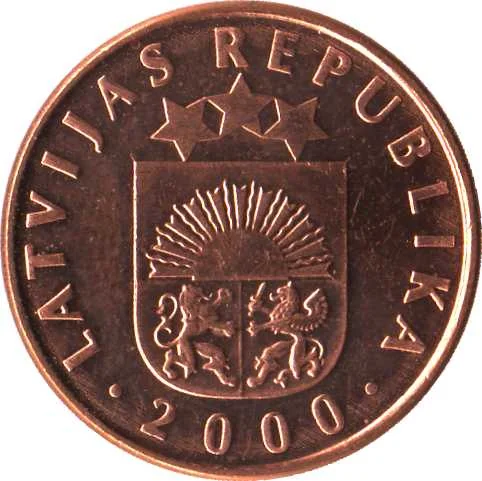
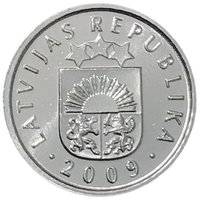
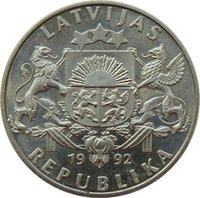
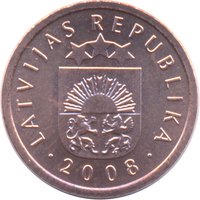
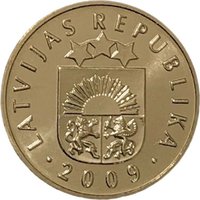
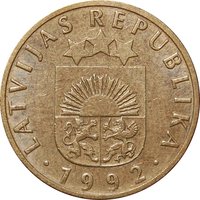
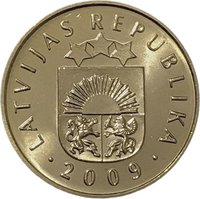
Latvian small coat of arms, encircled by LATVIJAS REPUBLIKA 2000.
Inscription:
LATVIJAS REPUBLIKA
· 2000 ·
· 2000 ·
Translation:
REPUBLIC OF LATVIA
· 2000 ·
· 2000 ·
Script: Latin
Language: Latvian
Engraver: Jānis Strupulis
Designer: Gunārs Lūsis
Reverse
Description:
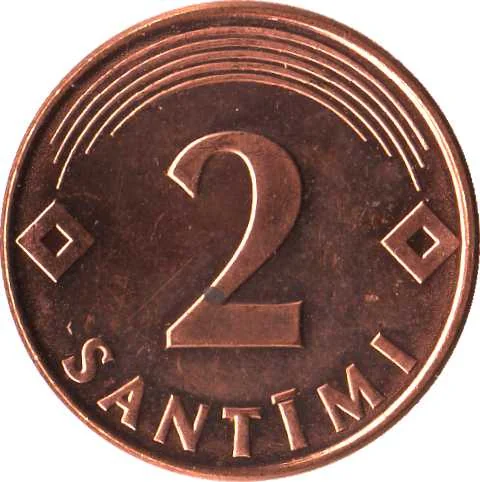
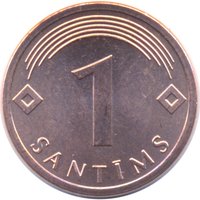
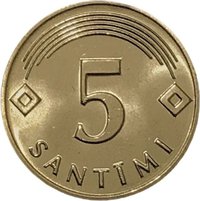
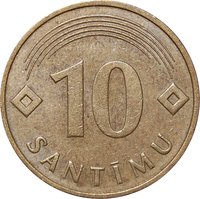
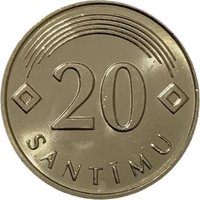
A centered numeral 2 is flanked by two diamond-shaped suns, connected by five arcs above. The word SANTĪMI curves along the bottom.
Inscription:
2
SANTĪMI
SANTĪMI
Translation:
Cents.
Script: Latin
Language: Latvian
Engraver: Jānis Strupulis
Designer: Gunārs Lūsis
Edge
Plain
Mints
| Name | Mark |
|---|---|
| Munich | — |
| Royal Dutch Mint | — |
| Royal Mint | — |
| Staatliche Münze Baden-Württemberg | — |
Mintings
| Year | Mint Mark | Mintage | Quality | Collection |
|---|---|---|---|---|
| 1992 | — | 35,000,000 | ||
| 2000 | — | 35,000,000 | ||
| 2006 | — | 18,000,000 | ||
| 2007 | — | 30,000,000 | ||
| 2009 | — | 50,000,000 |
Historical background
In 1992, Latvia was in the turbulent early phase of reclaiming its economic sovereignty following the collapse of the Soviet Union. The national currency, the Latvian ruble (popularly known as the "reponīks"), was introduced in May 1992 as an interim currency to break away from the hyperinflationary Soviet ruble zone. This was a critical and risky step, as the country lacked substantial foreign reserves and was experiencing severe economic contraction, with shortages of basic goods and a collapsing industrial sector tied to the former Soviet market.
The currency situation was characterized by a dual-circulation period. Initially, the Latvian ruble circulated alongside the rapidly depreciating Soviet rubles, creating confusion and instability. To stabilize the situation, the Bank of Latvia implemented a strict monetary policy and introduced a quasi-currency system, where the Latvian ruble was initially issued as a parallel currency coupon. Its success hinged on maintaining public trust and a relatively stable value compared to its Soviet counterpart, which required restrictive credit policies and careful management amidst political pressure to support struggling industries.
This precarious interim period laid the essential groundwork for the eventual introduction of the permanent national currency, the lats, in 1993. The successful stabilization of the Latvian ruble in 1992, despite the immense challenges, was a pivotal achievement. It allowed Latvia to fully exit the ruble zone, establish independent monetary policy, and curb hyperinflation, setting the stage for the subsequent economic reforms and, ultimately, integration into the European and global financial systems.
The currency situation was characterized by a dual-circulation period. Initially, the Latvian ruble circulated alongside the rapidly depreciating Soviet rubles, creating confusion and instability. To stabilize the situation, the Bank of Latvia implemented a strict monetary policy and introduced a quasi-currency system, where the Latvian ruble was initially issued as a parallel currency coupon. Its success hinged on maintaining public trust and a relatively stable value compared to its Soviet counterpart, which required restrictive credit policies and careful management amidst political pressure to support struggling industries.
This precarious interim period laid the essential groundwork for the eventual introduction of the permanent national currency, the lats, in 1993. The successful stabilization of the Latvian ruble in 1992, despite the immense challenges, was a pivotal achievement. It allowed Latvia to fully exit the ruble zone, establish independent monetary policy, and curb hyperinflation, setting the stage for the subsequent economic reforms and, ultimately, integration into the European and global financial systems.
Series: 1992 Latvia circulation coins
🌱 Very Common