

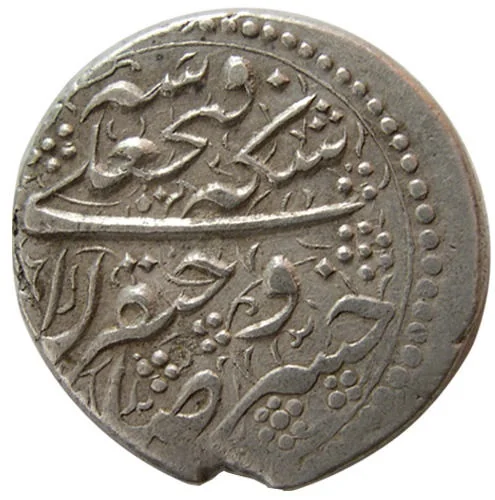
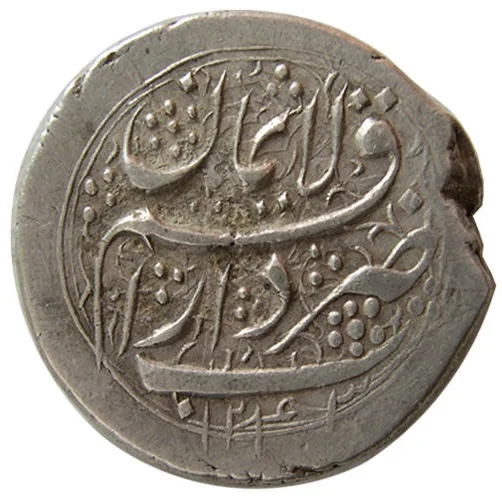
1 rial (Fat'h Ali reign) – Iran
Add to wishlist
Circulating commemorative coins
Commemoration: 30th anniversary of Fat'h Ali reign
Iran
Context
Year: 1827
Islamic (Hijri) Year:: 1243
Issuer: Iran
Ruler: Fath-Ali Shah
Currency:
(1798—1825)
Demonetization: 1834
Material
References
Numista: #196672
Value
Bullion value: $17.29
Obverse
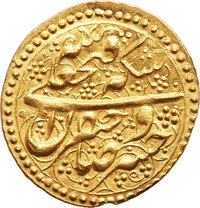
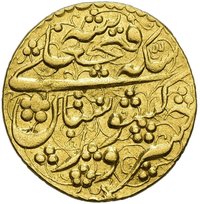
Inscription:
سکه فتحعلی شه
خسرو صاحبقران
خسرو صاحبقران
Translation:
Coin of Fath Ali Shah,
The Khusrow, Lord of the Auspicious Conjunction.
The Khusrow, Lord of the Auspicious Conjunction.
Language: Persian
Reverse
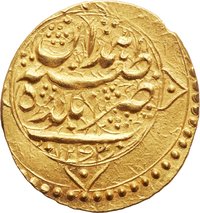
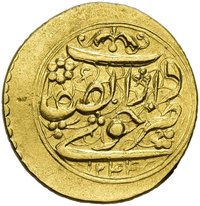
Inscription:
ضرب دارالایمان قـــم
۱۲۴۳
۱۲۴۳
Translation:
Struck in the Abode of Faith, Qom
1243
1243
Language: Persian
Edge
Plain
Mints
| Name | Mark |
|---|---|
| Qumm | قم |
Mintings
| Year | Mint Mark | Mintage | Quality | Collection |
|---|---|---|---|---|
| 1827 | — | — |
Historical background
In 1827, Iran’s currency system was in a state of profound disarray, a legacy of earlier 19th-century crises and weak central authority. The country operated on a bimetallic system of silver qirans and gold tomans, but the coinage was heavily debased. Successive Qajar shahs, facing massive state expenses for military campaigns and the royal court, had resorted to striking coins with progressively lower silver content to generate short-term revenue. This resulted in a chaotic circulation of coins of varying weights and purities from different mints and reigns, severely undermining public trust and hindering commerce.
This monetary instability was exacerbated by external pressures and a fragmented economy. Following the Russo-Persian Wars (1804–1813 and 1826–1828), Iran was forced into the Treaty of Turkmenchay in early 1828, which imposed a heavy indemnity of 20 million silver roubles on the state. While the treaty was signed in 1828, its financial terms were being negotiated and anticipated in 1827, placing immense strain on the treasury. The indemnity payments, which had to be made in pure silver, further drained the country of its sound currency, leaving the debased coins in domestic circulation and accelerating inflation.
Consequently, the year 1827 represented a low point on the path to a full monetary crisis. Internal trade was hampered by the need for money-changers to assess each coin, while external trade suffered due to the lack of a reliable standard. The state’s inability to reform the coinage or control its finances reflected the broader weaknesses of the Qajar administration. Thus, the currency situation on the eve of the Turkmenchay Treaty was one of severe depreciation and fragmentation, setting the stage for further economic hardship and foreign financial intervention in the decades to follow.
This monetary instability was exacerbated by external pressures and a fragmented economy. Following the Russo-Persian Wars (1804–1813 and 1826–1828), Iran was forced into the Treaty of Turkmenchay in early 1828, which imposed a heavy indemnity of 20 million silver roubles on the state. While the treaty was signed in 1828, its financial terms were being negotiated and anticipated in 1827, placing immense strain on the treasury. The indemnity payments, which had to be made in pure silver, further drained the country of its sound currency, leaving the debased coins in domestic circulation and accelerating inflation.
Consequently, the year 1827 represented a low point on the path to a full monetary crisis. Internal trade was hampered by the need for money-changers to assess each coin, while external trade suffered due to the lack of a reliable standard. The state’s inability to reform the coinage or control its finances reflected the broader weaknesses of the Qajar administration. Thus, the currency situation on the eve of the Turkmenchay Treaty was one of severe depreciation and fragmentation, setting the stage for further economic hardship and foreign financial intervention in the decades to follow.
✨ Legendary