

10 senti – Tanzania
Add to wishlist
Tanzania
Context
Material
Diameter: 25 mm
Weight: 5.03 g
Thickness: 1.49 mm
Shape: Scalloped
Composition: Nickel brass
Magnetic: No
Technique: Milled
Alignment: Medal alignment
flip
References
KM: #
Numista: #1962
Value
Exchange value: 0.10 TZS
Obverse
Description:
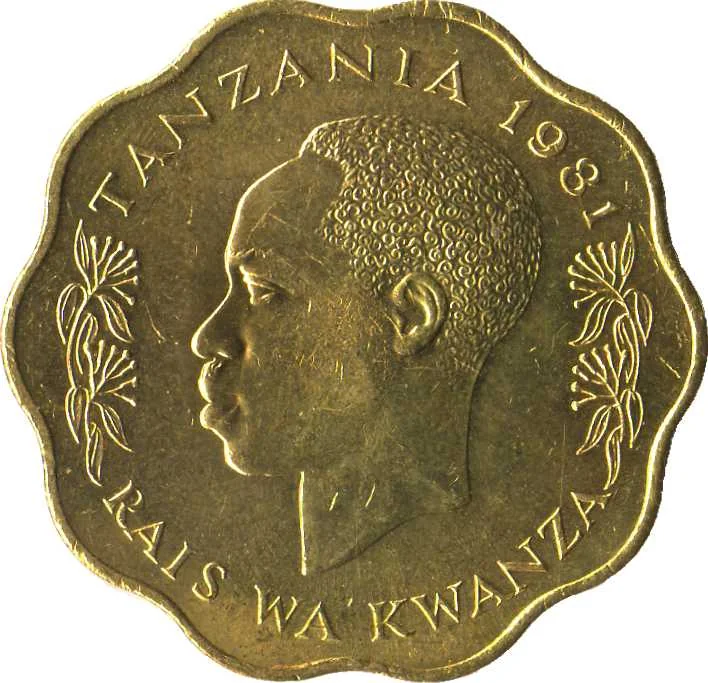
Julius Nyerere, left profile.
Inscription:
TANZANIA 1981
RAIS WA KWANZA
RAIS WA KWANZA
Translation:
FIRST PRESIDENT
Script: Latin
Language: Swahili
Engraver: Christopher Ironside
Reverse
Description:
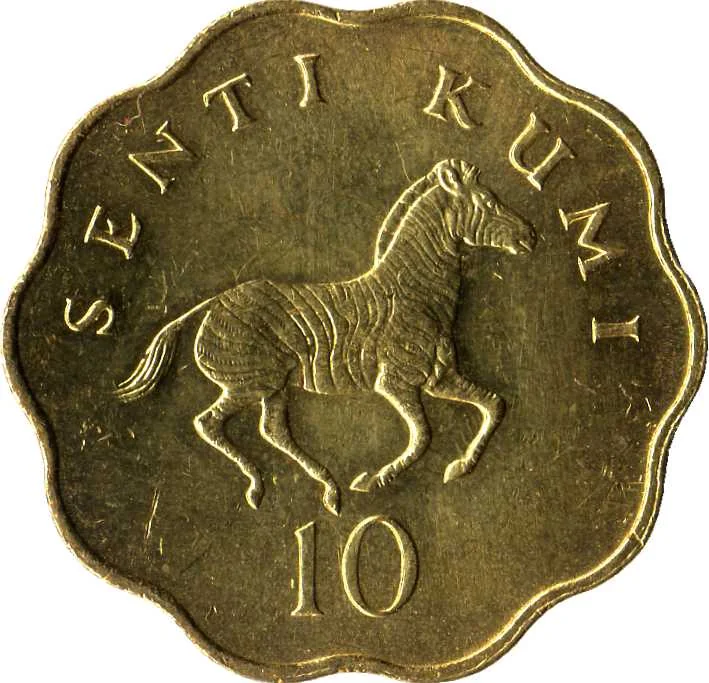
Prancing zebra facing right. *Equus quagga*
Inscription:
10 SENTI
KUMI
KUMI
Translation:
Ten Cents
Group
Group
Script: Latin
Language: Samoan
Engraver: Christopher Ironside
Edge
Plain
Mints
| Name | Mark |
|---|---|
| Royal Mint | — |
Mintings
| Year | Mint Mark | Mintage | Quality | Collection |
|---|---|---|---|---|
| 1977 | — | 19,505,000 | ||
| 1979 | — | 8,000,000 | ||
| 1980 | — | 10,000,000 | ||
| 1981 | — | 10,000,000 | ||
| 1984 | — | — |
Historical background
In 1977, Tanzania's currency situation was directly shaped by the political and economic union with the Seychelles under the East African Community (EAC). Following the collapse of the original EAC (with Kenya and Uganda) earlier that year, Tanzania remained in a smaller currency union with the Seychelles. Both nations used the East African shilling, which was issued by the East African Currency Board. This arrangement was a vestige of the broader regional cooperation that had dissolved, leaving Tanzania's monetary system in a transitional and somewhat anomalous state.
This period was one of significant monetary transition. The dissolution of the EAC necessitated the creation of a national currency. Consequently, 1977 saw the establishment of the Bank of Tanzania and the introduction of the Tanzanian shilling (TZS) to replace the East African shilling. The new currency was launched on June 14, 1966, but the process of full implementation and circulation continued into 1977, solidifying national monetary sovereignty. This move was a critical step in President Julius Nyerere's policy of Ujamaa (African socialism), as it granted the government direct control over monetary policy to pursue its socialist development goals.
The broader economic context was challenging. Tanzania's economy was strained by the costs of the Ugandan-Tanzanian War, the earlier oil price shocks, and the difficulties of implementing Ujamaa, which included costly villageization programs and declining agricultural productivity. Therefore, while the introduction of the Tanzanian shilling in 1977 was a symbol of economic self-reliance, it operated within an environment of growing foreign debt, scarcity of foreign exchange, and inflationary pressures. The new currency was thus born into a period of economic hardship that would define its early years.
This period was one of significant monetary transition. The dissolution of the EAC necessitated the creation of a national currency. Consequently, 1977 saw the establishment of the Bank of Tanzania and the introduction of the Tanzanian shilling (TZS) to replace the East African shilling. The new currency was launched on June 14, 1966, but the process of full implementation and circulation continued into 1977, solidifying national monetary sovereignty. This move was a critical step in President Julius Nyerere's policy of Ujamaa (African socialism), as it granted the government direct control over monetary policy to pursue its socialist development goals.
The broader economic context was challenging. Tanzania's economy was strained by the costs of the Ugandan-Tanzanian War, the earlier oil price shocks, and the difficulties of implementing Ujamaa, which included costly villageization programs and declining agricultural productivity. Therefore, while the introduction of the Tanzanian shilling in 1977 was a symbol of economic self-reliance, it operated within an environment of growing foreign debt, scarcity of foreign exchange, and inflationary pressures. The new currency was thus born into a period of economic hardship that would define its early years.
🌱 Very Common