

10 centimos – Spain
Add to wishlist
Spain
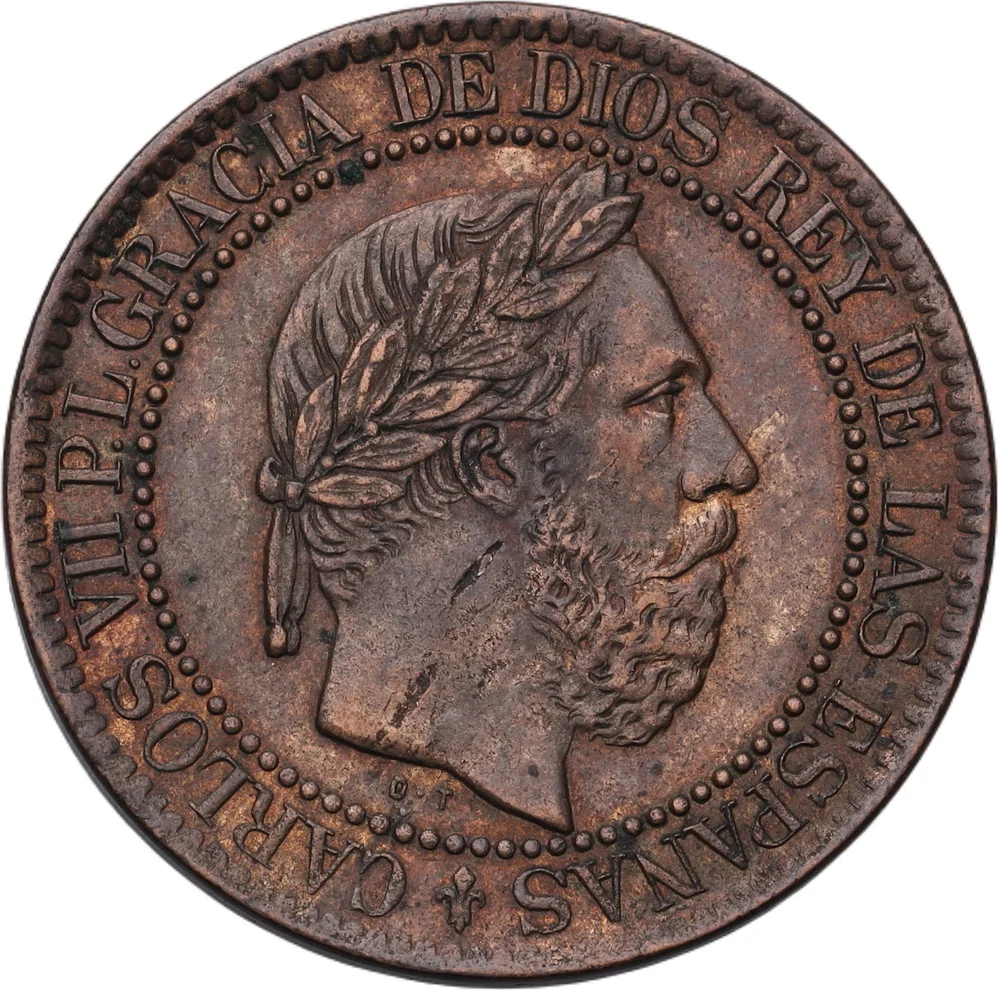
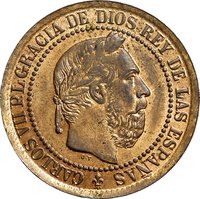
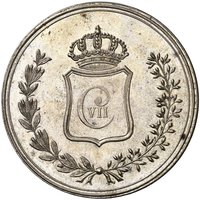
Obverse
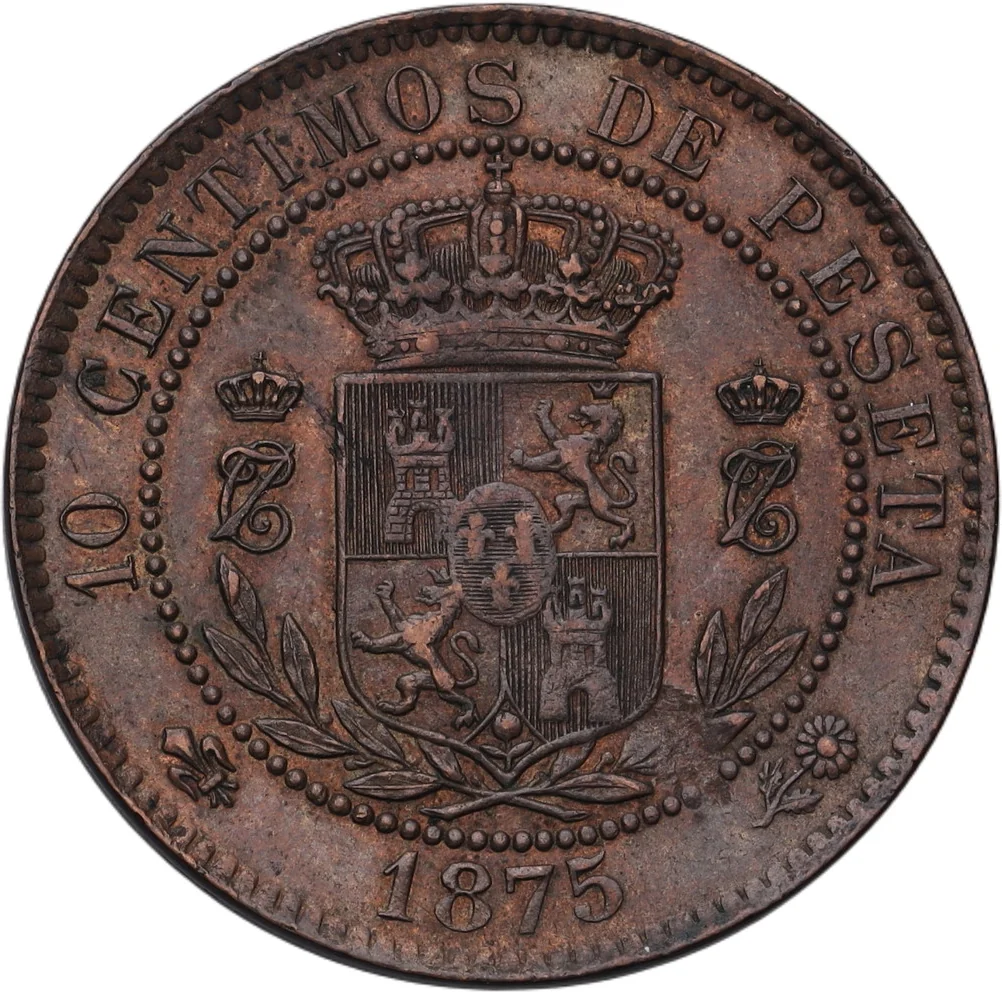
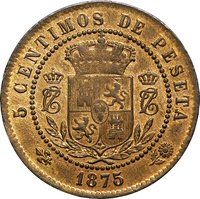
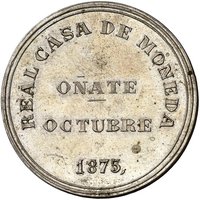
Reverse
Edge
Plain
Categories
| Symbols> Coat of Arms |
| Symbols> Monogram |
Mints
| Name | Mark |
|---|---|
| Oñate | OT |
Mintings
| Year | Mint Mark | Mintage | Quality | Collection |
|---|---|---|---|---|
| 1875 | OT | 100,000 |
Historical background
In 1875, Spain was in the midst of the Bourbon Restoration, a period of political consolidation following the turbulent First Republic. The currency situation, however, was a direct legacy of the preceding financial chaos. The country operated on a bimetallic system (gold and silver) in theory, but in practice it suffered from a severely depreciated paper currency known as the peseta. During the 1868-1874 period, excessive issuance of paper money to fund government deficits, wars, and political instability had led to a significant loss of public confidence and a sharp divergence between the face value of banknotes and their real metallic worth.
The new government under King Alfonso XII and Minister of Finance Juan Francisco Camacho recognized that monetary stability was essential for economic recovery and international credibility. Their primary objective was to return to a metallic standard and eliminate the damaging paper money premium. In 1874, the Bank of Spain was granted the exclusive right to issue banknotes, centralizing and controlling the money supply. Then, in 1875, Camacho initiated a crucial policy: the gradual withdrawal and burning of the depreciated paper currency from circulation, funded by a series of international loans.
This decisive action in 1875 marked the beginning of the peseta’s stabilization. By committing to retire the fiduciary currency and restore convertibility, the government aimed to re-establish the peseta on a de facto gold standard, which it would formally adopt in the coming decade. The reforms of 1874-1875 laid the essential groundwork, ending the era of wild monetary fluctuations and creating the conditions for the peseta to become Spain's stable and unified national currency for the next century.
The new government under King Alfonso XII and Minister of Finance Juan Francisco Camacho recognized that monetary stability was essential for economic recovery and international credibility. Their primary objective was to return to a metallic standard and eliminate the damaging paper money premium. In 1874, the Bank of Spain was granted the exclusive right to issue banknotes, centralizing and controlling the money supply. Then, in 1875, Camacho initiated a crucial policy: the gradual withdrawal and burning of the depreciated paper currency from circulation, funded by a series of international loans.
This decisive action in 1875 marked the beginning of the peseta’s stabilization. By committing to retire the fiduciary currency and restore convertibility, the government aimed to re-establish the peseta on a de facto gold standard, which it would formally adopt in the coming decade. The reforms of 1874-1875 laid the essential groundwork, ending the era of wild monetary fluctuations and creating the conditions for the peseta to become Spain's stable and unified national currency for the next century.
Series: 1875 Spain circulation coins
⭐ Somewhat Rare