


5 Pounds – United Kingdom
United Kingdom
Context

Material

References
KM: #Click to copy to clipboard1139a
Numista: #195948
Value
Exchange value: 5 GBP = $6.77
Bullion value: $74.87
Inflation-adjusted value: 8.57 GBP
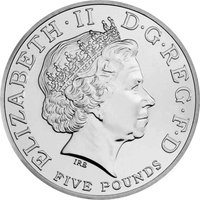
Obverse
Description:
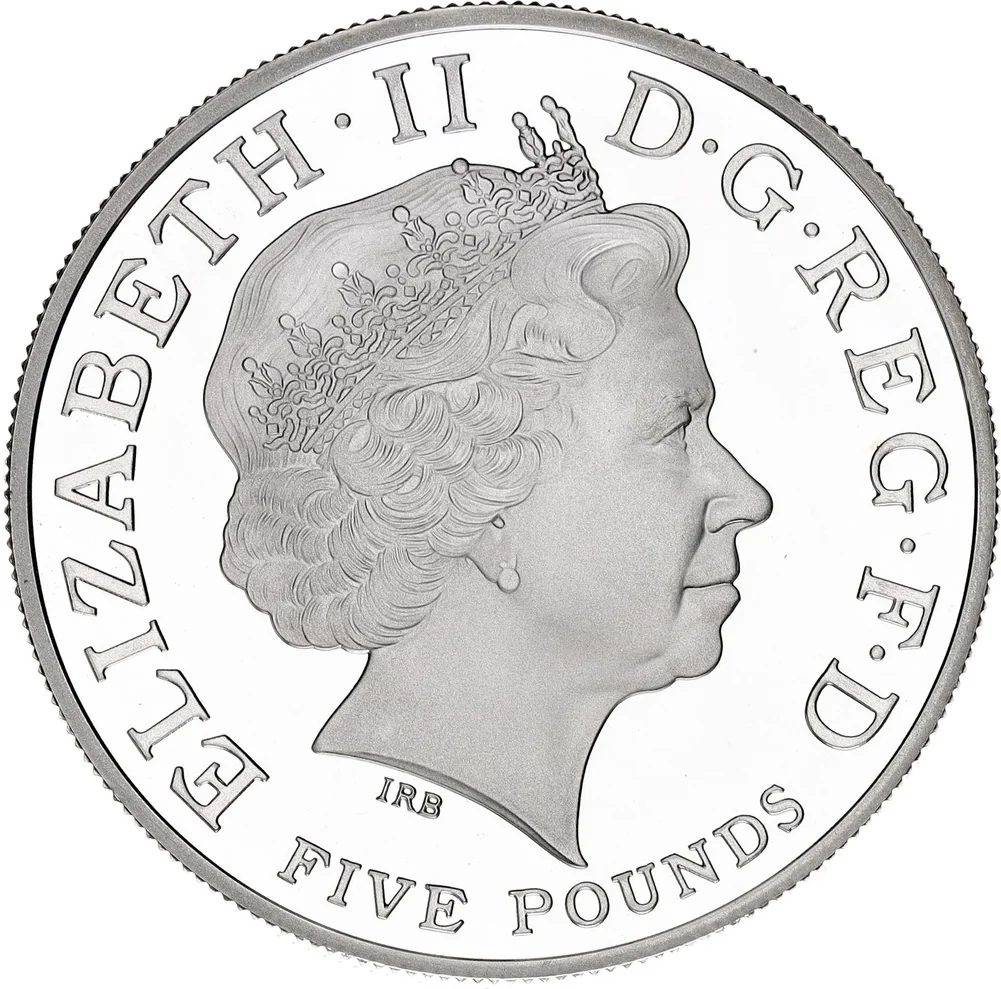
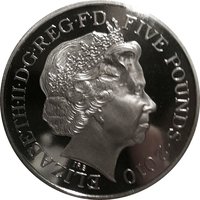
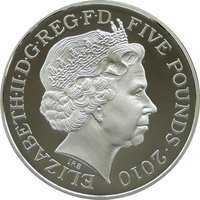
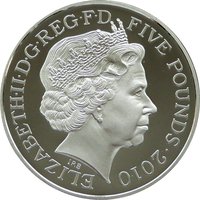
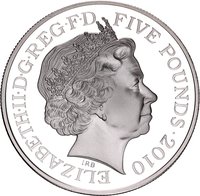
Queen Elizabeth IV facing right, wearing the Girls of Great Britain and Ireland tiara.
Inscription:
ELIZABETH·II D·G·REG·F·D
IRB
FIVE POUNDS
IRB
FIVE POUNDS
Translation:
Elizabeth II, by the Grace of God, Queen, Defender of the Faith
Five Pounds
Five Pounds
Script: Latin
Engraver: Ian Rank-Broadley
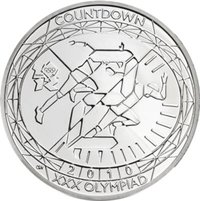
Reverse
Description:
Central stylized runners integrated with a large digital "2" for "two years to the 2012 Olympics."
Inscription:
COUNTDOWN
london
2
2010
CA XXX OLYMPIAD
london
2
2010
CA XXX OLYMPIAD
Script: Latin
Engraver: Claire Aldridge
Edge
Reeded
Mints
| Name | Mark |
|---|---|
| Royal Mint | — |
Mintings
| Year | Mint Mark | Mintage | Quality | Collection |
|---|---|---|---|---|
| 2010 | — | 20,159 | Proof |
Historical background
In 2010, the United Kingdom's currency situation was dominated by the profound and lingering effects of the 2007-2008 Global Financial Crisis. The economy had just emerged from a deep recession, and the newly elected Conservative-Liberal Democrat coalition government, under Prime Minister David Cameron and Chancellor George Osborne, immediately framed the national economic narrative around a dire need for fiscal austerity. Their central argument was that a record post-war budget deficit, exceeding 11% of GDP, posed an existential threat to market confidence in the pound sterling and the UK's sovereign credit rating. The fear of a sterling crisis or a loss of the UK's prized AAA credit rating was a powerful political tool used to justify sweeping public spending cuts.
Against this backdrop, the pound sterling (GBP) was in a period of relative weakness and volatility following a sharp depreciation during the crisis. Having fallen from over $2.00 to nearly $1.35 against the US dollar in 2009, it traded in a range between $1.45 and $1.60 for much of 2010. The Bank of England, under Governor Mervyn King, maintained an ultra-accommodative monetary policy to support the fragile recovery, holding the base interest rate at a historic low of 0.5% and continuing its Quantitative Easing (QE) programme. This policy divergence with other central banks, combined with eurozone debt anxieties, kept sterling under pressure, though it avoided the catastrophic collapse some austerity warnings had implied.
Ultimately, the currency's fate in 2010 was intertwined with the twin pillars of aggressive fiscal consolidation and sustained monetary stimulus. While the austerity agenda was intended to protect sterling's long-term value by restoring fiscal credibility, the immediate effect of low rates and QE worked to suppress it. This created a complex environment where the pound was seen as stable but fundamentally vulnerable, reflecting the broader economic uncertainty of a nation grappling with the legacy of a banking crisis and the untested experiment of large-scale deficit reduction during a recovery.
Against this backdrop, the pound sterling (GBP) was in a period of relative weakness and volatility following a sharp depreciation during the crisis. Having fallen from over $2.00 to nearly $1.35 against the US dollar in 2009, it traded in a range between $1.45 and $1.60 for much of 2010. The Bank of England, under Governor Mervyn King, maintained an ultra-accommodative monetary policy to support the fragile recovery, holding the base interest rate at a historic low of 0.5% and continuing its Quantitative Easing (QE) programme. This policy divergence with other central banks, combined with eurozone debt anxieties, kept sterling under pressure, though it avoided the catastrophic collapse some austerity warnings had implied.
Ultimately, the currency's fate in 2010 was intertwined with the twin pillars of aggressive fiscal consolidation and sustained monetary stimulus. While the austerity agenda was intended to protect sterling's long-term value by restoring fiscal credibility, the immediate effect of low rates and QE worked to suppress it. This created a complex environment where the pound was seen as stable but fundamentally vulnerable, reflecting the broader economic uncertainty of a nation grappling with the legacy of a banking crisis and the untested experiment of large-scale deficit reduction during a recovery.
Series: 2012 Summer Olympics, London






💎 Very Rare