

100 Dinars (Algeria's Independence) – Algeria
Circulating commemorative coins
Commemoration: 40th Anniversary of Algeria's Independence
Algeria
Context
Year: 2002
Issuer: Algeria 
Issuing organization: Bank of Algeria
Period:
(since 1962)
Currency:
(since 1964)
Material
References
KM: #Click to copy to clipboard137
Numista: #10829
Value
Exchange value: 100 DZD
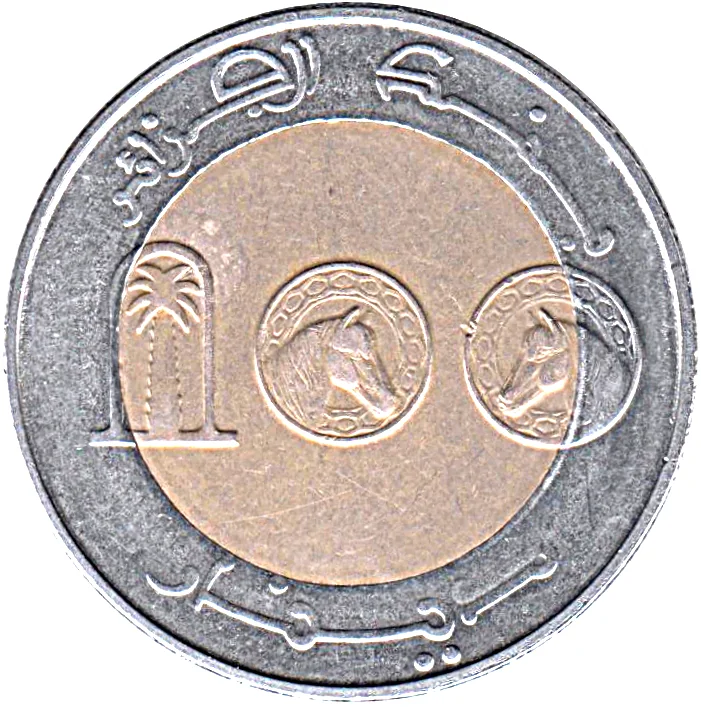
Obverse
Reverse
Description:
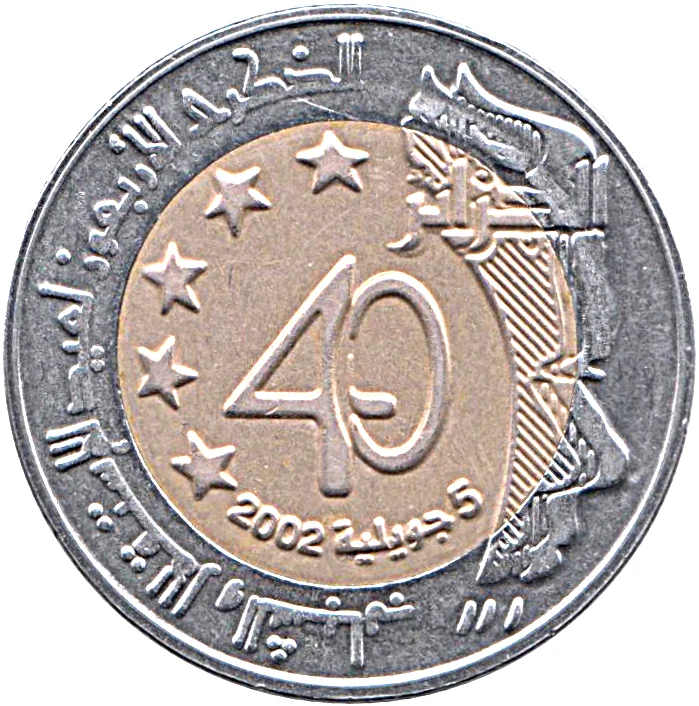
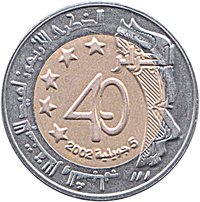
Central "40" with a left star, two right profiles, and an Arabic inscription arching along the bottom half.
Inscription:
Inner circle: 2002 جويلية 5
Ring: الذكرى الأربعين لعيد الاستقلال والشباب
Ring: الذكرى الأربعين لعيد الاستقلال والشباب
Translation:
5 July 2002
The Fortieth Anniversary of Independence and Youth
The Fortieth Anniversary of Independence and Youth
Script: Arabic
Language: Arabic
Edge
Reeded (185 reeds)
Mints
| Name | Mark |
|---|---|
| Algiers | — |
Mintings
| Year | Mint Mark | Mintage | Quality | Collection |
|---|---|---|---|---|
| 2002 | — | — |
Historical background
In 2002, Algeria's currency situation was characterized by a heavily managed exchange rate and a gradual shift away from the strict controls of the previous decade. The Algerian dinar (DZD) was officially pegged to a basket of currencies, heavily weighted toward the US dollar, but in practice, its value was administered by the Bank of Algeria. This created a significant disparity between the official rate and the more depreciated black-market rate, a persistent feature reflecting underlying economic pressures, including a reliance on hydrocarbon exports and demand for imported goods. The government maintained strict capital controls to conserve foreign exchange reserves, which had been rebuilt following the 1994 International Monetary Fund (IMF) agreement and subsequent reforms.
The macroeconomic context was dominated by high oil prices, which provided a crucial fiscal cushion. Rising crude prices throughout the early 2000s boosted state revenues, trade surpluses, and foreign exchange reserves, easing immediate balance of payments pressures. This hydrocarbon windfall allowed authorities to avoid a sharp devaluation and maintain relative stability in the official exchange rate. However, this also postponed more substantive market-oriented reforms, as the urgency to diversify the economy or liberalize the currency regime was diminished by comfortable energy revenues.
Overall, the currency regime in 2002 was in a state of cautious stability but faced underlying structural challenges. The system prioritized control and stability over flexibility, shielding the domestic economy from volatility but also perpetuating inefficiencies and a dual-rate system. While the immediate crisis of the 1990s had passed, the situation highlighted Algeria's ongoing dependence on hydrocarbons and the need for broader economic reforms to address the fundamental imbalances that sustained the gap between the official and parallel market dinar valuations.
The macroeconomic context was dominated by high oil prices, which provided a crucial fiscal cushion. Rising crude prices throughout the early 2000s boosted state revenues, trade surpluses, and foreign exchange reserves, easing immediate balance of payments pressures. This hydrocarbon windfall allowed authorities to avoid a sharp devaluation and maintain relative stability in the official exchange rate. However, this also postponed more substantive market-oriented reforms, as the urgency to diversify the economy or liberalize the currency regime was diminished by comfortable energy revenues.
Overall, the currency regime in 2002 was in a state of cautious stability but faced underlying structural challenges. The system prioritized control and stability over flexibility, shielding the domestic economy from volatility but also perpetuating inefficiencies and a dual-rate system. While the immediate crisis of the 1990s had passed, the situation highlighted Algeria's ongoing dependence on hydrocarbons and the need for broader economic reforms to address the fundamental imbalances that sustained the gap between the official and parallel market dinar valuations.
🌱 Fairly Common