

2 schilling – Austria
Add to wishlist
Austria
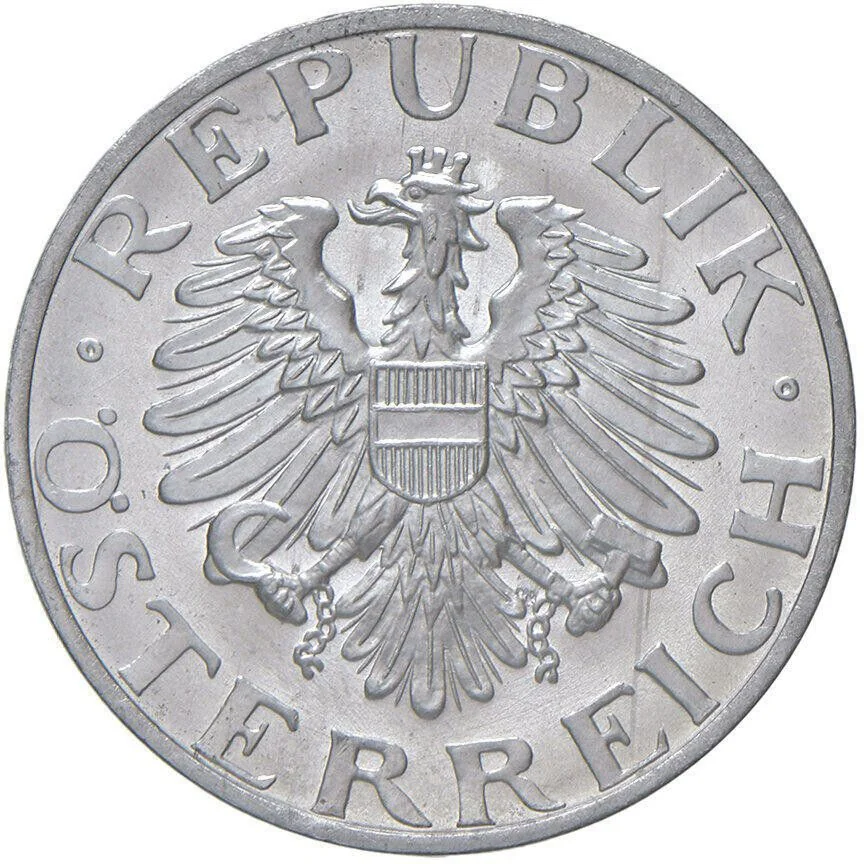
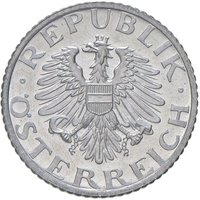
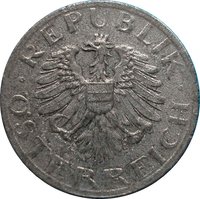
Obverse
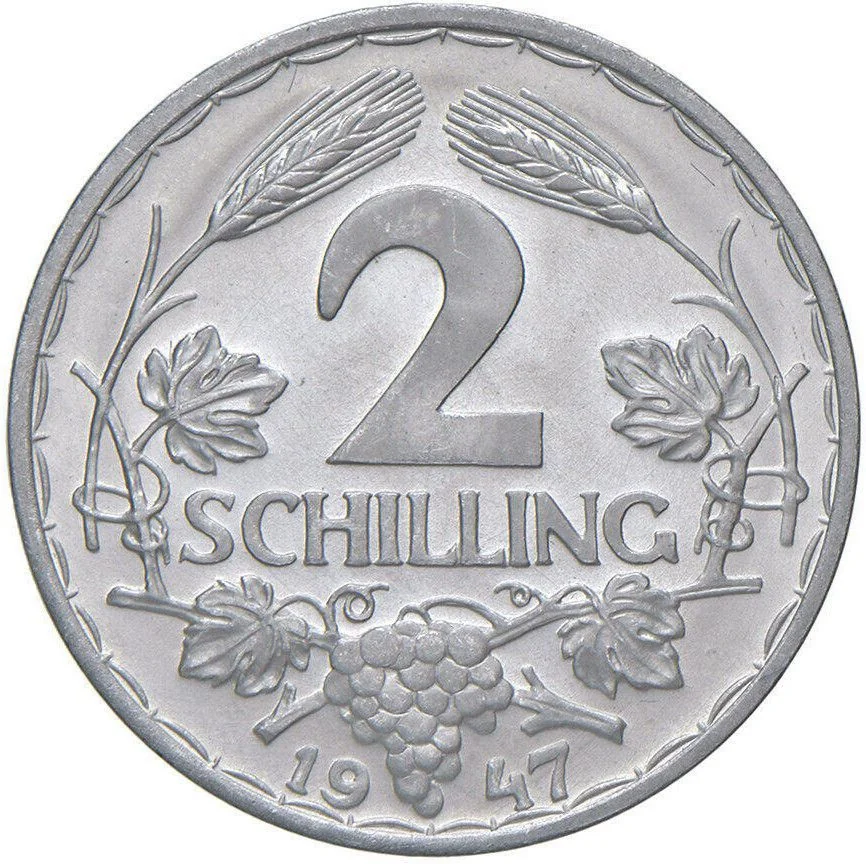
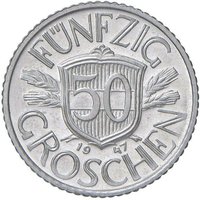
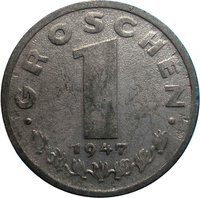
Reverse
Edge
Plain
Categories
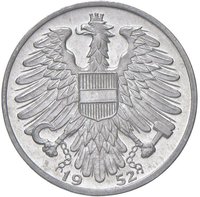
| Animal> Bird> Eagle |
| Plant> Fruit |
| Symbols> Coat of Arms |
| Symbol> Hammer and sickle |
Mints
| Name | Mark |
|---|---|
| Münze Österreich | — |
Mintings
| Year | Mint Mark | Mintage | Quality | Collection |
|---|---|---|---|---|
| 1946 | — | 10,082,000 | ||
| 1946 | — | — | Proof | |
| 1947 | — | — | Proof | |
| 1947 | — | 20,140,000 | ||
| 1952 | — | 149,000 | ||
| 1952 | — | — | Proof |
Historical background
In 1946, Austria was grappling with a severe currency crisis that threatened its post-war recovery and stability. The nation remained under Allied occupation, divided into four zones controlled by the United States, Soviet Union, United Kingdom, and France. A critical problem was the massive oversupply of the Reichsmark, the currency imposed by Nazi Germany after the 1938 Anschluss. This currency, which continued to circulate, was being printed in enormous quantities by the Soviet military administration to fund its costs, leading to rampant inflation, a thriving black market, and a collapse of legitimate economic activity. The Austrian schilling, the nation's historic currency, existed only as a symbolic "schilling currency" used for accounting by banks and the government, but not as physical cash.
Recognizing that economic chaos was undermining all reconstruction efforts, the Western Allies and the Austrian government devised a radical plan for currency reform. The pivotal Schilling Law of November 1946 was passed by the Austrian parliament, announcing that a new Austrian schilling would replace the Reichsmark. The conversion was harsh but necessary: for every 100 Reichsmarks in cash, individuals could exchange only 1.50 new schillings, with the rest forced into frozen bank accounts. This drastic reduction in the money supply was designed to wipe out the inflationary overhang and cripple the black market. Crucially, the Soviet Union initially refused to participate in this reform within its zone, creating a temporary but stark economic divide within the country.
The currency reform of late 1946 was a foundational step toward Austrian sovereignty and economic revival. While it initially caused hardship for those with cash savings, it successfully stabilized the monetary system, restored confidence, and allowed price controls to be gradually relaxed. The success of the reform in the three western zones eventually pressured the Soviet Union to implement a similar, though not identical, conversion in its zone in mid-1947. This monetary consolidation paved the way for the critical influx of Marshall Plan aid in 1948 and set the stage for the "economic miracle" of the 1950s, establishing the schilling as a symbol of regained national identity and stability.
Recognizing that economic chaos was undermining all reconstruction efforts, the Western Allies and the Austrian government devised a radical plan for currency reform. The pivotal Schilling Law of November 1946 was passed by the Austrian parliament, announcing that a new Austrian schilling would replace the Reichsmark. The conversion was harsh but necessary: for every 100 Reichsmarks in cash, individuals could exchange only 1.50 new schillings, with the rest forced into frozen bank accounts. This drastic reduction in the money supply was designed to wipe out the inflationary overhang and cripple the black market. Crucially, the Soviet Union initially refused to participate in this reform within its zone, creating a temporary but stark economic divide within the country.
The currency reform of late 1946 was a foundational step toward Austrian sovereignty and economic revival. While it initially caused hardship for those with cash savings, it successfully stabilized the monetary system, restored confidence, and allowed price controls to be gradually relaxed. The success of the reform in the three western zones eventually pressured the Soviet Union to implement a similar, though not identical, conversion in its zone in mid-1947. This monetary consolidation paved the way for the critical influx of Marshall Plan aid in 1948 and set the stage for the "economic miracle" of the 1950s, establishing the schilling as a symbol of regained national identity and stability.
Series: 1946 Austria circulation coins
🌱 Very Common