

5⁄10 Kreuzer – Austrian Empire
Austria
Context
Years: 1858–1866
Country: Austria 
Issuer: Austrian Empire
Ruler: Francis Joseph I
Currency:
(1857—1892)
Demonetization: 30 June 1898
Total mintage: 150,213,103
Material
References
KM: #Click to copy to clipboard2182
Numista: #19281
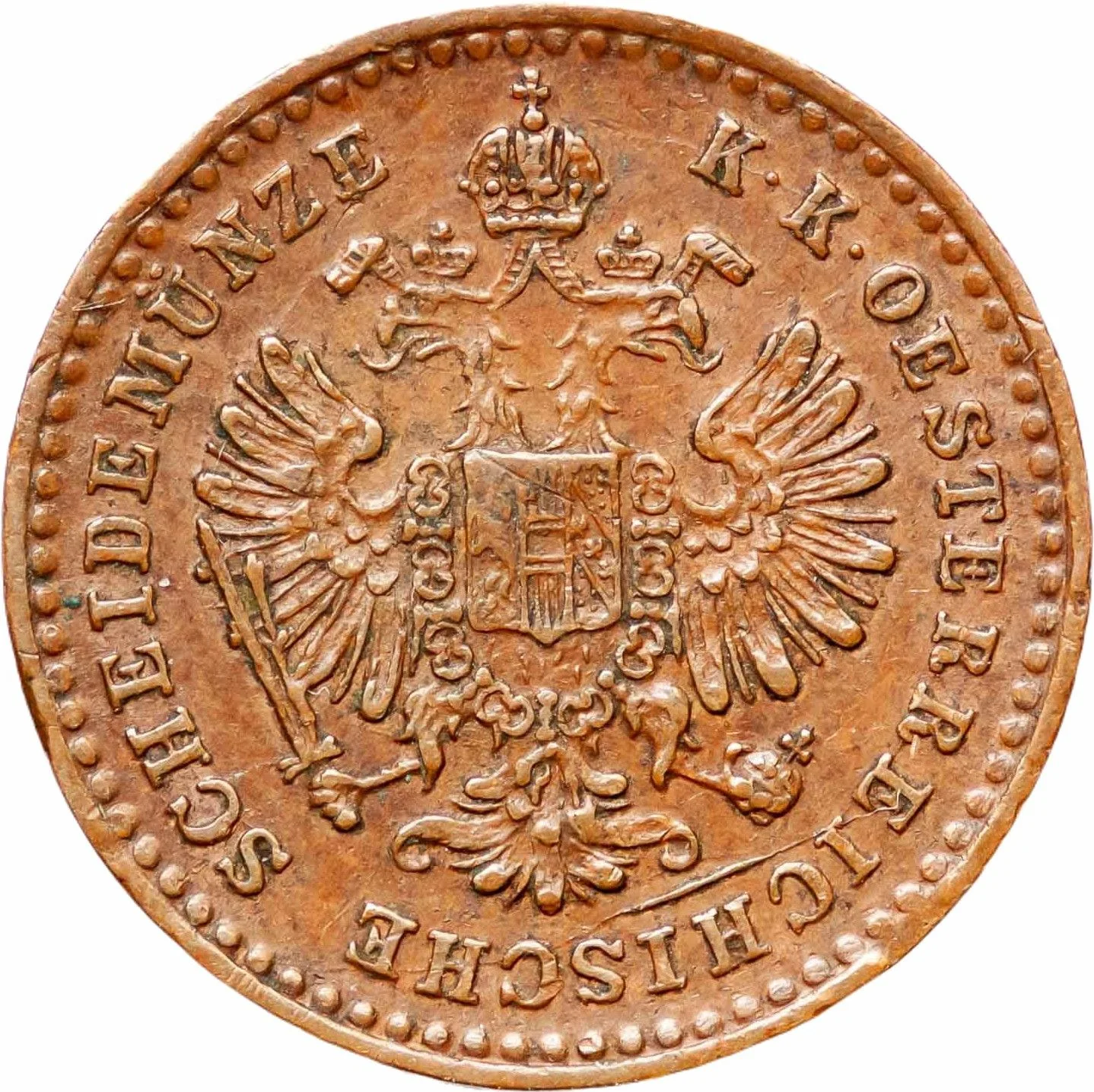
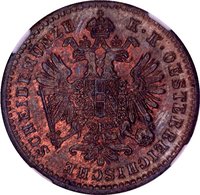
Obverse
Description:
Imperial eagle bearing Habsburg-Lorraine and Austrian arms.
Inscription:
K·K·OESTERREICHISCHE SCHEIDEMÜNZE
Translation:
I·I·Austrian small change coin
Script: Latin
Language: German
Engraver: Franz Gaul
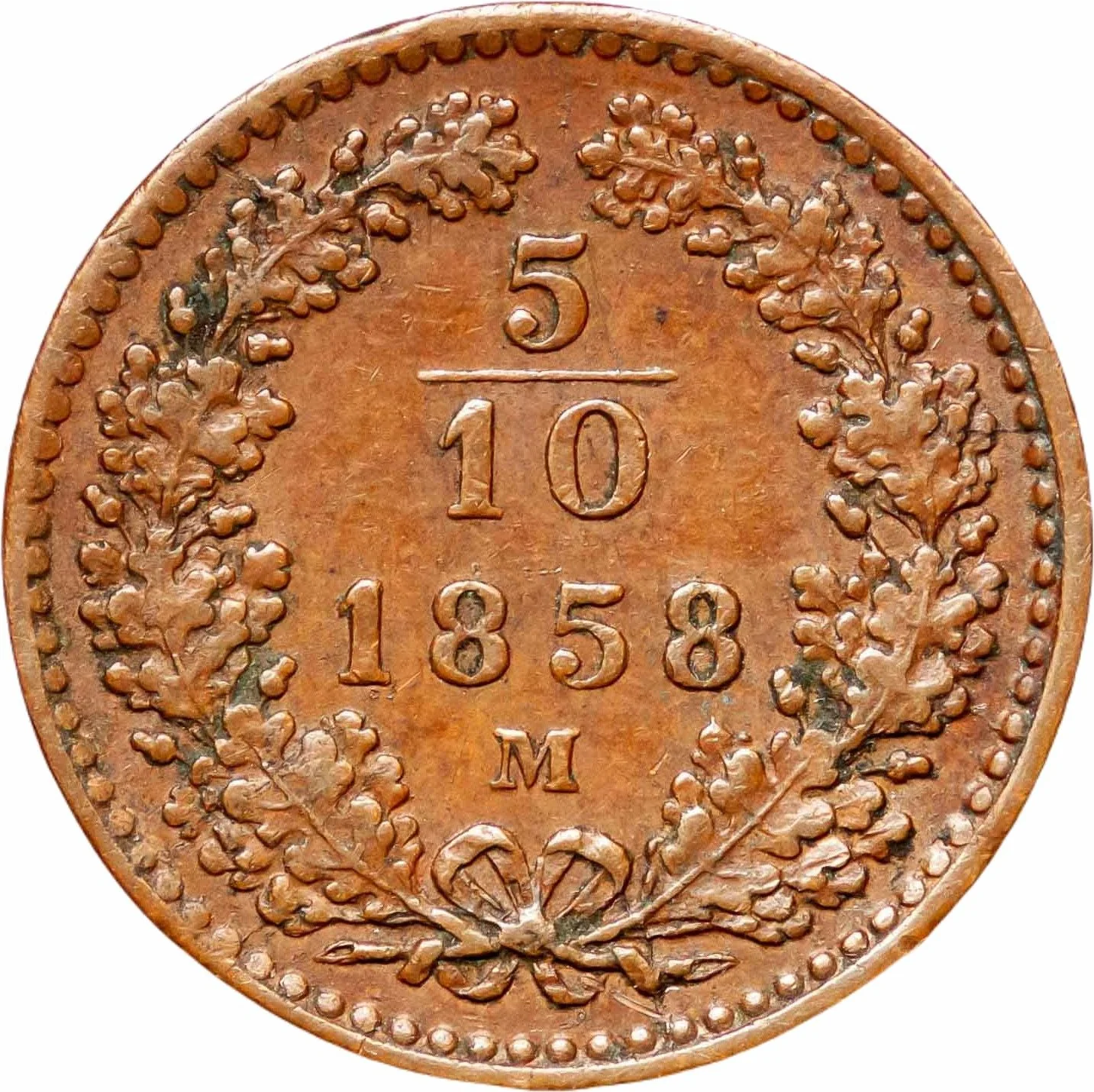
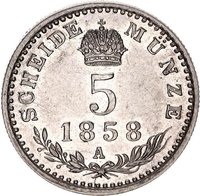
Reverse
Description:
Fraction, date, mint mark in wreath.
Inscription:
5
10
1858
M
10
1858
M
Script: Latin
Engraver: Johann Weiss
Edge
Plain
Mints
| Name | Mark |
|---|---|
| Milan | M |
Mintings
| Year | Mint Mark | Mintage | Quality | Collection |
|---|---|---|---|---|
| 1858 | A | 14,610,000 | ||
| 1858 | B | 11,058,000 | ||
| 1858 | E | — | ||
| 1858 | M | 2,460,000 | ||
| 1858 | V | 1,948,000 | ||
| 1859 | M | 7,324,000 | ||
| 1859 | V | 3,739,400 | ||
| 1859 | A | 24,360,000 | ||
| 1859 | B | 13,397,000 | ||
| 1859 | E | 5,204,493 | ||
| 1860 | A | 19,635,000 | ||
| 1860 | E | 4,000,710 | ||
| 1860 | V | 8,712,500 | ||
| 1861 | A | 5,670,000 | ||
| 1861 | B | 3,474,000 | ||
| 1863 | B | — | ||
| 1864 | V | — | ||
| 1864 | B | 7,598,000 | ||
| 1864 | A | 2,100,000 | ||
| 1865 | A | 2,850,000 | ||
| 1865 | B | 7,182,000 | ||
| 1866 | A | 4,890,000 |
Historical background
By 1858, the Austrian Empire's currency situation was one of profound instability and transition, rooted in the financial strains of the 1848 revolutions and the costly Crimean War (1853-1856). The state, deeply in debt, had long relied on paper money (Bankozettel) not fully backed by silver, leading to chronic depreciation and a confusing multiplicity of circulating mediums, including concurrent paper gulden and silver gulden at fluctuating values. This period was defined by the painful aftermath of the 1857 currency treaty (Wiener Münzvertrag) with the German states, which aimed to create a common silver standard but instead exacerbated Austria's difficulties by exposing the severe over-issuance of its paper currency.
The core problem was the stark divergence between the paper gulden (Wiener Währung) and the silver gulden (Conventionsmünze), with paper trading at a significant discount. Public confidence in state-issued paper was low, and the National Bank (Österreichische Nationalbank), struggling to maintain convertibility, was forced to suspend silver payments for its notes in 1858. This effectively placed the empire on a forced paper standard, isolating it economically and hindering both domestic commerce and international trade due to unpredictable exchange rates and the high cost of hedging against currency risk.
Consequently, 1858 represents a low point and a turning point. The financial crisis underscored the urgent need for radical reform, setting the stage for Finance Minister Ignaz von Plener's austerity measures and the pivotal 1859 Münzpatent. This decree began the arduous, decades-long process of stabilizing the currency, which would eventually lead to the introduction of the gold-backed gulden (Gulden Österreichischer Währung) in 1892. Thus, the situation in 1858 was the chaotic prelude to the empire's long and difficult journey toward monetary modernization.
The core problem was the stark divergence between the paper gulden (Wiener Währung) and the silver gulden (Conventionsmünze), with paper trading at a significant discount. Public confidence in state-issued paper was low, and the National Bank (Österreichische Nationalbank), struggling to maintain convertibility, was forced to suspend silver payments for its notes in 1858. This effectively placed the empire on a forced paper standard, isolating it economically and hindering both domestic commerce and international trade due to unpredictable exchange rates and the high cost of hedging against currency risk.
Consequently, 1858 represents a low point and a turning point. The financial crisis underscored the urgent need for radical reform, setting the stage for Finance Minister Ignaz von Plener's austerity measures and the pivotal 1859 Münzpatent. This decree began the arduous, decades-long process of stabilizing the currency, which would eventually lead to the introduction of the gold-backed gulden (Gulden Österreichischer Währung) in 1892. Thus, the situation in 1858 was the chaotic prelude to the empire's long and difficult journey toward monetary modernization.
🌱 Common