

50 Pfennigs – Germany
Germany

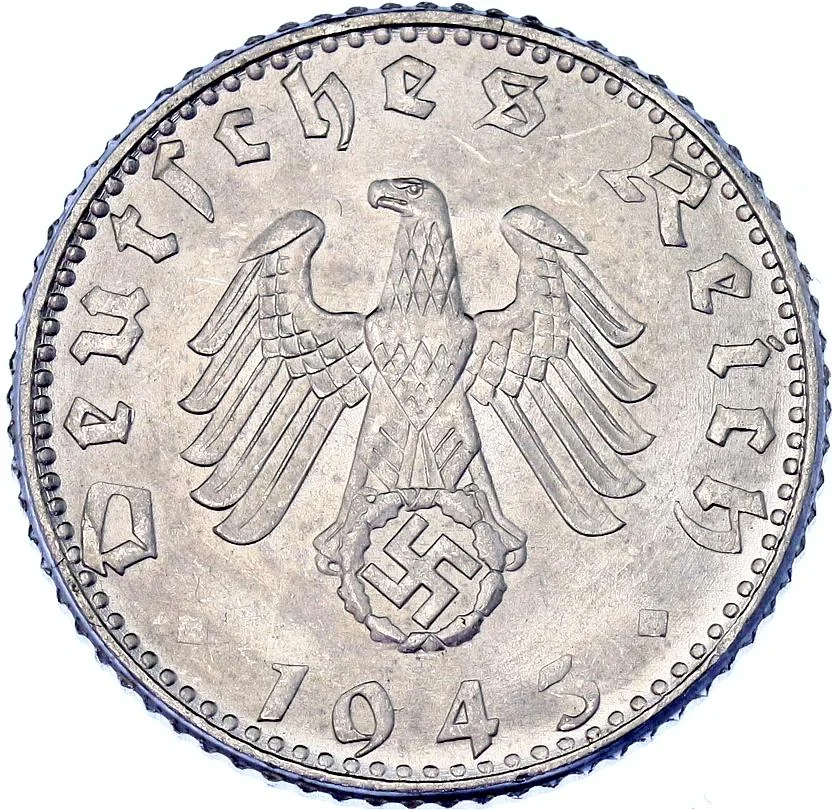
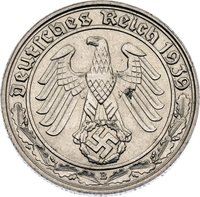
Obverse
Description:
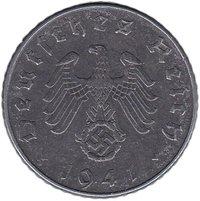
An eagle atop a swastika.
Inscription:
Deutsches Reich
1944
1944
Translation:
German Empire
1944
1944
Language: German
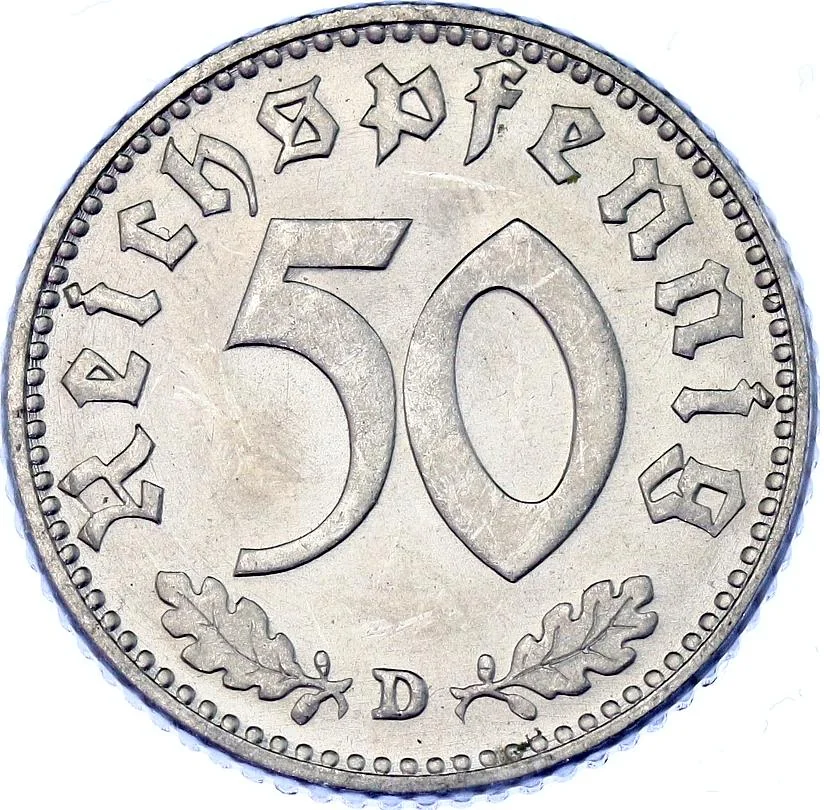
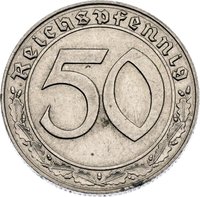
Reverse
Description:
Face value, oak leaves, mintmark between leaves.
Inscription:
Reichspfennig
50
F
50
F
Edge
Reeded
Mints
| Name | Mark |
|---|---|
| Berlin | A |
| Münze Österreich | B |
| Munich | D |
| Muldenhütten | E |
| Staatliche Münze Baden-Württemberg | F |
| Staatliche Münze Baden-Württemberg | G |
| Hamburgische Münze | J |
Mintings
| Year | Mint Mark | Mintage | Quality | Collection |
|---|---|---|---|---|
| 1939 | A | 5,000,000 | ||
| 1939 | B | 5,482,000 | ||
| 1939 | D | 600,000 | ||
| 1939 | E | 2,000,000 | ||
| 1939 | F | 3,600,000 | ||
| 1939 | G | 560,000 | ||
| 1939 | J | 1,000,000 | ||
| 1940 | B | 10,016,086 | ||
| 1940 | D | 13,800,000 | ||
| 1940 | E | 5,617,600 | ||
| 1940 | J | 7,335,048 | ||
| 1940 | F | 6,662,635 | ||
| 1940 | G | 5,615,611 | ||
| 1940 | A | 56,127,946 | ||
| 1941 | A | 31,262,834 | ||
| 1941 | J | 4,165,305 | ||
| 1941 | G | 3,090,835 | ||
| 1941 | B | 4,291,130 | ||
| 1941 | D | 7,200,000 | ||
| 1941 | E | 3,805,720 | ||
| 1941 | F | 5,127,810 | ||
| 1942 | A | 11,579,960 | ||
| 1942 | B | 2,875,500 | ||
| 1942 | D | 2,247,430 | ||
| 1942 | E | 3,810,480 | ||
| 1942 | G | 1,400,000 | ||
| 1942 | F | 5,132,756 | ||
| 1943 | J | 4,166,252 | ||
| 1943 | A | 29,325,023 | ||
| 1943 | B | 8,228,892 | ||
| 1943 | D | 5,314,600 | ||
| 1943 | G | 2,891,530 | ||
| 1944 | B | 5,622,400 | ||
| 1944 | D | 4,885,500 | ||
| 1944 | G | 1,190,000 | ||
| 1944 | F | 3,738,586 |
Historical background
By 1939, Germany’s currency, the Reichsmark, was a carefully managed instrument of state policy, stripped of its traditional functions and shielded from public scrutiny. The Nazi regime, having come to power in 1933, had eliminated unemployment through massive public works and rearmament, but this was financed not by sound fiscal policy but by massive deficit spending and financial manipulation. The government employed complex financial instruments like "Mefo bills"—promissory notes issued by a dummy company to hide military spending—and enforced strict capital controls to prevent citizens from exchanging Reichsmarks for foreign currency or gold. While price and wage controls maintained a facade of stability, the economy was fundamentally geared toward war preparation, with consumption goods increasingly scarce as resources were diverted to the military.
Internationally, the Reichsmark was a non-convertible currency, its value artificially sustained by bilateral trade agreements (clearing agreements) that forced trading partners in Southeastern Europe and Latin America to accept Reichsmarks for raw materials. This system allowed Germany to obtain crucial resources without spending scarce gold or hard currency reserves, effectively putting its trading partners on a war credit line. Domestically, the government relied heavily on borrowing from its own population through propaganda-driven savings schemes, while also plundering the assets of persecuted groups, particularly Jews, to bolster state coffers. This created a precarious "guns before butter" economy, where financial collapse was only staved off by the prospect of future conquest and plunder.
On the eve of World War II in September 1939, the German currency was therefore in a state of concealed crisis. The massive accumulation of secret debt and the diversion of all economic capacity to the military meant the Reichsmark’s stability was entirely dependent on the regime’s political control and the success of its impending aggressive wars. The currency was not an economic unit reflecting market value but a tool for resource mobilization, designed to function only within the closed, controlled system of the Nazi war economy. Its ultimate viability was tied to a victory that would provide the looted resources to pay off the nation's enormous hidden debts.
Internationally, the Reichsmark was a non-convertible currency, its value artificially sustained by bilateral trade agreements (clearing agreements) that forced trading partners in Southeastern Europe and Latin America to accept Reichsmarks for raw materials. This system allowed Germany to obtain crucial resources without spending scarce gold or hard currency reserves, effectively putting its trading partners on a war credit line. Domestically, the government relied heavily on borrowing from its own population through propaganda-driven savings schemes, while also plundering the assets of persecuted groups, particularly Jews, to bolster state coffers. This created a precarious "guns before butter" economy, where financial collapse was only staved off by the prospect of future conquest and plunder.
On the eve of World War II in September 1939, the German currency was therefore in a state of concealed crisis. The massive accumulation of secret debt and the diversion of all economic capacity to the military meant the Reichsmark’s stability was entirely dependent on the regime’s political control and the success of its impending aggressive wars. The currency was not an economic unit reflecting market value but a tool for resource mobilization, designed to function only within the closed, controlled system of the Nazi war economy. Its ultimate viability was tied to a victory that would provide the looted resources to pay off the nation's enormous hidden debts.
🌱 Very Common