

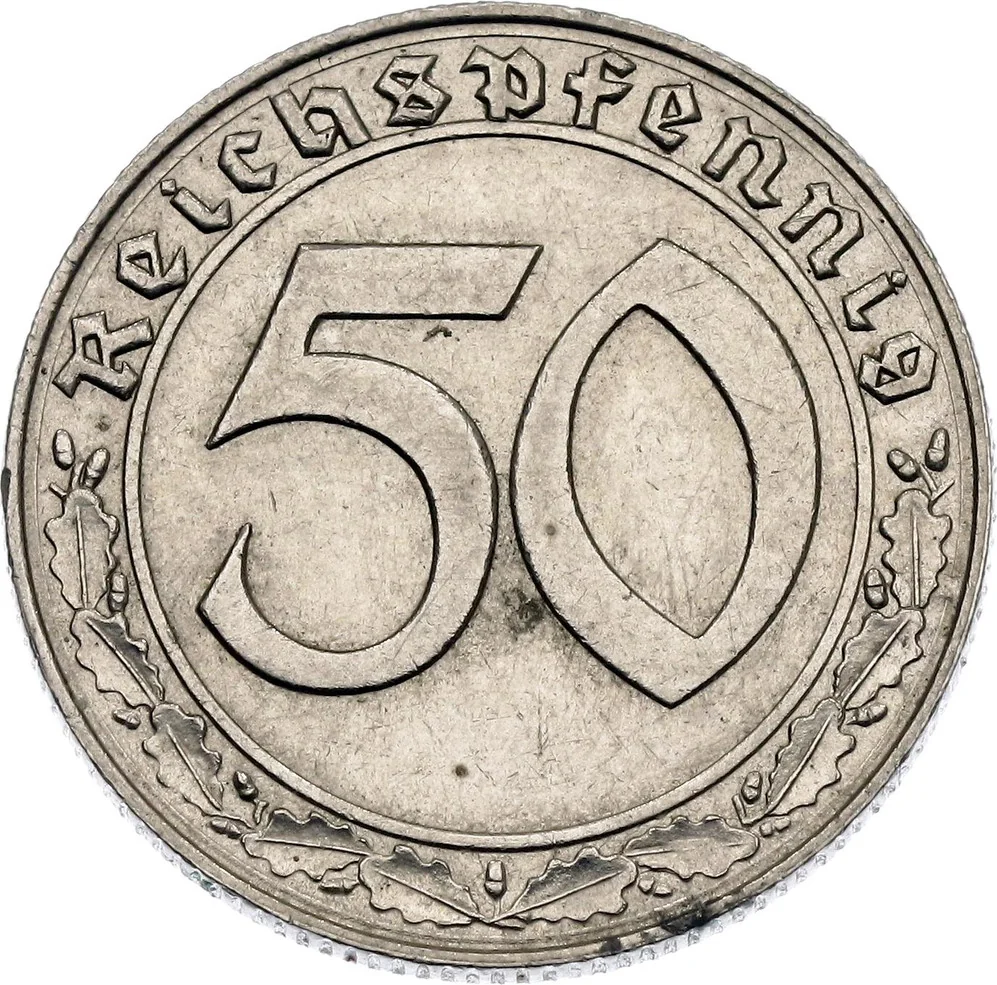
50 Pfennigs – Germany
Germany
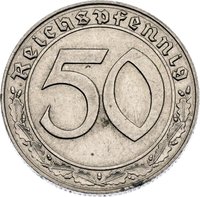
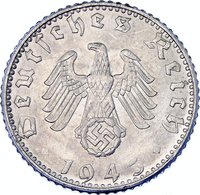
Obverse
Description:
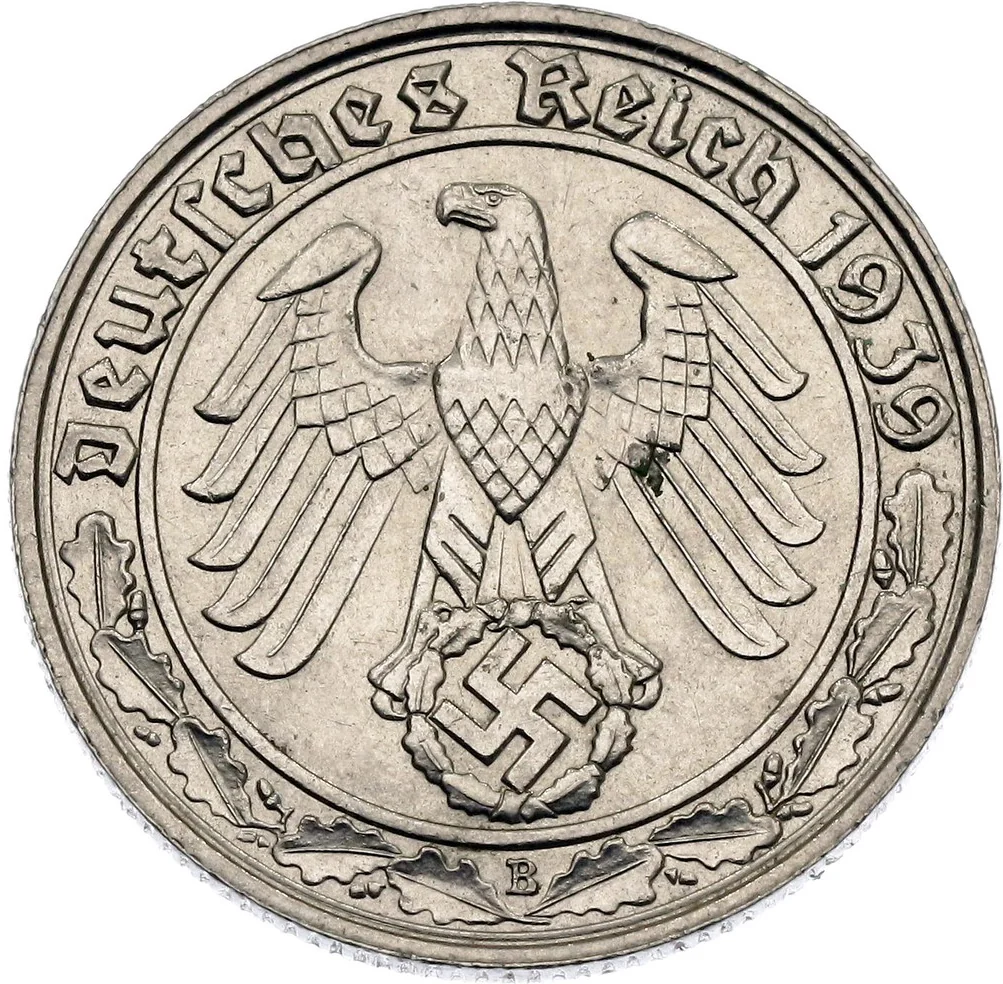
An eagle atop a swastika.
Inscription:
Deutsches Reich 1939
A
A
Translation:
German Reich 1939
Script: Latin
Language: German
Engraver: H. H. Schweitzer
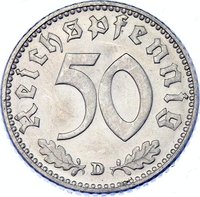
Reverse
Edge
Reeded
Mints
| Name | Mark |
|---|---|
| Berlin | A |
| Münze Österreich | B |
| Munich | D |
| Muldenhütten | E |
| Staatliche Münze Baden-Württemberg | F |
| Staatliche Münze Baden-Württemberg | G |
| Hamburgische Münze | J |
Mintings
Historical background
By 1938, Germany's currency situation was a tightly controlled facade of stability, masking a deeply strained and manipulated economy. The official currency, the Reichsmark, was no longer a freely convertible instrument but a tool of the Nazi regime's autarkic and rearmament policies. Strict capital controls, enacted after the 1931 banking crisis and intensified by the Nazis, prevented citizens from exchanging Reichsmarks for foreign currency or gold, effectively trapping capital within the country. This allowed the government, under the economic management of Hjalmar Schacht and later Hermann Göring, to finance massive public works and, most critically, a breakneck military expansion through deficit spending, while artificially suppressing visible inflation through price and wage controls.
This financial system was sustained by a complex web of artificial mechanisms and foreign exploitation. The government financed its deficits primarily through the issuance of short-term treasury bills (Mefo bills), which were discounted at the Reichsbank, creating a hidden expansion of the money supply. Internationally, Germany used "blocked mark" accounts and bilateral clearing agreements to force trade with its neighbors, often running deficits that amounted to economic plunder, particularly from occupied territories like Austria following the Anschluss in March 1938. The annexation of Austria provided a temporary boost by adding its gold and foreign exchange reserves to the Reichsbank, but this was a one-time windfall that did not address the underlying structural problems.
Consequently, while the public experienced stable prices for basic goods, the economy was characterized by severe hidden imbalances. Resources were overwhelmingly diverted to the military sector, leading to shortages of consumer goods and a growing "inflationary overhang" where citizens had money but little to spend it on. The economy was being run like a pyramid scheme, dependent on continuous expansion and conquest to avoid collapse. By 1938, the currency situation was fundamentally unsustainable under peacetime conditions, making further aggressive foreign policy and territorial acquisition not just an ideological aim for the Nazi regime, but an economic necessity to seize resources and postpone an inevitable financial reckoning.
This financial system was sustained by a complex web of artificial mechanisms and foreign exploitation. The government financed its deficits primarily through the issuance of short-term treasury bills (Mefo bills), which were discounted at the Reichsbank, creating a hidden expansion of the money supply. Internationally, Germany used "blocked mark" accounts and bilateral clearing agreements to force trade with its neighbors, often running deficits that amounted to economic plunder, particularly from occupied territories like Austria following the Anschluss in March 1938. The annexation of Austria provided a temporary boost by adding its gold and foreign exchange reserves to the Reichsbank, but this was a one-time windfall that did not address the underlying structural problems.
Consequently, while the public experienced stable prices for basic goods, the economy was characterized by severe hidden imbalances. Resources were overwhelmingly diverted to the military sector, leading to shortages of consumer goods and a growing "inflationary overhang" where citizens had money but little to spend it on. The economy was being run like a pyramid scheme, dependent on continuous expansion and conquest to avoid collapse. By 1938, the currency situation was fundamentally unsustainable under peacetime conditions, making further aggressive foreign policy and territorial acquisition not just an ideological aim for the Nazi regime, but an economic necessity to seize resources and postpone an inevitable financial reckoning.
🌱 Common