

5 Shillings – Isle of Man
Context
Year: 1811
Country: British Crown dependencies
Issuer: Isle of Man 
Ruler: George III
Currency:
(1709—1839)
Demonetized: Yes
Material
References
KM: #Click to copy to clipboardTn14
Numista: #107855
Obverse
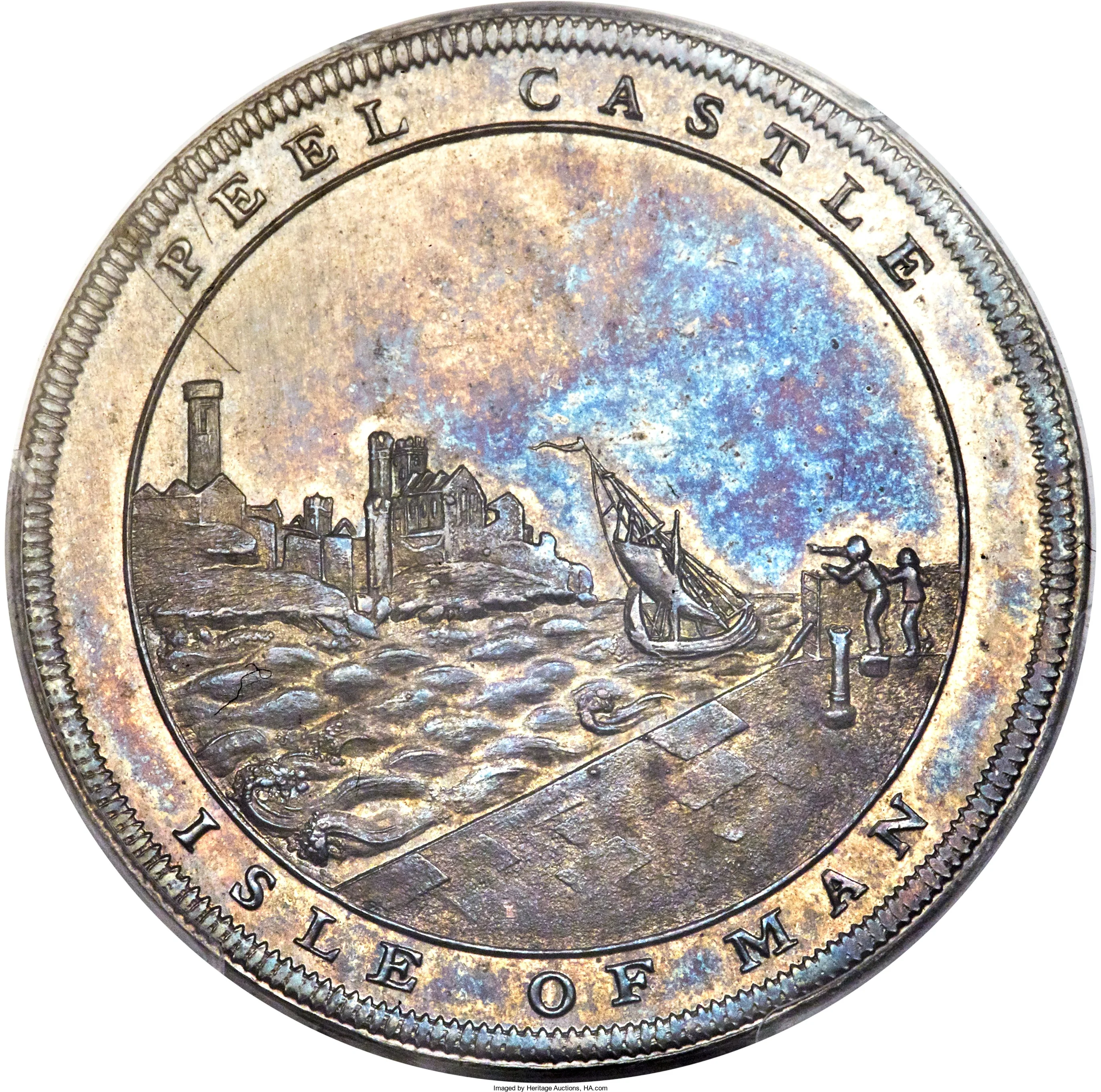
Description:
Sailboat and city skyline in a circle.
Inscription:
PEEL CASTLE
ISLE OF MAN
ISLE OF MAN
Script: Latin
Engraver: Thomas Halliday
Reverse
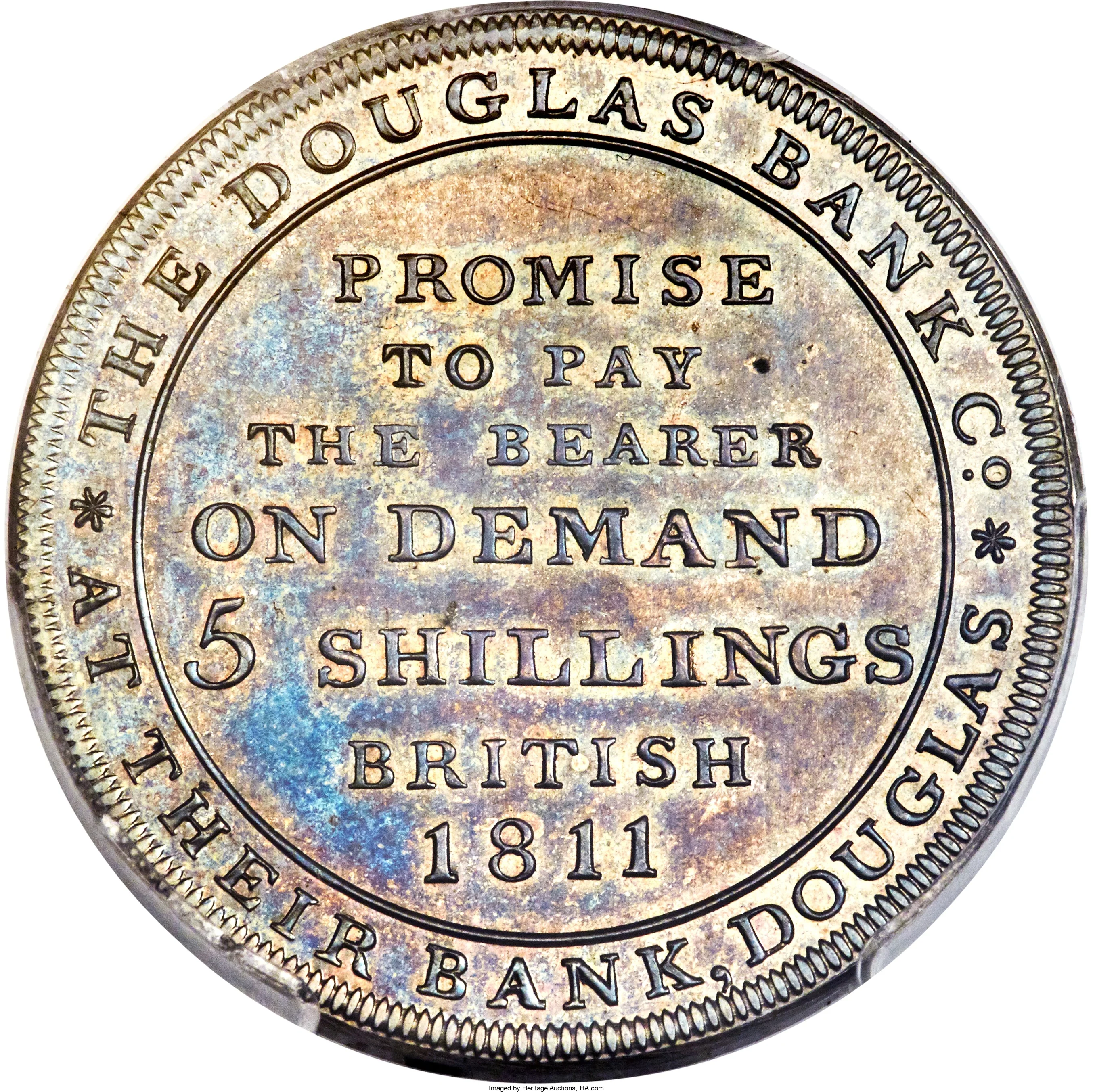
Description:
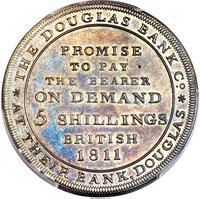
Inscribed and dated within a circle.
Inscription:
THE DOUGLAS BANK CO
PROMISE
TO PAY
THE BEARER
ON DEMAND
5 SHILLINGS
BRITISH
1811
AT THEIR BANK, DOUGLAS
PROMISE
TO PAY
THE BEARER
ON DEMAND
5 SHILLINGS
BRITISH
1811
AT THEIR BANK, DOUGLAS
Script: Latin
Engraver: Thomas Halliday
Edge
Categories
| Building> Castle or fortification |
| Transportation> Watercraft |
Mints
| Name | Mark |
|---|---|
| Thomason's Manufactory | — |
Mintings
| Year | Mint Mark | Mintage | Quality | Collection |
|---|---|---|---|---|
| 1811 | — | — | ||
| 1811 | — | — | Proof |
Historical background
In 1811, the Isle of Man found itself in a complex and challenging currency situation, caught between its historic autonomy and the economic dominance of its neighbours. Officially, the island's currency was the Manx pound, which was pegged at par with the British pound sterling. However, the reality was a chaotic mix of coins in daily circulation. Alongside limited Manx copper coinage (pence and halfpence minted since 1709), a vast array of British, Irish, Spanish, Portuguese, and French coins circulated, their value often determined by weight and metal content rather than face value. This created a confusing and inefficient system for trade.
The problem was exacerbated by a severe shortage of official small change, particularly copper coins, which crippled everyday transactions. This scarcity led to the widespread use of illicit tokens and "imitation halfpence," often of inferior quality, issued by local merchants and innkeepers to facilitate business. While these tokens filled a vital gap, they undermined the official currency and caused frequent disputes. Furthermore, the high volume of physically worn and clipped coins in circulation meant that the actual metallic value of a coin was often less than its stated nominal value, leading to distrust and complexity in commerce.
This monetary instability occurred within a specific political context. The Isle of Man, a British Crown Dependency, had its own legislature (Tynwald) and fiscal system, but its economy was deeply intertwined with Britain and Ireland. The British government, preoccupied with the Napoleonic Wars and its own currency issues, showed little interest in reforming the Manx situation. Consequently, the island's economy in 1811 laboured under a fragmented and unreliable monetary system, a persistent issue that would eventually lead to significant currency reforms in the following decades, including the establishment of a dedicated Manx coinage in the 1830s.
The problem was exacerbated by a severe shortage of official small change, particularly copper coins, which crippled everyday transactions. This scarcity led to the widespread use of illicit tokens and "imitation halfpence," often of inferior quality, issued by local merchants and innkeepers to facilitate business. While these tokens filled a vital gap, they undermined the official currency and caused frequent disputes. Furthermore, the high volume of physically worn and clipped coins in circulation meant that the actual metallic value of a coin was often less than its stated nominal value, leading to distrust and complexity in commerce.
This monetary instability occurred within a specific political context. The Isle of Man, a British Crown Dependency, had its own legislature (Tynwald) and fiscal system, but its economy was deeply intertwined with Britain and Ireland. The British government, preoccupied with the Napoleonic Wars and its own currency issues, showed little interest in reforming the Manx situation. Consequently, the island's economy in 1811 laboured under a fragmented and unreliable monetary system, a persistent issue that would eventually lead to significant currency reforms in the following decades, including the establishment of a dedicated Manx coinage in the 1830s.
✨ Legendary