

100 somoni – Tajikistan
Add to wishlist
Non-circulating coins
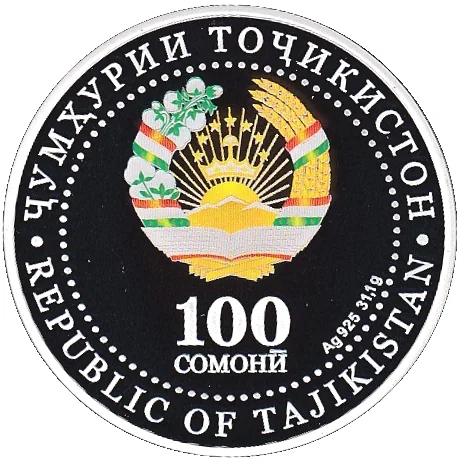
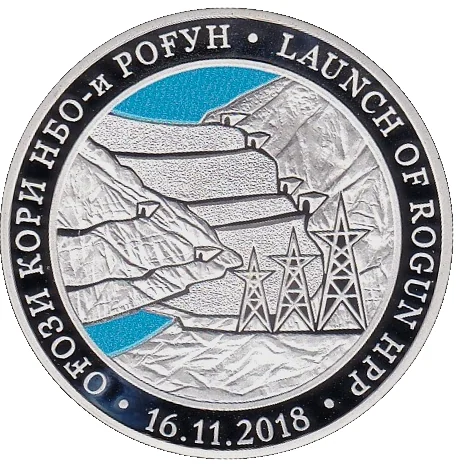
Commemoration: Opening of the Rogun Hydropower Project
Tajikistan
Context
Material
Diameter: 38.61 mm
Weight: 31.1 g
Silver Weight:: 28.77 g
Shape: Round
Composition: 92.5% Silver
Standard: Silver ounce
Magnetic: No
Alignment: Medal alignment

flip
References
KM: #
Numista: #191954
Value
Exchange value: 100 TJS
Bullion value: $70.01
Obverse
Reverse
Edge
Reeded
Categories
| Building> Dam |
| Industry |
| Symbols> Coat of Arms |
Mints
| Name | Mark |
|---|---|
| Kazakhstan Mint | — |
Mintings
| Year | Mint Mark | Mintage | Quality | Collection |
|---|---|---|---|---|
| 2018 | — | 29,000 | Proof |
Historical background
In 2018, Tajikistan's currency, the somoni, faced significant and sustained pressure, continuing a trend of depreciation that began several years prior. The primary driver was a substantial trade imbalance, with imports (particularly of essential goods like food, fuel, and machinery) far exceeding the value of exports, which remained heavily reliant on a few commodities like aluminum and cotton. This created a constant high demand for foreign currency, especially US dollars, to pay for imports, which the National Bank of Tajikistan (NBT) struggled to meet through its limited foreign exchange reserves.
The situation was exacerbated by a sharp decline in key sources of hard currency. Remittances from migrant workers in Russia, which historically constituted a critical inflow (often compared to a large percentage of GDP), had not recovered to pre-2014 levels due to Russia's own economic challenges and stricter migration laws. Furthermore, the year saw a major domestic banking crisis unfold, with the collapse of the country's largest bank, Tojiksodirotbank (TSB), and other significant lenders. This crisis eroded public confidence, spurred capital flight, and further constrained the availability of credit and foreign exchange within the formal banking system.
In response, the NBT employed a mix of measures to manage the decline. It continued a controlled devaluation policy, allowing the somoni to depreciate by roughly 10% against the US dollar over the course of the year, while intermittently intervening in the market to smooth volatility. Authorities also imposed stricter currency controls and regulations on forex transactions for businesses in an attempt to curb dollarization and preserve reserves. Despite these efforts, a wide gap persisted between the official exchange rate and the higher rate available on the informal market, reflecting ongoing scarcity and lack of confidence, which defined the challenging currency landscape of Tajikistan throughout 2018.
The situation was exacerbated by a sharp decline in key sources of hard currency. Remittances from migrant workers in Russia, which historically constituted a critical inflow (often compared to a large percentage of GDP), had not recovered to pre-2014 levels due to Russia's own economic challenges and stricter migration laws. Furthermore, the year saw a major domestic banking crisis unfold, with the collapse of the country's largest bank, Tojiksodirotbank (TSB), and other significant lenders. This crisis eroded public confidence, spurred capital flight, and further constrained the availability of credit and foreign exchange within the formal banking system.
In response, the NBT employed a mix of measures to manage the decline. It continued a controlled devaluation policy, allowing the somoni to depreciate by roughly 10% against the US dollar over the course of the year, while intermittently intervening in the market to smooth volatility. Authorities also imposed stricter currency controls and regulations on forex transactions for businesses in an attempt to curb dollarization and preserve reserves. Despite these efforts, a wide gap persisted between the official exchange rate and the higher rate available on the informal market, reflecting ongoing scarcity and lack of confidence, which defined the challenging currency landscape of Tajikistan throughout 2018.
✨ Legendary