

5 pfennigs – Germany
Add to wishlist
Germany
Context
Years: 1890–1915
Issuer: Germany
Ruler: William II
Currency:
(1873—1923)
Demonetization: 11 October 1924
Total mintage: 481,137,820
Material
References
KM: #
Numista: #1916
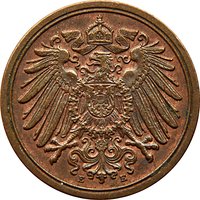
Obverse
Description:
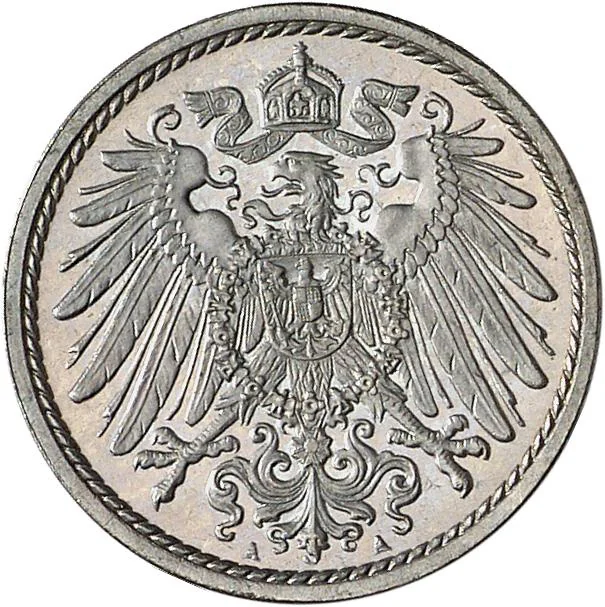
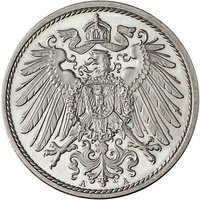
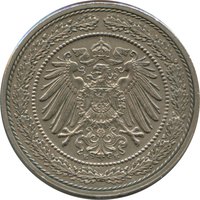
Imperial German Eagle with small shield (2nd type), mintmarks below.
Inscription:
G G
Script: Latin
Engraver: Otto Schultz
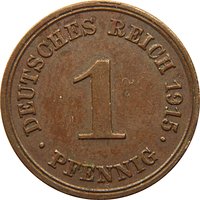
Reverse
Description:
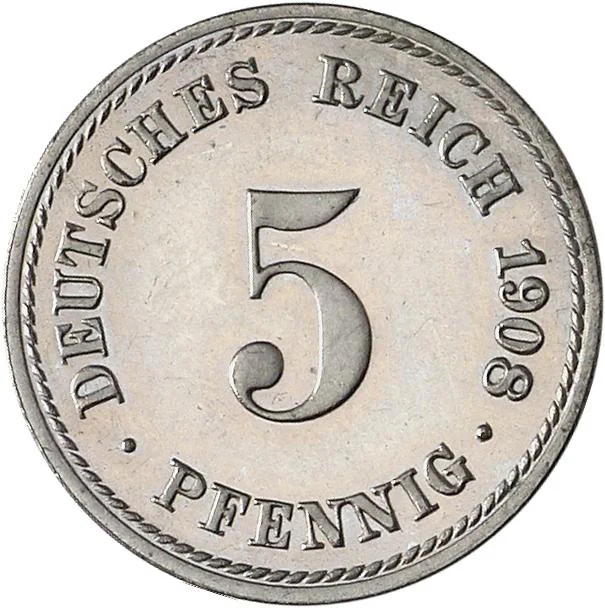
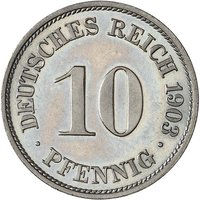
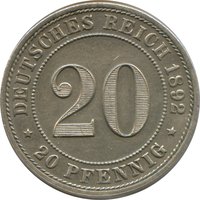
Large central denomination with rim lettering and date.
Inscription:
DEUTSCHES REICH 1910
5
• PFENNIG •
5
• PFENNIG •
Translation:
German Empire 1910
5
Pfennig
5
Pfennig
Script: Latin
Language: German
Engraver: Emil Weigand
Edge
Plain
Categories
| Symbols> Coat of Arms |
Mints
| Name | Mark |
|---|---|
| Berlin | A |
| Munich | D |
| Muldenhütten | E |
| Staatliche Münze Baden-Württemberg | F |
| Staatliche Münze Baden-Württemberg | G |
| Hamburgische Münze | J |
Mintings
| Year | Mint Mark | Mintage | Quality | Collection |
|---|---|---|---|---|
| 1890 | A | 4,547,959 | ||
| 1890 | D | 2,813,106 | ||
| 1890 | G | 948,000 | ||
| 1890 | J | 1,629,159 | ||
| 1890 | E | 1,318,000 | ||
| 1890 | F | 1,068,000 | ||
| 1891 | A | 6,313,399 | ||
| 1891 | E | 173,160 | ||
| 1891 | F | 942,020 | ||
| 1891 | G | 270,935 | ||
| 1892 | A | 2,278,602 | ||
| 1892 | D | 920,000 | ||
| 1892 | E | 346,000 | ||
| 1892 | F | 464,000 | ||
| 1892 | G | 800,000 | ||
| 1892 | J | 93,171 | ||
| 1893 | A | 8,571,994 | ||
| 1893 | D | 1,892,328 | ||
| 1893 | E | 1,148,794 | ||
| 1893 | F | 1,546,244 | ||
| 1893 | G | 421,862 | ||
| 1893 | J | 1,544,185 | ||
| 1894 | A | 10,830,195 | ||
| 1894 | D | 2,812,045 | ||
| 1894 | E | 802,000 | ||
| 1894 | F | 300,000 | ||
| 1894 | G | 280,000 | ||
| 1894 | J | 1,634,190 | ||
| 1895 | E | 686,290 | ||
| 1895 | F | 2,004,546 | ||
| 1895 | G | 940,213 | ||
| 1896 | G | — | ||
| 1896 | A | 1,459,302 | ||
| 1896 | E | 658,000 | ||
| 1896 | F | 2,009,013 | ||
| 1896 | J | 1,633,616 | ||
| 1897 | G | 1,220,557 | ||
| 1897 | A | 9,390,363 | ||
| 1897 | D | 2,812,084 | ||
| 1897 | E | 832,956 | ||
| 1898 | A | 10,836,205 | ||
| 1898 | E | 1,492,410 | ||
| 1898 | F | 2,006,558 | ||
| 1898 | G | 1,220,116 | ||
| 1898 | J | 1,634,510 | ||
| 1898 | D | 2,812,100 | ||
| 1899 | A | 10,833,872 | ||
| 1899 | D | 2,812,106 | ||
| 1899 | E | 1,487,740 | ||
| 1899 | F | 2,005,626 | ||
| 1899 | G | 1,221,571 | ||
| 1899 | J | 1,633,920 | ||
| 1900 | A | 18,941,259 | ||
| 1900 | D | 4,254,348 | ||
| 1900 | E | 2,235,690 | ||
| 1900 | F | 3,208,895 | ||
| 1900 | G | 2,135,958 | ||
| 1900 | J | 2,859,279 | ||
| 1901 | A | 8,155,077 | ||
| 1901 | D | 2,779,098 | ||
| 1901 | E | 1,492,220 | ||
| 1901 | F | 1,810,800 | ||
| 1901 | G | 914,744 | ||
| 1901 | J | 1,225,548 | ||
| 1902 | A | 8,949,124 | ||
| 1902 | D | 2,812,070 | ||
| 1902 | E | 1,120,480 | ||
| 1902 | F | 1,800,000 | ||
| 1902 | G | 1,220,044 | ||
| 1902 | J | 1,636,198 | ||
| 1903 | A | 5,932,341 | ||
| 1903 | E | 1,113,800 | ||
| 1903 | F | 1,209,051 | ||
| 1903 | G | 610,180 | ||
| 1903 | J | 816,854 | ||
| 1903 | D | 1,406,083 | ||
| 1904 | A | 6,791,156 | ||
| 1904 | J | 817,989 | ||
| 1904 | D | 1,408,137 | ||
| 1904 | E | 745,630 | ||
| 1904 | F | 1,005,850 | ||
| 1904 | G | 610,370 | ||
| 1905 | G | 914,883 | ||
| 1905 | A | 8,128,692 | ||
| 1905 | D | 2,109,000 | ||
| 1905 | E | 1,116,932 | ||
| 1905 | F | 1,504,600 | ||
| 1905 | J | 1,225,684 | ||
| 1906 | J | 2,859,064 | ||
| 1906 | F | 3,511,607 | ||
| 1906 | G | 2,135,598 | ||
| 1906 | A | 18,970,115 | ||
| 1906 | D | 4,921,901 | ||
| 1906 | E | 2,605,273 | ||
| 1907 | A | 11,929,815 | ||
| 1907 | D | 2,112,852 | ||
| 1907 | E | 1,517,175 | ||
| 1907 | F | 1,844,722 | ||
| 1907 | G | 915,075 | ||
| 1907 | J | 1,635,543 | ||
| 1908 | D | 4,991,343 | ||
| 1908 | E | 2,918,855 | ||
| 1908 | G | 3,356,902 | ||
| 1908 | J | 3,263,663 | ||
| 1908 | A | 22,114,293 | ||
| 1908 | F | 5,123,897 | ||
| 1909 | A | 5,796,996 | ||
| 1909 | D | 2,753,134 | ||
| 1909 | E | 983,910 | ||
| 1909 | F | 251,573 | ||
| 1909 | J | 1,632,296 | ||
| 1910 | F | 1,721,499 | ||
| 1910 | G | 1,222,227 | ||
| 1910 | J | 152,000 | ||
| 1910 | A | 7,343,617 | ||
| 1910 | D | 2,813,712 | ||
| 1910 | E | 1,290,377 | ||
| 1911 | A | 15,660,282 | ||
| 1911 | D | 2,220,563 | ||
| 1911 | E | 1,770,000 | ||
| 1911 | F | 2,714,075 | ||
| 1911 | G | 1,833,194 | ||
| 1911 | J | 3,115,758 | ||
| 1912 | A | 19,320,441 | ||
| 1912 | D | 4,015,322 | ||
| 1912 | E | 2,568,412 | ||
| 1912 | F | 3,679,355 | ||
| 1912 | G | 2,440,126 | ||
| 1912 | J | 3,020,000 | ||
| 1913 | D | 5,518,562 | ||
| 1913 | E | 2,373,018 | ||
| 1913 | F | 2,053,524 | ||
| 1913 | G | 1,220,863 | ||
| 1913 | A | 15,506,668 | ||
| 1913 | J | 252,702 | ||
| 1914 | E | 1,710,000 | ||
| 1914 | F | 2,205,993 | ||
| 1914 | G | 1,218,000 | ||
| 1914 | J | 3,235,093 | ||
| 1914 | A | 23,604,967 | ||
| 1914 | D | 3,014,490 | ||
| 1915 | D | 3,515,527 | ||
| 1915 | E | 833,976 | ||
| 1915 | F | 1,893,583 | ||
| 1915 | G | 894,639 | ||
| 1915 | J | 1,668,567 |
Historical background
By 1890, the currency situation in the German Empire was one of consolidated stability, a direct result of the political unification achieved in 1871. Prior to this, the German states used a confusing array of thalers, gulden, kreuzers, and other regional currencies. The new Reich government, under Chancellor Otto von Bismarck, moved decisively to create a single, uniform currency, culminating in the introduction of the Goldmark in 1873. This reform established Germany on the gold standard, defining the Mark as equal to 0.358423 grams of fine gold, which replaced the previously dominant silver-based thalers.
This shift to gold had profound economic and political implications. It aligned Germany with the financial powerhouse of Great Britain and other major industrializing nations, facilitating international trade and investment. Domestically, it symbolized modern statehood and economic strength. The transition was managed through a fixed exchange period for old currencies and the establishment of the Reichsbank in 1876 as the central issuing authority for the new banknotes, which circulated alongside gold and silver coins. By 1890, the old regional currencies had been almost entirely phased out, and the Goldmark was firmly entrenched as the symbol of a unified national economy.
However, this hard-won stability existed alongside underlying tensions. The deflationary pressures of the 1870s and 1880s, partly linked to the global shift to gold, had caused hardship for debtors and agricultural interests, fueling political discontent. Furthermore, while the coinage law provided for limited-value silver token coins (the Scheidemünze), the demonetization of silver had international repercussions and remained a point of contention. Thus, in 1890, Germany possessed a modern and credible currency system, but one that was inextricably linked to the debates about global monetary policy and domestic economic inequality that would continue into the new century.
This shift to gold had profound economic and political implications. It aligned Germany with the financial powerhouse of Great Britain and other major industrializing nations, facilitating international trade and investment. Domestically, it symbolized modern statehood and economic strength. The transition was managed through a fixed exchange period for old currencies and the establishment of the Reichsbank in 1876 as the central issuing authority for the new banknotes, which circulated alongside gold and silver coins. By 1890, the old regional currencies had been almost entirely phased out, and the Goldmark was firmly entrenched as the symbol of a unified national economy.
However, this hard-won stability existed alongside underlying tensions. The deflationary pressures of the 1870s and 1880s, partly linked to the global shift to gold, had caused hardship for debtors and agricultural interests, fueling political discontent. Furthermore, while the coinage law provided for limited-value silver token coins (the Scheidemünze), the demonetization of silver had international repercussions and remained a point of contention. Thus, in 1890, Germany possessed a modern and credible currency system, but one that was inextricably linked to the debates about global monetary policy and domestic economic inequality that would continue into the new century.
Series: 1890 Germany circulation coins
🌱 Very Common