

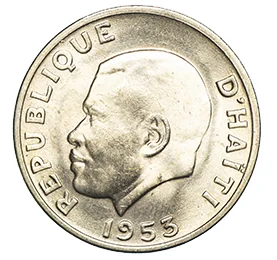
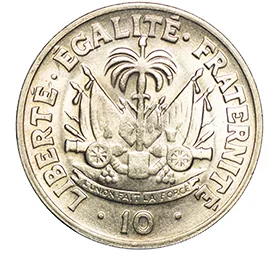
10 centimes – Haiti
Add to wishlist
Haiti
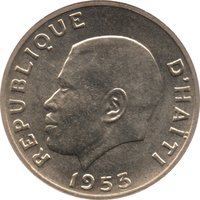
Obverse
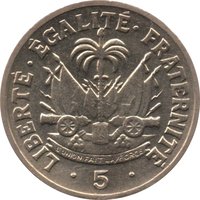
Reverse
Edge
Plain
Categories
| Symbols> Coat of Arms |
| Person> Politician |
Mints
| Name | Mark |
|---|---|
| United States Mint of Philadelphia | — |
Mintings
| Year | Mint Mark | Mintage | Quality | Collection |
|---|---|---|---|---|
| 1953 | — | 1,500,000 |
Historical background
In 1953, Haiti's currency situation was defined by the stability of the gourde, which was firmly pegged to the U.S. dollar at a fixed rate of 5 gourdes to $1. This peg, established in 1919, was managed by the Banque Nationale de la République d’Haïti (BNRH), a private institution with French and American capital that acted as the nation's central bank. The fixed exchange rate provided a measure of monetary stability for international trade and foreign investment, which was crucial for an economy heavily dependent on coffee and other agricultural exports. This stability, however, existed within a broader context of a chronically weak and underdeveloped economy.
Despite the stable exchange rate, Haiti's monetary system faced significant underlying pressures. The country's economy was vulnerable to fluctuations in global commodity prices, and its narrow export base limited foreign exchange earnings. Furthermore, the BNRH's role was controversial; as a privately-owned foreign entity controlling Haiti's treasury and currency issuance, it was a source of nationalist resentment and seen by critics as a constraint on the government's fiscal autonomy. The state often had limited capacity to finance development projects or respond to economic shocks without accommodating the bank's interests.
Overall, the currency picture in 1953 was one of superficial stability masking deeper structural fragility. The gourde's peg to the dollar facilitated the transactions of the export-oriented elite and foreign businesses, but did little to spur broad-based industrial development or alleviate widespread poverty. This dichotomy—between a stable nominal exchange rate and a stagnant, vulnerable real economy—would characterize Haiti's financial landscape until the political upheavals and economic changes of the later Duvalier era.
Despite the stable exchange rate, Haiti's monetary system faced significant underlying pressures. The country's economy was vulnerable to fluctuations in global commodity prices, and its narrow export base limited foreign exchange earnings. Furthermore, the BNRH's role was controversial; as a privately-owned foreign entity controlling Haiti's treasury and currency issuance, it was a source of nationalist resentment and seen by critics as a constraint on the government's fiscal autonomy. The state often had limited capacity to finance development projects or respond to economic shocks without accommodating the bank's interests.
Overall, the currency picture in 1953 was one of superficial stability masking deeper structural fragility. The gourde's peg to the dollar facilitated the transactions of the export-oriented elite and foreign businesses, but did little to spur broad-based industrial development or alleviate widespread poverty. This dichotomy—between a stable nominal exchange rate and a stagnant, vulnerable real economy—would characterize Haiti's financial landscape until the political upheavals and economic changes of the later Duvalier era.
🌱 Fairly Common