

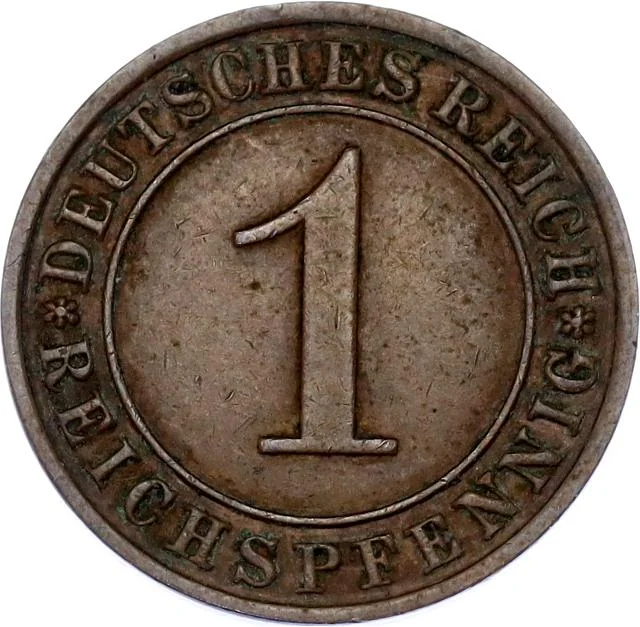

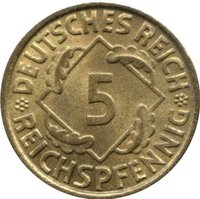
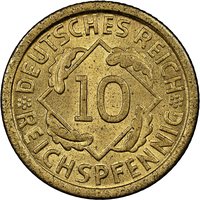
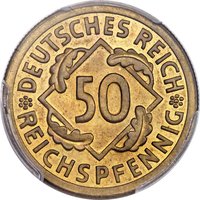
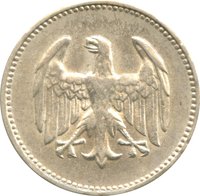
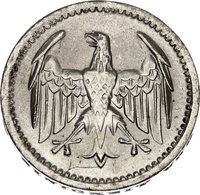
Obverse
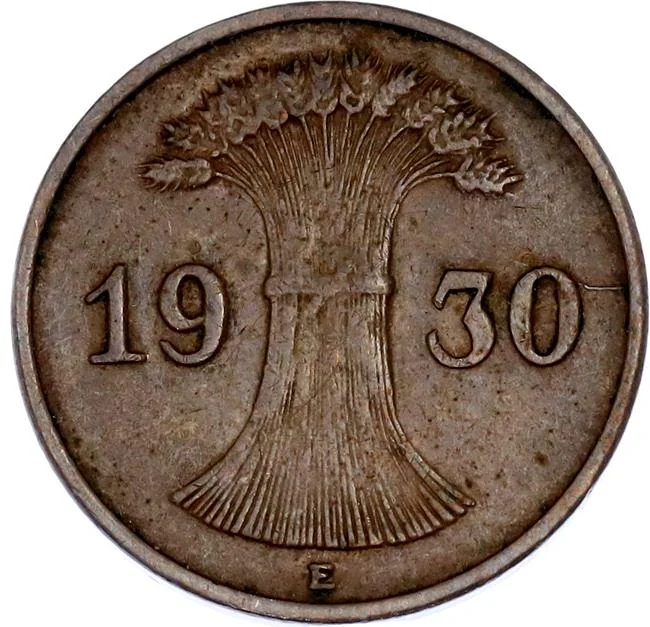
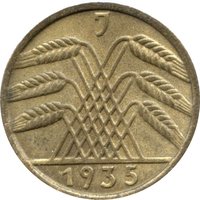
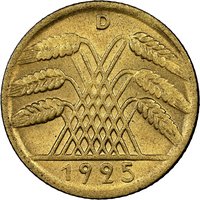
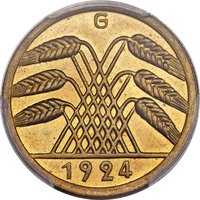
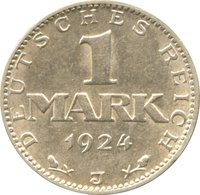
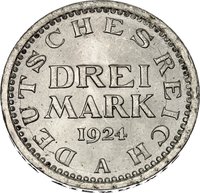
Reverse
Edge
Plain
Mints
| Name | Mark |
|---|---|
| Berlin | A |
| Munich | D |
| Muldenhütten | E |
| Staatliche Münze Baden-Württemberg | F |
| Staatliche Münze Baden-Württemberg | G |
| Hamburgische Münze | J |
Mintings
| Year | Mint Mark | Mintage | Quality | Collection |
|---|---|---|---|---|
| 1924 | A | 13,495,839 | ||
| 1924 | G | 5,100,000 | ||
| 1924 | D | 6,206,417 | ||
| 1924 | E | 1,100,000 | ||
| 1924 | F | 3,240,000 | ||
| 1924 | J | 24,400,000 | ||
| 1925 | A | 40,924,571 | ||
| 1925 | D | 1,558,402 | ||
| 1925 | E | 10,460,000 | ||
| 1925 | F | 5,673,269 | ||
| 1925 | G | 13,501,969 | ||
| 1925 | J | 30,299,830 | ||
| 1927 | A | 4,671,027 | ||
| 1927 | D | 4,203,085 | ||
| 1927 | E | 8,000,000 | ||
| 1927 | F | 2,350,000 | ||
| 1927 | G | 3,236,000 | ||
| 1928 | G | 3,764,003 | ||
| 1928 | A | 19,299,618 | ||
| 1928 | D | 10,200,094 | ||
| 1928 | F | 8,672,585 | ||
| 1929 | A | 37,170,131 | ||
| 1929 | D | 9,336,679 | ||
| 1929 | E | 6,600,000 | ||
| 1929 | F | 3,150,000 | ||
| 1929 | G | 1,986,400 | ||
| 1930 | A | 40,996,981 | ||
| 1930 | G | 5,016,581 | ||
| 1930 | D | 6,440,761 | ||
| 1930 | E | 1,412,000 | ||
| 1930 | F | 6,415,000 | ||
| 1931 | A | 38,480,582 | ||
| 1931 | D | 5,998,400 | ||
| 1931 | E | 12,800,000 | ||
| 1931 | F | 12,591,319 | ||
| 1931 | G | 2,622,220 | ||
| 1932 | A | 17,096,113 | ||
| 1933 | A | 37,845,645 | ||
| 1933 | F | 5,023,160 | ||
| 1933 | E | 2,944,568 | ||
| 1934 | A | 51,213,728 | ||
| 1934 | D | 7,408,587 | ||
| 1934 | E | 4,627,932 | ||
| 1934 | G | 2,450,000 | ||
| 1934 | F | 5,667,151 | ||
| 1934 | J | 4,270,650 | ||
| 1935 | A | 35,894,038 | ||
| 1935 | D | 15,489,698 | ||
| 1935 | E | 8,351,000 | ||
| 1935 | F | 12,094,068 | ||
| 1935 | G | 7,454,222 | ||
| 1935 | J | 8,505,098 | ||
| 1936 | A | 50,948,962 | ||
| 1936 | D | 12,261,715 | ||
| 1936 | E | 2,576,000 | ||
| 1936 | F | 6,914,532 | ||
| 1936 | G | 2,940,413 | ||
| 1936 | J | 5,421,000 |
Historical background
By 1924, Germany was emerging from the catastrophic hyperinflation of 1923, a period where the Reichsmark had become utterly worthless, rendered as mere fuel for stoves. This crisis was rooted in the immense reparations burden of the Treaty of Versailles, which the German government initially attempted to manage by printing money, leading to a total loss of confidence in the currency. The social and economic fabric was shattered, with savings wiped out and rampant poverty giving way to political extremism.
The solution arrived with the Rentenmark, introduced in November 1923 under the leadership of Chancellor Gustav Stresemann and Finance Minister Hans Luther. This new currency was not backed by gold but by a theoretical mortgage on German industrial and agricultural land, a psychological anchor to restore public trust. Its issuance was strictly limited, and it successfully halted hyperinflation almost overnight through a brutal policy of austerity and fiscal discipline, establishing a temporary but crucial stability.
This domestic stabilization was a prerequisite for the international Dawes Plan of 1924, which restructured Germany's reparation payments, provided foreign loans (primarily from American banks), and led to the withdrawal of French and Belgian troops from the Ruhr. The Rentenmark was then replaced in 1924 by the new, gold-backed Reichsmark, formally re-establishing Germany on the international gold standard. Thus, 1924 marked a fragile turning point—a year of enforced financial normalization that set the stage for the relative prosperity of the "Golden Twenties," yet left the underlying tensions of reparations and dependence on foreign capital unresolved.
The solution arrived with the Rentenmark, introduced in November 1923 under the leadership of Chancellor Gustav Stresemann and Finance Minister Hans Luther. This new currency was not backed by gold but by a theoretical mortgage on German industrial and agricultural land, a psychological anchor to restore public trust. Its issuance was strictly limited, and it successfully halted hyperinflation almost overnight through a brutal policy of austerity and fiscal discipline, establishing a temporary but crucial stability.
This domestic stabilization was a prerequisite for the international Dawes Plan of 1924, which restructured Germany's reparation payments, provided foreign loans (primarily from American banks), and led to the withdrawal of French and Belgian troops from the Ruhr. The Rentenmark was then replaced in 1924 by the new, gold-backed Reichsmark, formally re-establishing Germany on the international gold standard. Thus, 1924 marked a fragile turning point—a year of enforced financial normalization that set the stage for the relative prosperity of the "Golden Twenties," yet left the underlying tensions of reparations and dependence on foreign capital unresolved.
Series: 1924 Germany circulation coins
🌱 Very Common