

1 Crown – Isle of Man
Non-circulating coins
Commemoration: Manx Cat
Context
Year: 1970
Country: British Crown dependencies
Issuer: Isle of Man 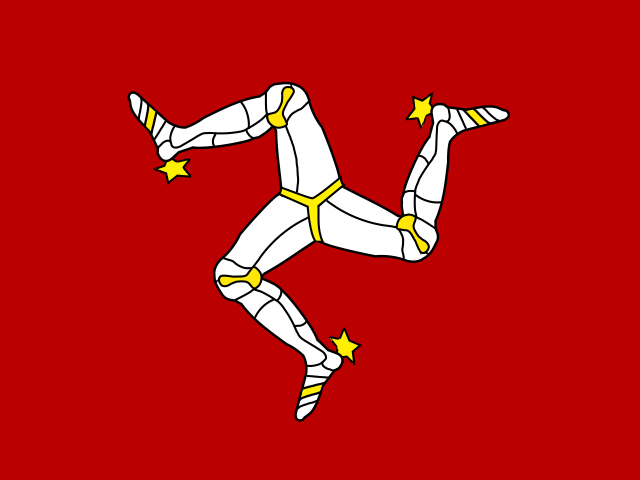
Ruler: Elizabeth II
Currency:
(1839—1971)
Demonetized: Yes
Total mintage: 15,000
Material
References
KM: #Click to copy to clipboard18a
Numista: #19124
Value
Bullion value: $75.81
Obverse
Description:
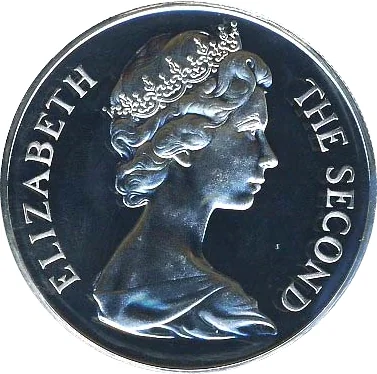
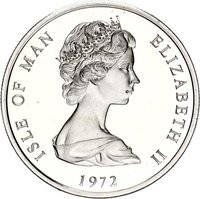
Queen Elizabeth II facing right, wearing the Girls of Great Britain and Ireland tiara.
Inscription:
ELIZABETH THE SECOND
Translation:
ELIZABETH THE SECOND
Script: Latin
Language: English
Engraver: Arnold Machin
Reverse
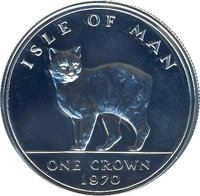
Description:
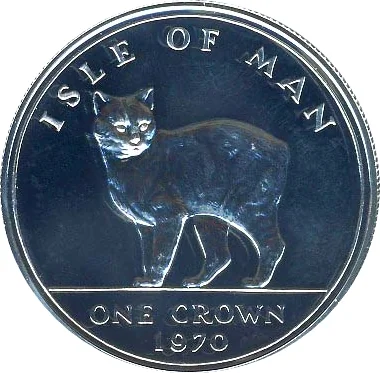
Tailless cat breed.
Inscription:
ISLE OF MAN
ONE CROWN
1970
ONE CROWN
1970
Script: Latin
Engraver: Christopher Ironside
Edge
Reeded
Mints
| Name | Mark |
|---|---|
| Royal Mint (Tower Hill) | — |
| Royal Mint | — |
Mintings
| Year | Mint Mark | Mintage | Quality | Collection |
|---|---|---|---|---|
| 1970 | — | 15,000 | Proof |
Historical background
In 1970, the Isle of Man's currency situation was defined by its unique constitutional position as a British Crown Dependency, which granted it a significant degree of autonomy in domestic affairs, including the issue of money. While the UK pound sterling (£) was legal tender and formed the bedrock of the island's economy, the Manx government had long exercised its right to produce its own distinct currency. These Manx pounds, issued by the Isle of Man Government Treasury, were pegged at par with sterling and circulated alongside Bank of England notes and UK coinage. This system created a practical duality where both sets of notes were used interchangeably in daily life, though Manx notes were generally not accepted in the wider United Kingdom.
The design of the island's currency in this period was a direct reflection of its national identity and heritage. The banknotes, in denominations of £1, £5 and £10, prominently featured the triskelion symbol (three bent legs) and the image of Queen Elizabeth II on the obverse, while the reverse celebrated Manx history and culture with depictions like the Viking longship on the £1 note. This was a conscious effort to distinguish the island's currency visually from sterling, even as it remained economically tied to it. The coins, which were first introduced in the modern era just a few years prior in 1965, also carried unique Manx symbolism, such as the Manx Loaghtan sheep and the Celtic cross.
This arrangement provided the Isle of Man with both economic stability, through its fixed link to the sterling area, and a tangible symbol of its political autonomy. There was no desire for monetary independence in terms of a separate exchange rate, as the island's economy was deeply integrated with that of the UK. The system functioned smoothly, with the Isle of Man Bank (a joint venture by the Westminster and Manx governments) acting as the currency issuer. The year 1970 thus represents a point of established tradition, where the island's currency was a settled and proud expression of its special status within the British Isles, a system that would see further evolution with the establishment of the independent Isle of Man Bank in 1975.
The design of the island's currency in this period was a direct reflection of its national identity and heritage. The banknotes, in denominations of £1, £5 and £10, prominently featured the triskelion symbol (three bent legs) and the image of Queen Elizabeth II on the obverse, while the reverse celebrated Manx history and culture with depictions like the Viking longship on the £1 note. This was a conscious effort to distinguish the island's currency visually from sterling, even as it remained economically tied to it. The coins, which were first introduced in the modern era just a few years prior in 1965, also carried unique Manx symbolism, such as the Manx Loaghtan sheep and the Celtic cross.
This arrangement provided the Isle of Man with both economic stability, through its fixed link to the sterling area, and a tangible symbol of its political autonomy. There was no desire for monetary independence in terms of a separate exchange rate, as the island's economy was deeply integrated with that of the UK. The system functioned smoothly, with the Isle of Man Bank (a joint venture by the Westminster and Manx governments) acting as the currency issuer. The year 1970 thus represents a point of established tradition, where the island's currency was a settled and proud expression of its special status within the British Isles, a system that would see further evolution with the establishment of the independent Isle of Man Bank in 1975.
⭐ Somewhat Rare