

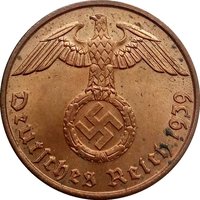
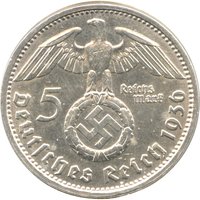
Obverse
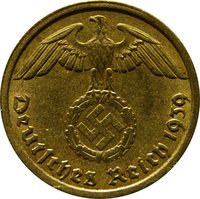
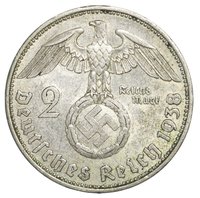
Description:
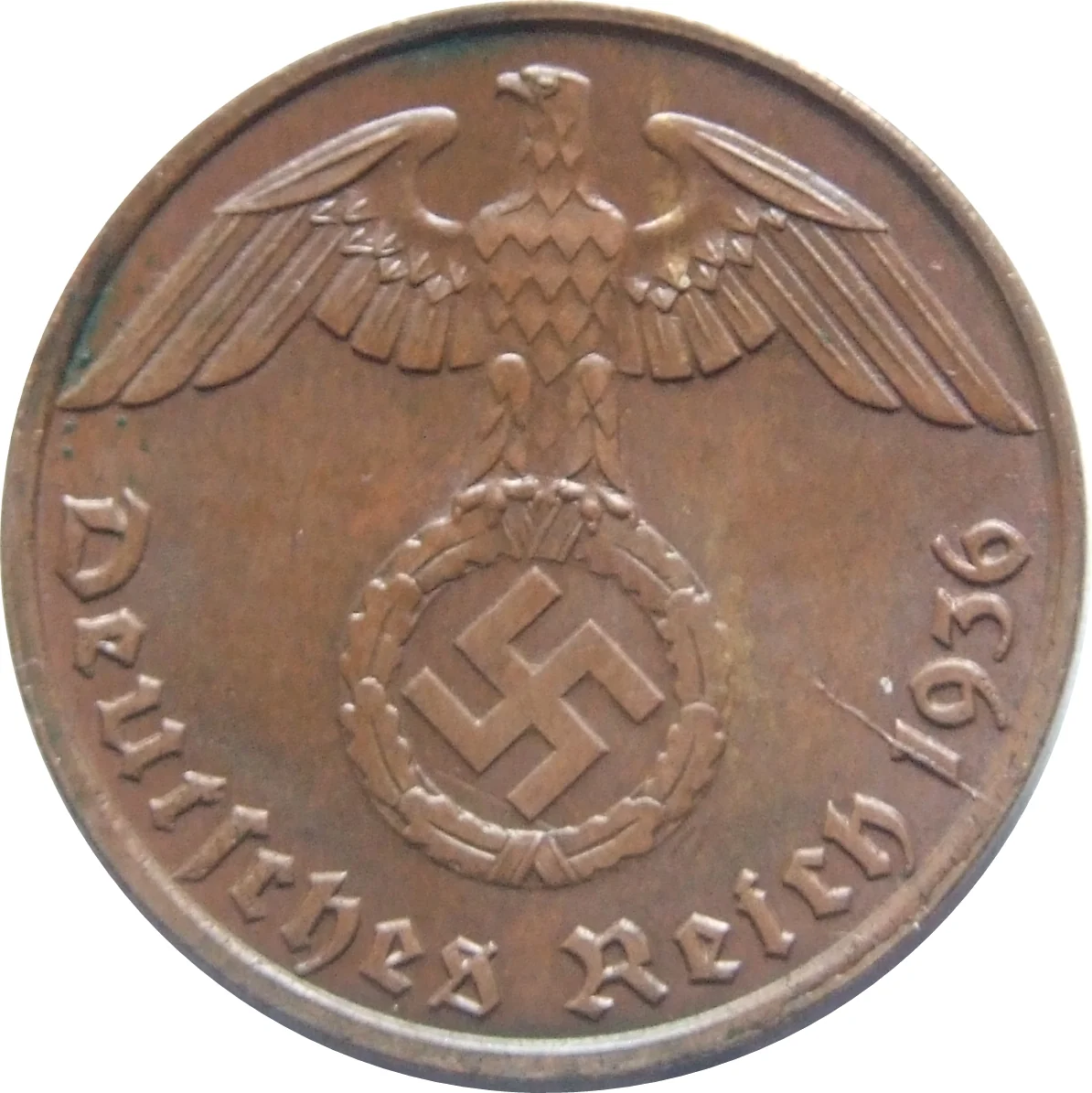
An eagle atop a swastika.
Inscription:
Deutsches Reich 1936
Translation:
German Empire 1936
Script: Latin (Fraktur blackletter)
Language: German
Engraver: Franz Paul Krischker
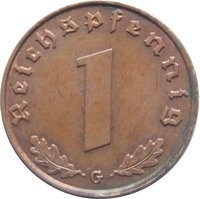
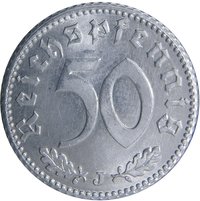
Reverse
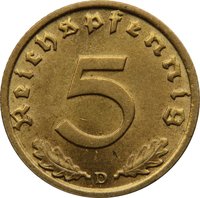
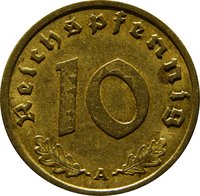
Description:
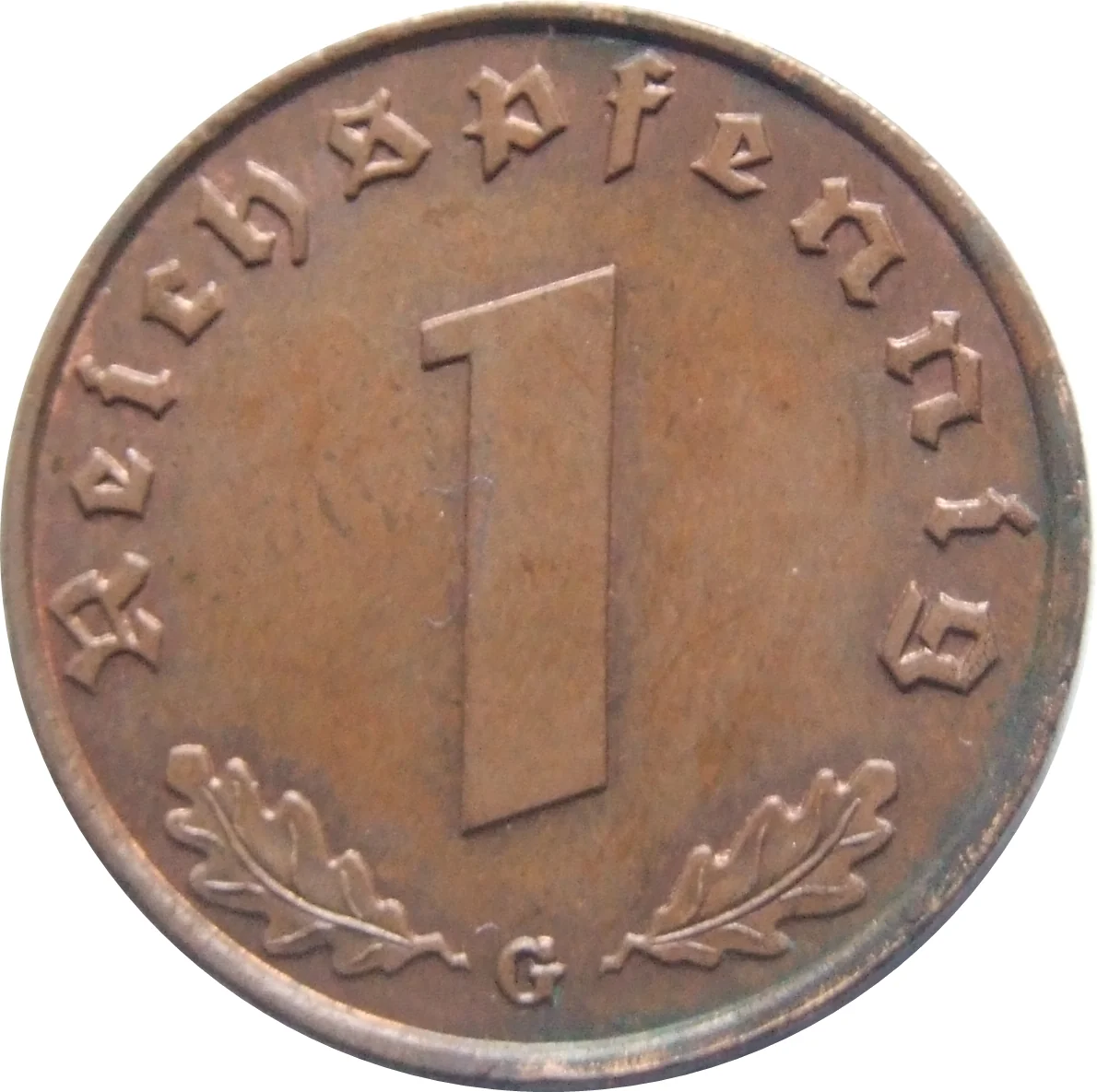
Oak-leaf base
Inscription:
Reichspfennig
1
G
1
G
Script: Latin (Fraktur blackletter)
Engraver: Franz Paul Krischker
Edge
Plain
Mints
| Name | Mark |
|---|---|
| Berlin | A |
| Münze Österreich | B |
| Munich | D |
| Muldenhütten | E |
| Staatliche Münze Baden-Württemberg | F |
| Staatliche Münze Baden-Württemberg | G |
| Hamburgische Münze | J |
Mintings
| Year | Mint Mark | Mintage | Quality | Collection |
|---|---|---|---|---|
| 1936 | A | — | ||
| 1936 | E | 150,000 | ||
| 1936 | F | — | ||
| 1936 | G | — | ||
| 1936 | J | — | ||
| 1937 | A | 67,180,396 | ||
| 1937 | D | 14,060,000 | ||
| 1937 | E | 10,700,000 | ||
| 1937 | F | 11,058,467 | ||
| 1937 | G | 4,250,104 | ||
| 1937 | J | 6,713,525 | ||
| 1938 | A | 75,707,447 | ||
| 1938 | B | 2,378,000 | ||
| 1938 | D | 13,930,000 | ||
| 1938 | E | 14,502,500 | ||
| 1938 | F | 11,714,409 | ||
| 1938 | G | 8,390,000 | ||
| 1938 | J | 15,458,353 | ||
| 1939 | A | 97,540,639 | ||
| 1939 | B | 22,732,400 | ||
| 1939 | D | 20,760,000 | ||
| 1939 | E | 12,477,600 | ||
| 1939 | F | 12,482,484 | ||
| 1939 | G | 12,250,000 | ||
| 1939 | J | 8,368,230 | ||
| 1940 | A | 27,094,471 | ||
| 1940 | F | 7,850,000 | ||
| 1940 | G | 3,875,332 | ||
| 1940 | J | 7,450,000 |
Historical background
By 1936, Germany's currency situation was a tightly controlled paradox, superficially stable but built on unsustainable and militaristic foundations. The Nazi regime, having come to power in 1933, had eliminated the hyperinflation trauma of the 1920s through severe capital controls, wage and price freezes, and the suppression of independent economic data. The Reichsmark was not a freely convertible currency; its value on international markets was artificially maintained by government decree. Internally, this created an illusion of stability, but it masked a growing scarcity of consumer goods and a severe shortage of foreign exchange, which was desperately needed to purchase critical raw materials like oil, rubber, and high-grade iron ore for rearmament.
To circumvent the foreign currency crisis and fund its massive rearmament program in violation of the Treaty of Versailles, the regime implemented a complex system of financial instruments and bilateral barter agreements. The most notable tool was the Mefo bill, a form of promissory note used to finance armaments spending off the official budget and hidden from public view. Furthermore, Germany forced "clearing agreements" with trading partners in Southeastern Europe and Latin America, exchanging German industrial goods for raw materials without using hard currency. This allowed the Reich to import vital resources while conserving its dwindling gold and foreign currency reserves, effectively creating a separate, controlled economic sphere.
Consequently, the German public experienced a stable but constrained economic environment. While unemployment had fallen dramatically due to public works and conscription, and savings accounts held their nominal value, the reality was an economy on a war footing. Consumer goods were increasingly scarce or of ersatz (substitute) quality, as industrial capacity was wholly directed toward military production. The apparent stability of the Reichsmark was therefore a carefully managed façade, entirely dependent on state control, economic autarky, and the relentless prioritization of military expansion over civilian economic health, setting the stage for the economy's eventual collapse.
To circumvent the foreign currency crisis and fund its massive rearmament program in violation of the Treaty of Versailles, the regime implemented a complex system of financial instruments and bilateral barter agreements. The most notable tool was the Mefo bill, a form of promissory note used to finance armaments spending off the official budget and hidden from public view. Furthermore, Germany forced "clearing agreements" with trading partners in Southeastern Europe and Latin America, exchanging German industrial goods for raw materials without using hard currency. This allowed the Reich to import vital resources while conserving its dwindling gold and foreign currency reserves, effectively creating a separate, controlled economic sphere.
Consequently, the German public experienced a stable but constrained economic environment. While unemployment had fallen dramatically due to public works and conscription, and savings accounts held their nominal value, the reality was an economy on a war footing. Consumer goods were increasingly scarce or of ersatz (substitute) quality, as industrial capacity was wholly directed toward military production. The apparent stability of the Reichsmark was therefore a carefully managed façade, entirely dependent on state control, economic autarky, and the relentless prioritization of military expansion over civilian economic health, setting the stage for the economy's eventual collapse.
Series: 1936 Germany circulation coins
🌱 Very Common