


50 dinars – Yugoslavia
Add to wishlist
Context
Year: 1955
Issuer: Yugoslavia
Issuing organization: National Bank of Yugoslavia
Period:
(1945—1963)
Currency:
(1944—1965)
Demonetization: 31 December 1985
Total mintage: 49,051,000
Material

References
KM: #
Numista: #1910
Obverse
Description:
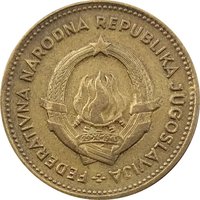
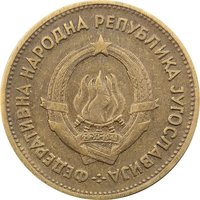
Federal People's Republic of Yugoslavia (1943-1963), with five torches on its coat of arms.
Inscription:
FEDERATIVNA NARODNA REPUBLIKA JUGOSLAVIJA
29·XI·1943
29·XI·1943
Translation:
FEDERATIVE PEOPLE'S REPUBLIC OF YUGOSLAVIA
29·XI·1943
29·XI·1943
Script: Latin
Language: Serbo-Croatian
Designer: Frano Meneghello Dinčić
Reverse
Description:
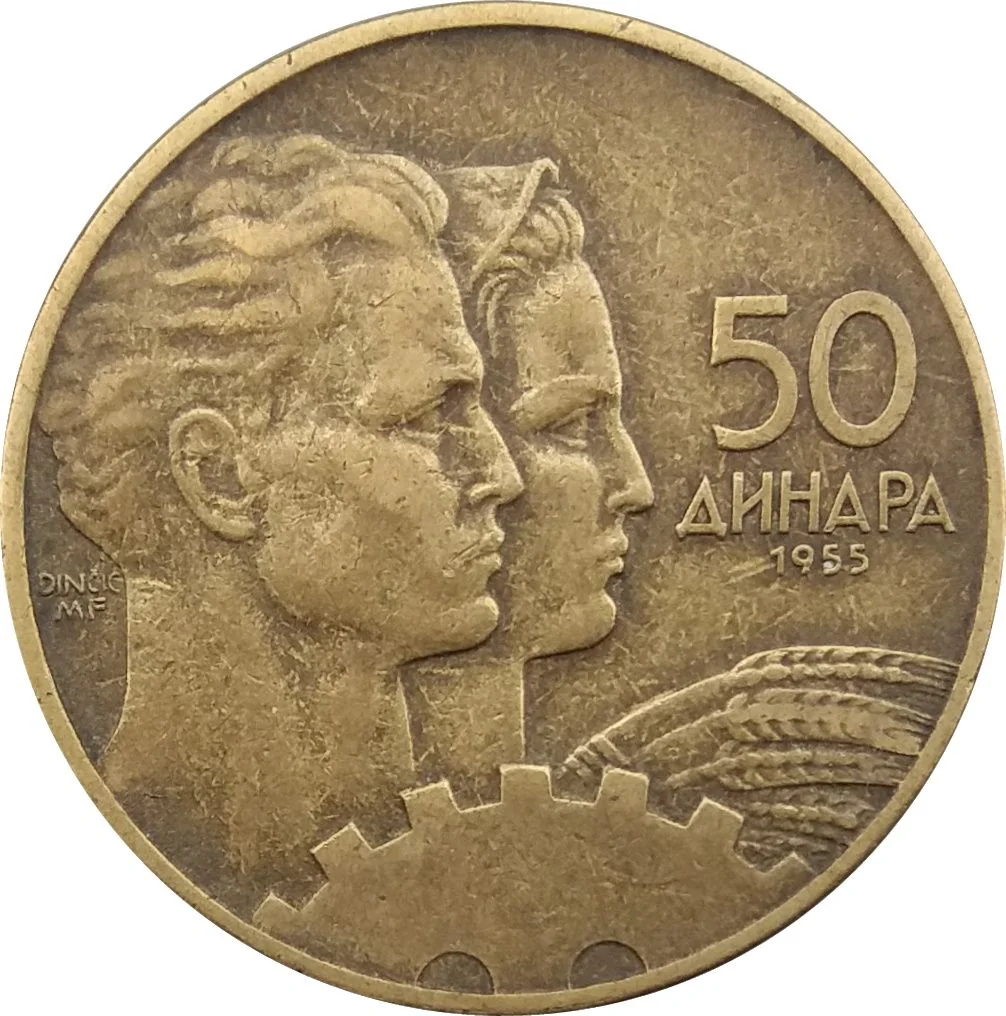
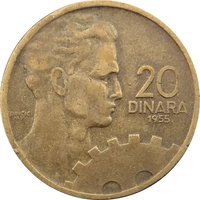
Man and woman facing right with wheat and cogwheel.
Inscription:
50
ДИНАРА
1955
DINČIĆ
MF
ДИНАРА
1955
DINČIĆ
MF
Translation:
50
DINARA
1955
DINČIĆ
MF
DINARA
1955
DINČIĆ
MF
Script: Cyrillic
Designer: Frano Meneghello Dinčić
Edge
Reeded
Categories
| Agriculture |
| Industry |
Mints
| Name | Mark |
|---|---|
| Belgrade | — |
Mintings
| Year | Mint Mark | Mintage | Quality | Collection |
|---|---|---|---|---|
| 1955 | — | 49,051,000 |
Historical background
In 1955, Yugoslavia's currency situation was characterized by the "1954 Monetary Reform," which had been implemented the previous year to stabilize an economy suffering from high inflation, a complex multi-tiered exchange rate system, and the lingering effects of the 1948 break with the Soviet Union. The reform simplified the system by introducing a new Yugoslav dinar (YUD) at a rate of 1 new dinar for 100 old dinars, effectively devaluing the currency. This was part of a broader shift toward "market socialism," where the state began to decentralize economic control, allowing enterprises more autonomy and moving away from a rigid command model.
The reform aimed to establish a unified and realistic exchange rate to foster foreign trade, which was crucial as Yugoslavia sought economic partnerships with both Western and non-aligned nations. However, by 1955, the system remained tightly managed. The National Bank of Yugoslavia maintained strict control over foreign currency allocations, and a formal, fixed parity with the U.S. dollar was established. While this provided short-term stability, it did not fully resolve underlying structural inefficiencies. The economy still relied on administrative measures rather than a genuine market for currency, with the state prioritizing the allocation of hard currency for strategic imports and industrial development.
Overall, the currency situation in 1955 reflected a transitional phase. The reforms of 1954 had successfully curbed hyperinflation and created a cleaner slate, but the dinar was not a freely convertible currency. Its value and use were instruments of state policy, supporting Yugoslavia's unique and precarious path between East and West Blocs. The relative stability achieved was thus fragile, dependent on continuous state intervention and the success of the broader experiment in workers' self-management and decentralized planning.
The reform aimed to establish a unified and realistic exchange rate to foster foreign trade, which was crucial as Yugoslavia sought economic partnerships with both Western and non-aligned nations. However, by 1955, the system remained tightly managed. The National Bank of Yugoslavia maintained strict control over foreign currency allocations, and a formal, fixed parity with the U.S. dollar was established. While this provided short-term stability, it did not fully resolve underlying structural inefficiencies. The economy still relied on administrative measures rather than a genuine market for currency, with the state prioritizing the allocation of hard currency for strategic imports and industrial development.
Overall, the currency situation in 1955 reflected a transitional phase. The reforms of 1954 had successfully curbed hyperinflation and created a cleaner slate, but the dinar was not a freely convertible currency. Its value and use were instruments of state policy, supporting Yugoslavia's unique and precarious path between East and West Blocs. The relative stability achieved was thus fragile, dependent on continuous state intervention and the success of the broader experiment in workers' self-management and decentralized planning.
🌱 Very Common